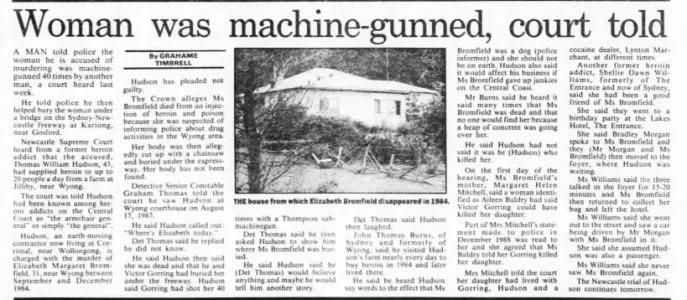
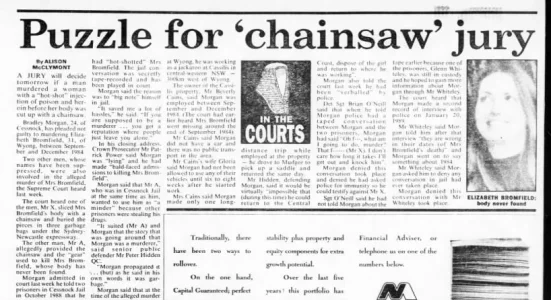
Police Misconduct Context: The trial took place during an era when units like the Gosford Drug Unit and the Major Crime Squad North (where officers like James Justin King served) were later found by the Police Integrity Commission (Operation Florida) to have been involved in protecting drug dealers and fabricating evidence. This has led to long-standing public theories that Elizabeth may have been a victim of the very criminal-police networks she was reportedly informing on.
• The "Snitching" Allegation: While the police have not publicly confirmed her "confidential informant" (CI) was she murdered because she was providing information to the authorities about local drug dealers.
Because Bradley Scott Morgan was acquitted and Elizabeth's body was never found, her case remains on the NSW Parliament’s Unsolved Homicide list. The lack of a body and the acquittal of the only person ever charged means that, legally, the door remains open to the possibility that others—including those with links to the "major drug" scene or corrupt elements of the force—were responsible.
• she was a heroin addict who was silenced by a "hot shot" (a lethal injection) to prevent her from further cooperation with the police.
The Witness and "Corrupt Police" Theories
The trial highlighted significant tensions between the investigation and the reality of the local drug scene:
• The Witness: The "star witness" was a female friend of Elizabeth (also described as a heroin addict) who was flown in by police to testify. She claimed to have seen Elizabeth at a hotel with three people, which the prosecution used to link Morgan to a conspiracy. What made this Witness testify that she saw a person at the hotel when he wasn't there,Elizabeth Margaret Bromfield case and the era in which she disappeared, the theory that corrupt police were involved is a significant part of the unofficial narrative surrounding her death.
While no police officer was ever charged with her murder, the following factors from the case records and the historical context of the NSW Police at that time contribute to this theory:
1. The "Snitching" Narrative
The central motive was that Elizabeth was killed because she was "snitching" on drug dealers.
• In the Gosford/Central Coast region during the mid-1980s, the line between major drug syndicates and certain police units was notoriously thin.
• If she was providing information to the authorities, she would have been a direct threat to any corrupt officers who were "green-lighting" or profiting from those drug operations.
2. Corruption in the Units Involved
As we discussed, the units overseeing such cases—the Gosford Drug Unit and the Major Crime Squad North—were later the subjects of massive corruption inquiries (like the Wood Royal Commission and Operation Florida).
• Operation Florida specifically found that officers like James Justin King and others in the Major Crime Squad North were involved in protecting dealers, stealing money, and "fixing" cases.
• The environment of the time meant that if an informant was "burnt" (their identity revealed), it often happened through a leak from within the police force itself.
• In 2004 while living on the Central Coast Gosford, a car had hit me,it mounted the gutter and destroyed my bike I was concussed two witnesses saw the accident and called police ,two detectives from the Gosford Police Station turned up After taking my side of the story The police spoke to the alleged driver, Then they spoke to the two witnesses , And told the the two witnesses to go away right in front of me, two constables were called and they drove me in my damaged bike home ,I was confused Was this a protection Of an informant certainly police corruption it's widespread and there are a lot of good offices and honesty detectives. One damaged bike $ 2,500 concussion am I dignity damaged