
- Joined
- Sep 1, 2011
- Messages
- 610
- Reaction score
- 1,459
I agree with almost everything that they did and said. They are much more experienced than Dr. Novelli, most of whose work is not in forensic DNA.Conti & Vecchioti ... good forensic science?



I agree with almost everything that they did and said. They are much more experienced than Dr. Novelli, most of whose work is not in forensic DNA.Conti & Vecchioti ... good forensic science?
Their test for blood was negative, as was Stefanoni's test. They did not have a chance to test the bra clasp, because it was incomprehensibly stored in the presence of extraction buffer, causing it to rot and rust. They made the correct decision not to amplify the DNA sample that they did find IMO. That noted, the fact that Amanda's DNA was later identified actually strengthens the case that Meredith's profile arose from a source that is unrelated to the crime. How can one clean a bloody knife so thoroughly that it escapes the limit of detection (at least one part in 500,000) yet leave DNA in two places and starch in at least one? It is absurd.They concluded that there was no blood or DNA on the knife or the bra clasp, which obviously was incorrect.
From their report
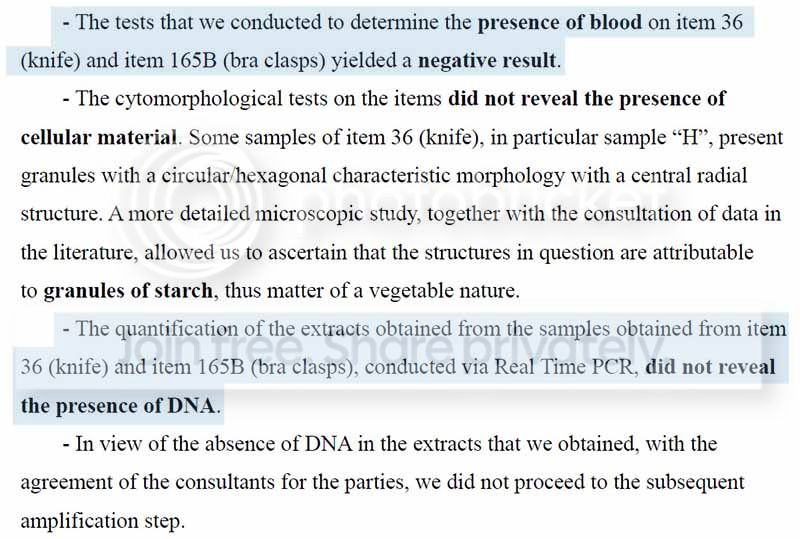
BBM - Have the prosecution or their related experts offered anything in the way of a theory or explanation as to this?Their test for blood was negative, as was Stefanoni's test. They did not have a chance to test the bra clasp, because it was incomprehensibly stored in the presence of extraction buffer, causing it to rot and rust. They made the correct decision not to amplify the DNA sample that they did find IMO. That noted, the fact that Amanda's DNA was later identified actually strengthens the case that Meredith's profile arose from a source that is unrelated to the crime. How can one clean a bloody knife so thoroughly that it escapes the limit of detection (at least one part in 500,000) yet leave DNA in two places and starch in at least one? It is absurd.
Did the Supreme Court (really not sure how this works) review both, compare them, and make a corresponding judgment?I agree with almost everything that they did and said. They are much more experienced than Dr. Novelli, most of whose work is not in forensic DNA.
What witness is this?
BTW Amanda never changed her story. She never lied, either.
I agree with almost everything that they did and said. They are much more experienced than Dr. Novelli, most of whose work is not in forensic DNA.
The closest thing of which I am aware is the claim that there was a groove in the knife. If it were real, one might argue that some biological matter could get caught in it. However, the photos that I have seen do not lead me to believe in its existence. Even if it existed, I don't see what would keep cells in this putative groove from being lysed by, for example, detergent.BBM - Have the prosecution or their related experts offered anything in the way of a theory or explanation as to this?
Their test for blood was negative, as was Stefanoni's test. They did not have a chance to test the bra clasp, because it was incomprehensibly stored in the presence of extraction buffer, causing it to rot and rust. They made the correct decision not to amplify the DNA sample that they did find IMO. That noted, the fact that Amanda's DNA was later identified actually strengthens the case that Meredith's profile arose from a source that is unrelated to the crime. How can one clean a bloody knife so thoroughly that it escapes the limit of detection (at least one part in 500,000) yet leave DNA in two places and starch in at least one? It is absurd.
I am not sure what you mean.So Balding got it wrong?
Was he told that he got it wrong during the interview ... when he did not provide the preferred answers?
They engaged in a certain amount of puffery with respect to Novelli IMO. One thing that is so bothersome is that if court prefers the prosecution's experts to independent experts, what chance does the defense have?Did the Supreme Court (really not sure how this works) review both, compare them, and make a corresponding judgment?
BBM - Have the prosecution or their related experts offered anything in the way of a theory or explanation as to this?
Did the Supreme Court (really not sure how this works) review both, compare them, and make a corresponding judgment?
What in your opinion is the reason that the Supreme Court would not be open to independent experts, while maintaining a protective stance toward the prosecution expert? (I really am not sure of how prosecutors and SCs are connected)They engaged in a certain amount of puffery with respect to Novelli IMO. One thing that is so bothersome is that if court prefers the prosecution's experts to independent experts, what chance does the defense have?
The closest thing of which I am aware is the claim that there was a groove in the knife. If it were real, one might argue that some biological matter could get caught in it. However, the photos that I have seen do not lead me to believe in its existence. Even if it existed, I don't see what would keep cells in this putative groove from being lysed by, for example, detergent.
Some time ago I looked at the standard curve that Conti and Vecchiotti used with respect to real-time PCR. My recollection is that the knife sample in question fell below the lowest data point in the standard curve, meaning it was a very small amount. They made the correct call not to amplify it, as I said before.Therefore, C&V got it wrong. SNIP
I am not sure what you mean.
DNA from a bleached sample would show evidence of degradation. This sample did not show such evidence.Thankfully, experts were able to identify and analyze the DNA.
They engaged in a certain amount of puffery with respect to Novelli IMO. One thing that is so bothersome is that if court prefers the prosecution's experts to independent experts, what chance does the defense have?
Some time ago I looked at the standard curve that Conti and Vecchiotti used with respect to real-time PCR. My recollection is that the knife sample in question fell below the lowest data point in the standard curve, meaning it was a very small amount. They made the correct call not to amplify it, as I said before.
Dr. Balding reviewed a paper that Dr. Vecchiotti wrote. He must have agreed that it was worthy of publication in the journal in question. Dr. Balding did not peer review the work that Conti and Vecchiotti did with respect to this case, however. Dr. Balding did acknowledge that he had not examined the negative controls and that he had not examined the electronic data files or other case-related files. His statistical technique for analyzing mixtures no doubt has great merit. However, one cannot perform a complete case review without the things I just mentioned.
Are you unable to access the linked report?