I definitely agree with you. They were NOT equal. I was coming from a place of how she had been on this path to become an alpine climber for a while, and may have had ambition herself. She had climbed a 3000+ peak before, so had experience with the altitude, and may have thought she was more prepared than she really was. Thomas knew what she was in for, but did she?
Also, If she was a marathon runner, a peak runner, etc, she has ambition, drive, and the ability to control her will. How much of the drive to summit on Jan 18/19 was her drive, and how much of it was Thomas's? We may never know. They never should have continued past the breakfast spot, and I would like to know why they did.
There is no doubt in my mind that she had ambition and strong drive to achieve her goals.
No reason to think that she was different IRL than she was showing up online. And all, literally ALL her posts are giving me a feeling of a young woman who loves mountains, loves to have fun but wants to earn it. No instant gratitude, always putting some effort in it.
But there is significant deviation - to phrase it oddly.
Before Studlgrat her goals are ambitious but APART from Hoher Goell that she didnt expected to climb freehand - each time she's like picture perfect prepared climber/hiker. She's dressed appropriately. Where websites say helmets are advised she wears helmet. On hiking trails that have required hiking boots, not just sports shoes she has them. No snowboarding without helmet and glasses. Thats responsible and well prepared person.
And then there is Studlgrat. Like what the hell?
No doubt in my mind that she wanted to climb and challenge herself, no doubt in my mind that she loved winter sports and hoped to combine the two.
But its not like she lived in some super flat area and only rarely on in-advance planned trips could get a chance to practice her passion. She lived in Salzburg. Plenty of climbing and skiing options everywhere. Some of which would be a great challenge to do in January.
But Studlgrat in January is no "great challenge", its crazy. In what was her first winter climbing season? Crazy. Doesnt fit with what she was doing before, but there are some implications that it fits to what Thomas was proposing before.
Dachstein is not that hard, but to go there as first serious climbing trip in Winter? Bit iffy. Wouldnt mean that much if it was just this one time cause many more other climbers, good weather, not that long climbing part of the route. But then is Hoher Goell, inspired by him. Reasonable challenges follow. And there is Studlgrat - which he knew well and she didnt.
And on top of everything. If she thought that she can made it, she wasnt wrong. She almost made it to the summit.
Are we supposed to assume that doubting your significant other, doubting their judgement in what appears to be their area of expertise and experience is a normal thing to do? Like she could be expected to do that? Why? These are HIS
mistakes, if we even call it this way.
Im not willing to call it this way. I would if it was just one or two, maybe three. No issue picturing a scenario in which one, two or three of these "bad decisions" could be made in good faith cause of some circumstances. But its not one, two or three.
1. Studlgrat in late JANUARY, most extreme time of the year to climb it.
2. Studlgrat in late January for a person who never climbed it before.
3. Studlgrat in late January as a first serious winter climb for a newbie climber in their first season.
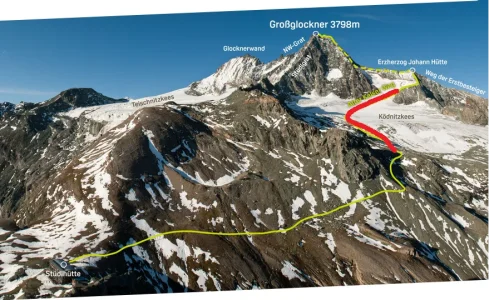
4. Starting with or right before the dusk. Not only shortening this usually two-days long escapade into one day attempt, but starting from farther than most people do, later than most people do, and in weather circumstances that are obviously, no doubt, 100% predictable WILL slow down not only the climbing part but even hiking.
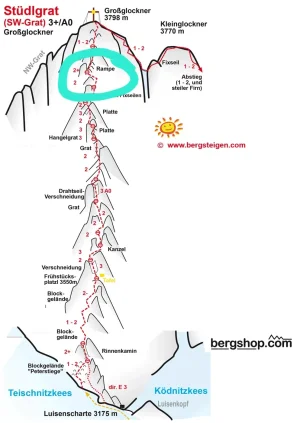
5. Having her go in snowboarding boots. They may be not that much of an issue on easier climbs but at this point we all saw how that route looks like. Snowboarding boots offer no flexibility where its needed while climbing and no stability where its needed. We can give it a pass with less cold-resisting endurance being somewhat unforeseen isue. But decreasing control over foot stability doing hard winter climbs is NOT unforeseen issue.
6. Not turning back arriving at the breakfast spot at 13:30, having just 4,5 hours before sundown. Smooth descend through Klein's stony part is one hour at the very very best. So they had just 3,5 hours. That seem to be average summer climber time. Sure as hell Thomas is no average climber. And neither was she, despite of being a newbie. But it doesnt matter, cause it was freaking JANUARY and it wasnt first "issue" but sixth already. Basically seventh.
7. Its virtually NOT possible for an experienced climber to NOT KNOW how much ANY additional weight affects person's speed, endurance, strength and cold-resistance. Splitboards weight 12-18 pounds. Thats no joke. For a person her size? That had to be at least 10 if not 20% of her weight. Not only affecting her balance but everything. She would be faster, lose less energy and body heat without that splitboard on her.
8. Not alerting the heli. Its not like she knew whats still waiting for them on the way. He knew and he as far as I know wasnt carrying ~15% additional body weight on him.
9. Not calling for help again.
10. Not covering her with bivvy and heat blankets.
11. Leaving her alone.
12. Going there in a group of two people instead of three or more which would increase the safety and climbing speed significantly.
Take one, two or three of these mentioned above and I think that anyone can undestand and explain how such unfortunate decision could be made. Take 5, 6 or 7 and ist starting to feel weird. Then we have all 12 here.
All 12 that come from a guy who could absolutely foresee tragic consequences of each one of those. He seemed to be very active in social media and on several climbing-community websites. For years. Long, long years. Nobody can do that and not know.
I cant even recall anything similar to this. Literally anything.
No shortage of bad decisions, panic and so on that overcomes people as they meet the unexpected. No shortage of bad decisions that seem not that big of a deal at first and may seem like not that big of a deal at first but end up to turn out huge and tragic. No shortage of bad decisions made in altered state of fear, cold, dehydration, pain, medical emergency, food or substance poisoning/toxic reaction.
But to have it so consistent and repeated through the whole ordeal, with all endangering the other person/s only or them more than themselves... Does that even happen at random?
1. Whole idea put them both at risk.
2. She was more at risk than him.
3. She was more at risk than him.
4. Both of them at risk.
5. Her at risk.
6. Both of them, but more risk on her.
7. Her at risk.
8. Both of them, but more risk on her.
9. Her at risk.
10. Her at risk.
11. Both of them at risk: her left alone, him descending in the dark in deep frost.
12. Both of them, but more risk on her.
It cannot even be justified by his ambition and goal orientation. If he was so obsessed with summiting Gross in January, her dropping the splitboard and any unnecessary weight would speed them both up. So what? Several different motives behind all of these 12 decisions?
1. Ambition.
2. Safety disregard.
3. Safety disregard.
4. Neglect.
5. Safety disregard.
6. Ambition.
7. Neglect.
8. Pride and ambition.
9. Altitude and cold indulged confusion.
10. Neglect and bravery.
11. Ambition, pride, lack of people willing to go? Bad organisation? Safety disregard.
...