

Found Alive Burkina Faso (Africa) - Edith Blais, 34 & Luca Tacchetto, 30, Canada & Italy tourists, 15 Dec 2018

  • #261
Un anno fa in Niger il sequestro di padre Maccalli, nessuna notizia certa su suo destino – Articolo21

A year since the kidnapping of Father Maccali in Niger without any reliable information about his fate


The break-in at dawn in the simple house attached to the mission of Bamoanga, in Niger, 125 km from the capital Niamey. In action are most likely Islamists shepherds of Fulani ethnicity from Mali who had camped for months in a village 40 km from the mission. Father Pierluigi Maccalli, 58 years old, originally from Crema, a missionary of the Society of African Missions, was dragged away by force.

All this happened just a year ago, on September 17, 2018. Since then, there has been no reliable information about his fate.

Maccalli was swallowed up by the black hole in which also disappeared Silvia Romano (kidnapped in Kenya on November 20, 2018), and the Paduan engineer Luca Tacchetto togetjer with his Canadian girlfriend Edith Blais, who were kidnapped on December 15 in Burkina Faso.

Father Maccalli was serene: his faithful had informed him of the presence of the Jahidists not far from the mission. But his 12 years of work in Niger spent in the educational and health fields (of which the Islamic community had benefited greatly) reassured him. Perhaps it was precisely his commitment on the school front that was seen as a challenge by the terrorists who carried out the kidnapping. The immediate effect was the closure of the school founded by the missionary.

Last April the spokesman for the government of Burkina Faso declared that Father Pierluigi was alive. He would have been taken first to Burkina and then brought back by the kidnappers to Niger. On the same occasion he said that Luca Tacchetto and Edith Blais would be held prisoners in Niger. These statements were not confirmed and they were accepted with scepticism by both the family and the religious congregation.

Today it is perhaps darker than yesterday for all the Italian abductees of whom nothing is known after so many months. Officially for none of them there is proof of life, ransom demands or exchanges of prisoners. And this feeds everyone's anguish infinitely.


BBM

Switzerland says citizen held hostage in Mali has been killed by captors

French aid worker Sophie Petronin was released with Italians Rev. Pierluigi Maccalli and Nicola Chiacchio, and prominent Malian politician Soumaila Cisse this week, days after the Malian government freed nearly 200 Islamic militants in an apparent prisoner exchange.

BBM
 
  • #262
Switzerland says citizen held hostage in Mali has been killed by captors

Switzerland’s Foreign Ministry said Friday that a Swiss woman who was held hostage in Mali has been killed by an Islamist group.


The ministry said it was informed by French authorities that the hostage had been “killed by kidnappers of the Islamist terrorist organization Jama’at Nusrat al-Islam Muslimeen about a month ago.”

The group, known as JNIM, is Mali’s branch of al-Qaida.

Switzerland’s foreign minister condemned the killing of the hostage, Beatrice Stoeckli, whose release his country had quietly been trying to negotiate since she was kidnapped four years ago.

“It was with great sadness that I learned of the death of our fellow citizen,” Ignazio Cassis said in a statement. “I condemn this cruel act and express my deepest sympathy to the relatives.”


BBM


RIP Beatrice Stoeckli


Jama’at Nusrat al-Islam Muslimeen also abducted Luca Tacchetto and Edith Blais
 
  • #263
Swiss Evangelical Missionary Executed by Islamic Extremists in Mali After 4 Years in Captivity

An evangelical missionary from Switzerland who had been held as a captive by Islamic extremists in Mali since January of 2016, was killed by her kidnappers about a month ago, according to a fellow captive.

Beatrice Stockli, 59, was shot and killed after she refused to move with her captors in the Sahara. Fellow captive Sophie Pétronin, who was released earlier this month gave the details about Stockli's death to French officials who passed the information along to Swiss government officials.

The 75-year-old charity worker told authorities the extremists moved their camp regularly to keep Malian and French soldiers from finding them. Pétronin said after Stockli refused to move, the extremists dragged her outside, and then a shot was heard, according to EN24 News.


BBM
 
  • #264
I don't "like" this per se but I do appreciate and acknowledge the information. How awful that her captivity ended in such a way. I can't imagine - and don't really want to - what the last four years had been like for her. RIP Beatrice RIP.
 
  • #265
Swiss Evangelical Missionary Executed by Islamic Extremists in Mali After 4 Years in Captivity

The 75-year-old charity worker told authorities the extremists moved their camp regularly to keep Malian and French soldiers from finding them.
The fact that they same group apparently held her over four years could point to the long term staying power of the insurgents. If so, they are going to be a security problem for years

In contrast, I have read accounts of other captives being sold and re-sold as the various groups holding the hostages fragmented into different factions, needed immediate cash, suffered too many desertions to guard and move the captives etc.
 
  • #266
Greystone Books to publish hostage memoir from Édith Blais | The Bookseller

Greystone Books will publish Édith Blais' memoir of being kidnapped and held hostage for 450 days in Burkina Faso at the hands of a militant group.

Rob Sanders, publisher for Greystone Books in Canada, acquired world English rights from French language publisher Les Editions de l'Homme, which will publish the memoir in Quebec in January 2021 and in France in April 2021. Greystone will publish the English translation in October 2021.

Sanders said: “Greystone considers itself extremely fortunate to be publishing Edith Blais’ harrowing story which our editors are calling a powerful and moving literary narrative. Edith is a strong and positive force, a gifted creator. Her story, and this book, will surprise everyone when it is published."

BBM
 
  • #267
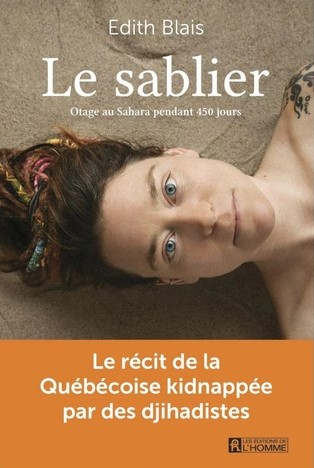
Otage au Sahara pendant 450 jours | Edith Blais racontera sa détention dans un livre

56186717.jpg


"I was their hostage, both a treasure and something less than nothing," she writes in the book entitled Le Sablier [ The Hourglass ], according to an excerpt sent to the media by Les Éditions de l'Homme to announce the publication scheduled for January 20.

"After reading her manuscript, we were confirmed that we were holding a powerful and luminous book in our hands, one of those books that touches your heart and that you put down gently after the last word, lest something might break," according to Judith Landry, the publishing house's managing director.

Edith Blais, who has not been interviewed since her return home, plans to answer questions from the media in the days leading up to the publication of her book.


BBM
 
  • #268
"Mi sono convertita all'Islam per finta, dovevo salvarmi", Edith Blais, rapita in Mali con il fidanzato italiano, racconta i 15 mesi da incubo in Africa - Tgcom24

"I pretended to convert to Islam, I had to save myself", Edith Blais, kidnapped in Mali with her Italian boyfriend, recounts her 15-month nightmare in Africa.

The capture, the hunger, the escape: in a book, the Canadian woman describes her adventure with Luca Tacchetto from Padua.


The meeting with Luca Tacchetto, the love at first sight. The car trip from Padua to Togo, the kidnapping. The hunger, the separation and the fake conversion. Then the escape, the liberation. It's not a film, it's real life. The one lived by Edith Blais, a Canadian woman who was kidnapped for 15 months between December 2018 and March 2020 in Africa. In a few days, 'Le sablier', an autobiographical book that reveals many unpublished details of her kidnapping, will be published in France.

Edith met Luca in 2016. Since that day, they made several trips together. The one in December 2018 is certainly the most adventurous: from Padua to central Africa, by car. In Burkina Faso, 50 km from the border, inside the Elephant Park, they are kidnapped. "Six men in turbans, armed with Kalashnikovs, were waiting for us. Four of them threw themselves on Luca, pointing their guns at him like madmen', according to the 'Corriere del Veneto', offering a preview of the contents of Edith's book due to be published in France.

The Canadian woman narrates of the continuous passages from one gang of kidnappers to another, some of them made up of child soldiers. "They might have been 13 to 15 years old, miniature soldiers holding big Kalashnikovs." On 4 March 2019, 79 days after the kidnapping, Luca and Edith are separated. The new kidnappers force her to convert to Islam, Edith pretends to accept: "I washed and wore the hijab, I had to survive and conversion was the lesser evil. Today I have kept nothing of this religion."

After eleven months Edith and Luca are able to reunite. Then the man decides to escape: it will be the end of the nightmare. A truck they stopped along the way takes them to Kidal, in front of a government building. They are then flown to Bamako, the Malian capital, where they meet a UN delegate: "I wanted to shake his hand, but instead he offered me his elbow. The ambassador realised we didn't know anything, so he explained that we were in the middle of a pandemic. For the first time I heard about the coronavirus."

BBM
 
  • #269
“Convertita all’Islam per salvarmi”: Edith Blais racconta la prigionia in un libro

According to Edith in her book, Luca told her about the presence of other hostages in places where he had been taken during the separation from his partner. He had already tried to escape, but it was over after a distance of 30 km. He said he was brought back to the camp and beaten with a stick, then left in the sun for days. For another two months he was kept in ankle chains, day and night. Once reunited with his companion, he tries again. "He took a stick and drew a map of Mali," she explains. 'The idea was to reach the road to Kidal and ask for help." The two of them, favoured by darkness, reach a rocky area that erases the traces behind them and then walk for tens of kilometres, orienting themselves by the stars.

BBM
 
  • #270
Padova, «io convertita per finta, Luca è diventato Sulayman: la verità sul nostro sequestro»

On 4 March 2019, 79 days after the kidnapping, Luca and Edith are separated. "I curled up in his arms. I knew I couldn't fight it, I knew I had to leave Luca to his fate...". The Canadian woman ends up in a new camp, where there are other prisoners. "They told me what to do and I obeyed. I became docile, a puppet in their hands. In August, she was handed over to the Tuareg, where she received two letters from Canada: this was proof that the diplomats had always kept in touch with the kidnappers.

In December 2019, they forced her to convert. The captor left her no choice: "You will become a Muslim! If we die and both stand before God, he will ask me why I did not convert you. What should I answer? That I tried, but you wouldn't listen to me? No!" Edith pretends to accept: "I washed and wore the hijab (...) I do not regret my choice: I had to survive and conversion was the lesser evil. Today I have kept nothing of this religion. A few days later, the kidnappers allowed her to reunite with Tacchetto, after eleven months apart. Edith describes that meeting ("Luca approached me and gave me the most beautiful smile in the world") and the man's accounts: the presence of other hostages (probably Father Maccalli and Nicola Chiacchio, freed several months later) and his attempt to escape, in September 2019, which ended after he had covered 30 kilometres:
'In November I converted to Islam (...) and for them now my name is Sulayman'. The Canadian woman, on the other hand, chooses to be called Asiya. "According to the Koran, we were now their brothers," she recalls, "and they had to treat us with respect, even if we were still hostages."


BBM
 
  • #271
  • #272

"The road suddenly got darker and my blood froze. Six turbaned men were waiting for us with Kalashnikov rifles in their hands," says a voice at the beginning of the video, which seems to relate extracts from different moments of the endless detention.

In her own words, Édith Blais tells that she will always remember the look she exchanged with her friend Luca Tacchetto. "Is it possible that we have reached our final destination? And the end of our lives? " she asks.

Ms. Blais reports that her captors were not a small band of bandits, but a well-oiled organization that demanded money or an exchange of prisoners from the Canadian and Italian governments.

"Our journey was 99% desolate and 1% abundant. Just enough for us to survive yet another day," she says afterwards.

Édith Blais, who can be seen at the end of the video, adds that she had 57 poems attached to her waist when she escaped. 57 poems... and a bottle of water.

BBM

La sortie du livre d’Édith Blais repoussée [VIDÉO]


Due to the current circumstances (COVID-19), the publication of the book has been postponed until February 17.
 
  • #273
Thank you for sharing the story of her survival. This is interesting and inspiring. She did what she had to and what she could to ensure her survival. And it WORKED!
 
  • #274
Switzerland says citizen held hostage in Mali has been killed by captors

Switzerland’s Foreign Ministry said Friday that a Swiss woman who was held hostage in Mali has been killed by an Islamist group.


The ministry said it was informed by French authorities that the hostage had been “killed by kidnappers of the Islamist terrorist organization Jama’at Nusrat al-Islam Muslimeen about a month ago.”

The group, known as JNIM, is Mali’s branch of al-Qaida.

Switzerland’s foreign minister condemned the killing of the hostage, Beatrice Stoeckli, whose release his country had quietly been trying to negotiate since she was kidnapped four years ago.

“It was with great sadness that I learned of the death of our fellow citizen,” Ignazio Cassis said in a statement. “I condemn this cruel act and express my deepest sympathy to the relatives.”


BBM


RIP Beatrice Stoeckli


Jama’at Nusrat al-Islam Muslimeen also abducted Luca Tacchetto and Edith Blais
The remains of the Swiss hostage Beatrice Stöckli have been found and identified with DNA.
Swiss hostage in Mali: Remains of missionary identified
 
  • #275
Sept 19 2021
Quebecer Edith Blais talks writing and moving on after 450 days as hostage in Africa
''MONTREAL - Almost 250 days into her 15-month captivity in Mali, Edith Blais realized her life was no longer her own, and she didn’t know if she’d ever get it back.

Separated from her travelling companion, Luca Tacchetto, and the group of women with whom she’d earlier been held hostage, the Quebec woman found herself in a truck racing across the Sahara in the company of yet another group of armed men. Despite the imminent danger, all she felt was numbness.''

Quebec woman held captive in Mali for 450 days details ordeal in new book
image.jpg

Canadian Edith Blais and Italian Luca Tacchetto

''A year and a half after her March 2020 liberation, Blais appears remarkably well-adjusted. Talking in a park south of Montreal overlooking the St. Lawrence River, sporting dreadlocks and a loose blue outfit, she said she's eager to move forward.

After her return, she spent some time in nature in Jasper, Alta., which she said helped her regain her bearings.

Now she's hitting the road again, setting off on a two-month road trip to the East Coast, where she'll live in a van with her new boyfriend. She says she's also eager to travel internationally again one day, although she laughingly says she's had enough of Africa.''
 
  • #276
Warm and shaking with happiness, however
I wish for her a different journey and to lead herself
 
  • #277
‘Where are you taking us? To whom?’ Canadian held captive in North Africa for 450 days details her harrowing ordeal for the first time

'Where are you taking us? To whom?' Canadian held captive in North Africa for 450 days details her harrowing ordeal for the first time


The little boss was pacing back and forth, his phone pressed to his ear. Someone was giving him orders for our trip. The Italian and the Canadian had been captured, and now things were starting to happen. The translator wasn’t coming with us. He explained to us before we left that we were going to meet their leader, that it wouldn’t take more than three days to get there — the first of many lies we would be told.


He said they were mujahideen, soldiers fighting in the way of Allah. We were supposed to help them in their mission. At the time we didn’t fully grasp what he was telling us. We thought we’d been kidnapped by a bunch of second-rate bandits who planned to take us to their chief. Maybe he wanted to steal what little money we had in our bank accounts? We just hoped he wouldn’t go after our families.

Three motorbikes were lined up in a row. Meanwhile, members of the group were collecting some things for us: food they had found in the trunk, a pot, our camp stove, and our tent. Luca tried to gesture that my contact lenses and cleaning solution were in the car but they never managed to make out what he was telling them. I didn’t have glasses, which would have been much easier to explain. In any case, at that point my contacts were the least of my worries.

They gave us clothes to wear that were typical of the region— loose tops that went down to our knees and plain cotton pants— but they must have been extra-large and we had to tie them around our waists with string. The tops and the pants matched: mine were purple and Luca’s navy blue. They handed us long turbans that we were supposed to wrap around our heads and faces, then sunglasses, gloves, and big overcoats.

We were going to melt in these outfits in the 120 F heat. Finally, when not a single patch of white skin was visible, we were ready to go. We had to cross the W National Park to get to the first Fula camp.

The road was rough, and the three bikes were constantly getting caught in elephant tracks, snagging in the wide hollows of their footsteps. The ground was soft and wet and we were sinking all over the place. Our kidnappers didn’t seem so professional now; under their turbans, their faces looked very young. But behind those kids there must have been a strong, well-organized command, and the young men diligently took us to their leader.

===============

Excerpt from 'The Weight of Sand' by Edith Blais.
Much more at link
 
  • #278
Just got the book 'The Weight of Sand' today, so far so good!
 
  • #279
  • #280
Bomoanga, tra le stelle e la stoffa sofferente di una speranza | il manifesto

Catene di libertà. Per due anni rapito nel Sahel || Chains of Freedom. Kidnapped for two years in the Sahel (Emi, pp. 207, €14) is the intimate diary of a captivity in the desert where sun rhymes with thirst and sand exchanges kisses with loneliness. At the same time, it is the gripping chronicle of the kidnapping and imprisonment of a missionary, Pier Luigi Maccalli, and his companions in misfortune (Luca Tacchetto and Nicola Chiacchio). Maccalli spends 25 months in the desert prison where there are no walls or barbed wire, because the emptiness and the sun are enough to discourage any movement.

EVERYTHING BEGAN on 17 September 2018 in the small town of Bomoanga (about 150 km from Niamey - Niger) when a group of armed men burst into the mission and grabbed Father Gigi, who immediately realised that they did not speak his language, Gurmancé, they were peul (shepherds) and were not coupeurs de routes (street bandits) but mujaheddin. He is loaded onto a motorbike and taken north through internal tracks, paths, until he arrives at a first hideout on 5 October 2018 and is chained. He lives under the close surveillance of the men of Gsim (Support Group for Islam and Muslims, Nassaratu Islam wa Muslimins).

IN THE DESERT he waits every day for something that doesn't happen, he feels he has ended up in "an immense absurdity", he talks to God, but feels no response. The physical fatigue of living face down on the ground, the chains, the insults, the time that seems to pass uselessly, depress Maccalli and throw him into a situation of prostration, but "day after day, month after month," he says, "my heart is filled with so much sadness and bitterness. I hardly recognise myself in the mirror. I have always been a joyful, optimistic and positive person." A physical and spiritual isolation where all communication is interrupted. Even God seems absent. Time passed and Luigi thought of all he was losing, of pastoral commitments that had been cancelled, of programmes, of the mission school that should have started up again, of the training of teachers, of the cleaning of wells, of the pharmacy and then of the children to take to the hospital in Niamey, but time did not reverse. The silence becomes superhuman: 'what weighs most is the silence of God and with God is my greatest struggle: why have you forgotten me.' Then there are some facts of the "casualities" that make the trust grow, the stars, the setting sun, the words with the companions of imprisonment (Tacchetto will arrive after 3 months and Chiacchio after 6) and then at a certain point the radio that puts them in connection with the world again.

THE PAGES proceed with a good rhythm where facts are intertwined with a deep confidential tone. "I understand that this imprisonment is a turning point in my life as a man and as a missionary". Between videos, negotiations, movements, changes of guards, the months pass by, we wait for the leader Abu Naser and with every visit there seems to be a turning point, but then everything seems to fade away. The kidnappers are wrapped up in larger events, such as the coup d'état in Mali, the coronavirus, attacks by groups linked to Isis, and diplomatic tactics. Father Gigi is in an imprisonment of nonsense that brings tears to his face and heart: a river of lava flowing in his bowels and burning. He suffers, but at the same time he offers himself, he tries to be a gift. He prays, with a cloth he makes a small rosary that he recites every day, remembering his family, the poor, his mission, the church. And as Pope Francis said, 'we have supported you, but you have supported the church'.

He will be released on 8 October 2020 along with other prisoners including Mali's opposition leader (Soumaïla Cissé): two years to lose and find himself. "The hostile wind of fundamentalism has dispersed the sacred values of hospitality and respect for the elderly. In the nights, I saw my life again and relaunched my yes. The stars are an invitation to look far ahead and to set sail.


BBM
 

Guardians Monthly Goal

Members online

Online statistics

Members online
86
Guests online
1,864
Total visitors
1,950

Forum statistics

Threads
637,044
Messages
18,708,468
Members
244,029
Latest member
boundstk11
Back
Top