• #241
Could be but from what they told the family she was missing and presumed dead from a fall or the elements. If they are not actively looking into the case as an abduction then there is no reason to not release the file.
A long time ago I read that the FBI had sealed the case as classified.........if true that is interesting. It would also be the reason for them not releasing it.
What else could they say if someone made the decision that letting anyone know that there is a suspicion of foul play would take away all their chances to ever prosecute?
May it be just a very careful wording?
Cause "not actively looking into the case" may mean: investigation went nowhere, we havent found anything to suggest anything but tragic accident and case files are just stored somewhere... as well as: there is nothing to investigate further, we are pretty sure that nobody can come forward with any useful tip, we figured it out, it seems like it was/could be an abduction, we have a clear suspect and lot of circumstantial evidence but it wont be enough for court, we cant prove it beyond reasonable doubt but locating Stacy would make it possible... - or something like that?
 
  • #242
I totally agree that opportunity perp abducting a girl to drag her more than 4 miles to the nearest road (likely much farther back to his vehicle) is "unlikely to say the least".
But why drag her to the road? To take her to some less secluded area than Yosemite - where most people agree that dozens of experienced organized searchers aware of the disappearance could miss her?

As far as I recall Stacy told the older man that she will be back in "few minutes". So at least that much passed before he followed where she went (+ few minutes before he got there), probably looked around for a bit, as much as he could (+ few minutes), even with high adrenaline rush surely it would take him at least few minutes to get back to the camp and alarm others in the camp. Few minutes before some of them got there.
Thats 5 x "few minutes" at least. That could be slightly less but probably bit more than 30 minutes. Considering that Stacy was taking pictures and surely wasnt going fast in straight line the moment she passed these trees that obscured her from the sight of others. So the most she could make in that time would be approx. 1 mile.

Before that nightfall came Stacy would be well aware that she's lost.
Yet she didnt heard people calling her (I assume that they were) not screamed for help herself. Why not? Cause she was already severely injured and couldnt do that or already dead? That would mean it happened relatively close to the camp.

That was a massive search. And people were very fast to start it. No rainfalls, no snowstorms, no thick bushes, no wild rivers.
Instead of that steeps, boulders, lakes and no super distinctive trails - enough to get lost. Stacy may be unaware of that, her dad may be unaware of that, older guy may be unaware of that... but sure as hell the guides who were there with them should be aware of that. Yeah, they could be not alerted seeing two people going relatively short path to the nearest lake. But that one who allegedly saw Stacy walking farther alone knew that she disappeared from his sight walking somewhere alone.

For me this case sounds just vastly different to almost all of these "disappeared in the wilderness" kind of cases. Rarely all these factors combined appear:
  • Not much of a delay with starting the search.
  • Massive search, decent effort, good resources, experienced searchers, tracking dogs, decent presence of the event in newspapers.
  • No sudden change of weather that would force the searchers to stop or make it harder for them.
  • Very clear idea where exactly Stacy was right before she disappeared.
  • Confirmed presence of at least one other group of hikers/horseback riders who came from the direction where Stacy would be expected to go if she followed the trail not so long after she disappeared who didnt saw her on their way.
And excuse me for the roughness of that note, but as far as the coverage that I was able to get and read about this case (which as we all know isnt rich in solid info) nobody on that searching group got injured during the search - which sadly happens in rough and challenging areas. Not here. Doesnt mean that area is safe to aimlessly wander around but it implies that it wasnt that bad and dangerous to search and look around.

And what about animals? In case she slip and fell somewhere and succumbed to exhaustion and possibly an injury in that summer heat - wouldnt that attract scavenger birds that would alert searchers?
Maybe not cause some reason, maybe something else cause another reason.

And maybe I wasnt clear enough with the abduction theory - which is in my opinion like 45% probability vs. 55% that she got lost and wandered so far away before accident happened that searchers didnt even consider looking there for her.
Im not seeing some random hiker attacking her right away or dragging her miles away by force or threat as very probable scenario.

My bet would be on someone with good grasp on the area, with good awareness that late afternoon means that most hikers either went somewhere to camp or leave the park and possibly even some knowledge how to get by away from trails. Surely someone who knew that nobody but overwhelmed, tired elderly guy could look for her right away.

Sources cant agree even on that how many people were in that group Stacy was travelling with. Was it 7? 9? 12? 20? How many guides? Were all these people together as Stacy left and stayed together so 100% nobody from that group followed? Were all their horses in the camp?
Pretty sure nobody followed Stacy the exact route she took to get to the first lake but was it impossible to get there other way? It doesnt look like it wasnt. And surely someone from the group could easily convince her to go with him under false promise of leading her to another lake. Or maybe even taking her on the horseback with him. Nobody whitnessed that, but avoiding meeting people on the trail for someone who knows the area and doesnt want to be seen by anyone aint that hard.
If not someone from the group then someone who coerced her to believe that theyre working in the park or friendly and helpful could be a reason why she "disappeared". She could be literally miles away when she realized that something is off or before she got attacked.

Would dogs be able to follow her scent if she got on a horse with someone?

For me it doesnt work both ways:
a) super easy for Stacy to get lost and wander away to not be seen, heard or traced by anyone,
b) crazy and impossible than abductor with evil intent could not possibly get away from there with her unseen.
For me either A was as (if not more) easy as B - or if B is so totally unplausible that A is not that plausible either considering all the searching efforts.
*by "getting away from there" I mean getting far enough to have some time to assault, murder and hide the body


Again, I believe you are underestimating that large-scale, coordinated searches miss bodies more often than you think. The complexity of the terrain in Yosemite has numerous blind drops, talus fields, crevices, dense patches of vegetation, and boulder mazes where a body can be completely invisible just a few feet away. There are many cases where bodies were found decades after the person went missing despite extensive searches at the time.

Also, you are working on the premise that as soon as Stacy got lost she would've started screaming for help. It could be that Stacy didn't want to embarrass herself and was confident that she if she kept walking she could find her way back to the trail, but unbeknownst to her, she was actually walking AWAY from her intended direction. By the time she realized she had a problem, it was getting dark and she started panicking. That's assuming she didn't suffer an accident early on and her body disappeared out of sight.

While I don't completely rule out foul play, I think it's extraordinarily unlikely. What's more reasonable, that a young girl got lost and perished in the wilderness, or she got abducted as soon as she left the trail and no one saw or heard anything suspicious?
 
  • #243
And btw. anyone have any idea what on Earth is THAT about and why is this clipping a part of her alleged case file?
Its not like on the side of article about Stacy, its one of the clippings that got cut out of the newspaper and put in there. Why?

1764436401417.webp
 
Last edited:
  • #244
Again, I believe you are underestimating that large-scale, coordinated searches miss bodies more often than you think. The complexity of the terrain in Yosemite has numerous blind drops, talus fields, crevices, dense patches of vegetation, and boulder mazes where a body can be completely invisible just a few feet away. There are many cases where bodies were found decades after the person went missing despite extensive searches at the time.
Im fully aware that it happens.
Also, you are working on the premise that as soon as Stacy got lost she would've started screaming for help. It could be that Stacy didn't want to embarrass herself and was confident that she if she kept walking she could find her way back to the trail, but unbeknownst to her, she was actually walking AWAY from her intended direction. By the time she realized she had a problem, it was getting dark and she started panicking. That's assuming she didn't suffer an accident early on and her body disappeared out of sight.
No. Im aware that only experienced/trained/very level headed person would realize that they got lost and stay in place immediately to think how to make themselves visible/heard/found. Normal human reaction is panic, and thats when things turn much worse than it were. I was pretty experienced when I did same thing, and eventually walked out of that forest over 15 miles from the last spot I knew I was. No way anybody would consider that I may be there.

My premise is that women in general, and young girls in general are much less likely to wander alone into the wilderness than young boys and guys.
It happens, its not that rare, but its much less likely.
And sadly I dont know much about Stacy. So I rely on what I have - same scraps of info about this case as anyone else can get + my own experience and observations.
While I don't completely rule out foul play, I think it's extraordinarily unlikely. What's more reasonable, that a young girl got lost and perished in the wilderness, or she got abducted as soon as she left the trail and no one saw or heard anything suspicious?
The fact that nobody saw or heard anything suspicious... would they even? Its not like we know where that tree line was, where Stacy's companion was sitting and what other people in the camp were doing. If we knew then probably to this day someone would go there and tested if anyone could hear anything from where they were in perfect silence.

Theoretically I agree. If you put it that way then yes: it is much more likely and reasonable to assume that a young girl got lost and perished in the wilderness, than that she got abducted as soon as her companion lost sight of her.

But is not same level of likelyness and reasonability if you consider whats more likely: that a young girl who first asked her dad to go with her, then joined an elderly guy who she didnt or barely knew to walk with her to that nearby lake suddenly felt like walking farther all alone, or that something happened that prevented her from going right back?
Clearly her dad wasnt concerned to let her go there. So it kinda implies that she was not the type to decide on a whim to hike 2 more miles after kinda promising to him, and to her companion that she will be right back?
 
  • #245
I'm currently compiling as much information as i can with the very limited files released. I'm going to be using ChatGPT plus to write a formal FOIA request with citations. I just missed this years window to head out on Tioga Rd and inspect the Sunrise Campground area for a weekend. Looks like I'll have 9 months or so to dig and dig for more information and strategize for a solid game plan. If anyone is years ahead of me with information, files, etc. please reach out. I think a multi person party collaborating info would help this case. With modern tech, ai, drones etc. ( i know about national park drone no-nos), I think headway can be made (I'm hopeful and willing to put in time and commit).


Interview with George Arras from “The San Francisco Examiner newspaper 1984

Stacy with Gerald -

She headed up the trail that headed west through pine trees, alpine meadows and granite outcroppings toward Sunrise Lakes, about a mile away. “She asked me to go with her, but I didn’t feel up to it,” Arras said. “I saw nothing wrong with her going for a walk with the older man. ”Stacey was fairly experienced in the mountains for a girl her age, although she was unfamiliar with that part of Yosemite, her father said. She left camp wearing white shorts, a white shirt and carrying a small camera and possibly a package of gum. A soccer player in good condition, Stacey bolted up the switchbacks. The man, huffing in the thin air at 9,500 feet, lagged behind. She waited for him several hundred yards up the trail. After he arrived and caught his breath, she started up the trail again. That was the last anyone saw of her.

The Search -

The search began at 10:30 that night. During the next several days, park rangers were joined by nearly 20 search-and-rescue teams, some from as far away as San Diego. Helicopters, eight specially trained dog teams and local climbers joined in the operation. At its height, about 160 people a day were searching for Stacey. They divided a 25-square-mile area around the camp into small grids, tracing and retracing the girl’s possible steps. Divers searched Sunrise Lakes. But after nine days without a trace of her, the search was called off. “We felt we did everything we could do,” Johnson said. Eight to ten people get lost in Yosemite each year. This was only the second time in the park’s recent history that searchers failed to find someone who disappeared.

SAR Theories -

Three things could have happened to Stacey, park officials believe. She could have fatally injured herself in some remote spot where she was never found, she could have been abducted or she could have run away. Rangers and Stacey’s father believe the latter two possibilities are very remote. “I can’t recall any instances of someone being accosted in the back country,” Johnson said. “If someone wanted to do something like that, they probably wouldn’t hike that far to do it. ”Although park officials recall at least one instance when someone used a similar situation to run away from his wife, Arras doesn’t think his daughter would have run away. “Sure, she had problems, just like all girls her age,” Arras said. “But if she wanted to run away, she could have done it at home. It would have been a lot easier.”When Stacey left camp, she had no money, no identification, only light clothing and no food. “Besides, she originally asked me to hike with her that day,” he said. “If she planned to run away, she wouldn’t have asked me to go with her.”

Park officials and Stacey’s father believe her remains are still hidden somewhere in Yosemite’s high country. Johnson theorised she could have become disoriented after dark, walked about three miles in the wrong direction and fallen 1,500 feet into rocky Tenaya Canyon.“There are no trails there and hardly anybody ever goes there,” he said. “Once in a while, a climber will find the body down there of someone we didn’t even know was missing.”Another possibility is that Stacey was mauled by a bear, but that is considered very unlikely.“Grizzly bears will do something like that, but we don’t have any in Yosemite,” Johnson said. “The black bears we have here are not aggressive toward humans, especially when they don’t have any food. They’re pretty lazy.”

George continues to search -Arras believes his daughter probably scrambled up some rocks and fell into a deep, narrow crevice. Somehow, the searchers and rescue dogs never found a trace of her, he believes. He plans to head back to the granite outcroppings near the Sunrise camp this summer to continue his search.“They say the snow should melt off by late June or early July this year,” he said. “I hope they’re right. Last year it didn’t melt off until August. That doesn’t give you much time.”

My Take -

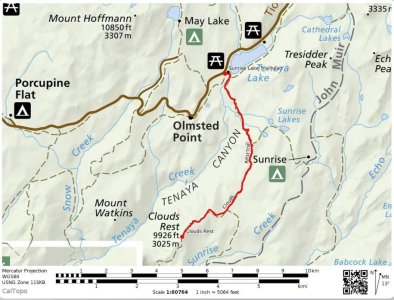
For those hikers out there, venturing out in the late afternoon without a compass and sufficient supplies is very risky, especially if you're unfamiliar with the area. My opinion lines up with Johnson's; falling into dangerous terrain beyond the lakes in the dark is very likely. Without a compass after visiting one of the Sunrise lakes, it would be really easy to take the wrong direction on the trail, as it looks the same in both directions, it wouldn't be noticeable at first. If you study a topo map of Sunrise Lakes Trail, you will see that if you walk in the wrong direction, it takes you via Clouds Rest's sheer drop on one side and Tenaya Creek on the other. Darkness falls, and staying on the trail is difficult; one slip, one fall, and not being found is a rational explanation for her disappearance.
 
  • #246
Interview with George Arras from “The San Francisco Examiner newspaper 1984

Stacy with Gerald -

She headed up the trail that headed west through pine trees, alpine meadows and granite outcroppings toward Sunrise Lakes, about a mile away. “She asked me to go with her, but I didn’t feel up to it,” Arras said. “I saw nothing wrong with her going for a walk with the older man. ”Stacey was fairly experienced in the mountains for a girl her age, although she was unfamiliar with that part of Yosemite, her father said. She left camp wearing white shorts, a white shirt and carrying a small camera and possibly a package of gum. A soccer player in good condition, Stacey bolted up the switchbacks. The man, huffing in the thin air at 9,500 feet, lagged behind. She waited for him several hundred yards up the trail. After he arrived and caught his breath, she started up the trail again. That was the last anyone saw of her.

The Search -

The search began at 10:30 that night. During the next several days, park rangers were joined by nearly 20 search-and-rescue teams, some from as far away as San Diego. Helicopters, eight specially trained dog teams and local climbers joined in the operation. At its height, about 160 people a day were searching for Stacey. They divided a 25-square-mile area around the camp into small grids, tracing and retracing the girl’s possible steps. Divers searched Sunrise Lakes. But after nine days without a trace of her, the search was called off. “We felt we did everything we could do,” Johnson said. Eight to ten people get lost in Yosemite each year. This was only the second time in the park’s recent history that searchers failed to find someone who disappeared.

SAR Theories -

Three things could have happened to Stacey, park officials believe. She could have fatally injured herself in some remote spot where she was never found, she could have been abducted or she could have run away. Rangers and Stacey’s father believe the latter two possibilities are very remote. “I can’t recall any instances of someone being accosted in the back country,” Johnson said. “If someone wanted to do something like that, they probably wouldn’t hike that far to do it. ”Although park officials recall at least one instance when someone used a similar situation to run away from his wife, Arras doesn’t think his daughter would have run away. “Sure, she had problems, just like all girls her age,” Arras said. “But if she wanted to run away, she could have done it at home. It would have been a lot easier.”When Stacey left camp, she had no money, no identification, only light clothing and no food. “Besides, she originally asked me to hike with her that day,” he said. “If she planned to run away, she wouldn’t have asked me to go with her.”

Park officials and Stacey’s father believe her remains are still hidden somewhere in Yosemite’s high country. Johnson theorised she could have become disoriented after dark, walked about three miles in the wrong direction and fallen 1,500 feet into rocky Tenaya Canyon.“There are no trails there and hardly anybody ever goes there,” he said. “Once in a while, a climber will find the body down there of someone we didn’t even know was missing.”Another possibility is that Stacey was mauled by a bear, but that is considered very unlikely.“Grizzly bears will do something like that, but we don’t have any in Yosemite,” Johnson said. “The black bears we have here are not aggressive toward humans, especially when they don’t have any food. They’re pretty lazy.”

George continues to search -Arras believes his daughter probably scrambled up some rocks and fell into a deep, narrow crevice. Somehow, the searchers and rescue dogs never found a trace of her, he believes. He plans to head back to the granite outcroppings near the Sunrise camp this summer to continue his search.“They say the snow should melt off by late June or early July this year,” he said. “I hope they’re right. Last year it didn’t melt off until August. That doesn’t give you much time.”

My Take -

For those hikers out there, venturing out in the late afternoon without a compass and sufficient supplies is very risky, especially if you're unfamiliar with the area. My opinion lines up with Johnson's; falling into dangerous terrain beyond the lakes in the dark is very likely. Without a compass after visiting one of the Sunrise lakes, it would be really easy to take the wrong direction on the trail, as it looks the same in both directions, it wouldn't be noticeable at first. If you study a topo map of Sunrise Lakes Trail, you will see that if you walk in the wrong direction, it takes you via Clouds Rest's sheer drop on one side and Tenaya Creek on the other. Darkness falls, and staying on the trail is difficult; one slip, one fall, and not being found is a rational explanation for her disappearance.

Tenaya Canyon.jpg
 
Last edited:
  • #247
This photo is right off the Sunrise Lake trail past the lakes. Tenaya Canyon.
 
  • #248
An examination of the Stacey Arras case from a hiker's perspective.


As a hiker, what most people on the internet don't seem to understand is how quickly a simple afternoon stroll in the high Sierra can go wrong. When I look at what happened to Stacey, one thing stands out — she broke almost every basic rule that experienced hikers live by.


Hiking Safety


She left Sunrise High Sierra Camp late in the day with Gerald, taking almost nothing with her: just a camera, cigarettes, and gum. No map, no compass, no water, no flashlight, no proper backpack. You should always carry those basics, especially when you're not familiar with the area. It’s also rarely a good idea to separate from your hiking partner. When Gerald couldn’t continue, she carried on alone. I suspect she thought, "I’ll just follow the trail down to the lakes, take a few photos, and be back." But without a compass, one wrong turn can put you in completely different terrain in minutes, and once the light drops, you’re in real trouble.


Sunrise Lakes trail


There are three Sunrise Lakes. Starting from High Sierra Camp, the first one you reach is actually Sunrise Lake 3, then Lake 2, and Lake 1 is the farthest down. Once you pass Sunrise Lake 1, Tenaya Canyon is right there on one side of the trail and Clouds Rest on the other. Get just one turn wrong after the lakes and you’re already hiking away from camp. As the light was dropping, losing the trail and falling on that granite terrain would have been frighteningly easy.


Abduction theory


Some people believe she was abducted. But just getting down to the trailhead from there is a solid four to five miles, and the last two miles are a brutal, steep descent dropping at least two hundred feet — very hard on the legs. Climbing up from Tenaya Lake is the same tough incline. It’s far easier on horseback. To abduct a teenage girl would likely require at least two people, getting her down those last two miles in fading light without anyone falling. And when you finally reach the trailhead, you’re in a busy car park right on Tioga Road, with people constantly coming and going. The idea that someone could do that without being noticed just doesn’t hold up.


Conclusion


This is sadly a perfect example of what happens when lack of preparation meets inexperience in the mountains — and it ends in tragedy.
 
  • #249
Abduction theory


Some people believe she was abducted. But just getting down to the trailhead from there is a solid four to five miles, and the last two miles are a brutal, steep descent dropping at least two hundred feet — very hard on the legs. Climbing up from Tenaya Lake is the same tough incline. It’s far easier on horseback. To abduct a teenage girl would likely require at least two people, getting her down those last two miles in fading light without anyone falling. And when you finally reach the trailhead, you’re in a busy car park right on Tioga Road, with people constantly coming and going. The idea that someone could do that without being noticed just doesn’t hold up.
If it does hold up that its so easy to get lost, disappear and never be found there then how it doesnt hold up that someone could abduct her, assault in some distance from trail, but not all the way out of the park and dispose of her body in convenient location?
What would be the reason to abduct someone in the middle of wilderness TO get them out of that wilderness into some other secluded location as secluded location is already there? Must be something pretty elaborated and indeed next level inefficient.

Some people believe that she could get abducted to held captive as the narrative set tells them that there was barely anyone there and chances of passing someone on these trails were close to zero. Then why not? Four miles or 40 miles doesnt matter if abductor is armed, motivated, familiar with the area and there is nobody to cry for help to.
But abduction doesnt always mean taking the victim far far away before assault and murder. It often happens relatively close to the site of abduction. And if its so easy to get lost there forever by accident, while trying to get back to the camp or out of the park, then it's highly likely even easier if it would be somebodys exact goal.
 
  • #250
If it does hold up that its so easy to get lost, disappear and never be found there then how it doesnt hold up that someone could abduct her, assault in some distance from trail, but not all the way out of the park and dispose of her body in convenient location?
What would be the reason to abduct someone in the middle of wilderness TO get them out of that wilderness into some other secluded location as secluded location is already there? Must be something pretty elaborated and indeed next level inefficient.

Some people believe that she could get abducted to held captive as the narrative set tells them that there was barely anyone there and chances of passing someone on these trails were close to zero. Then why not? Four miles or 40 miles doesnt matter if abductor is armed, motivated, familiar with the area and there is nobody to cry for help to.
But abduction doesnt always mean taking the victim far far away before assault and murder. It often happens relatively close to the site of abduction. And if its so easy to get lost there forever by accident, while trying to get back to the camp or out of the park, then it's highly likely even easier if it would be somebodys exact goal.
Very well said. They could have found a cave or a place to dwell in for weeks. Once the search party stopped, get rid of the body and leave.
 
  • #251
This photo is right off the Sunrise Lake trail past the lakes. Tenaya Canyon.
Sadly, this has always been my primary theory of what happened. She had never visited or hiked that area, it was new to her. It would be very easy to get disoriented on the hike around the lakes, with a major hazard so close by.

I've never been able to envision a kidnapping scenario. Would the kidnappers just decide to go cruising for young women way up in the isolated and dangerous back country of Yosemite? How would they know they would find an appealing victim? As I understand it, there aren't that many people who hike that far away from the main part of the park.

Thanks for your analysis.
 
  • #252
Sadly, this has always been my primary theory of what happened. She had never visited or hiked that area, it was new to her. It would be very easy to get disoriented on the hike around the lakes, with a major hazard so close by.

I've never been able to envision a kidnapping scenario. Would the kidnappers just decide to go cruising for young women way up in the isolated and dangerous back country of Yosemite? How would they know they would find an appealing victim? As I understand it, there aren't that many people who hike that far away from the main part of the park.

Thanks for your analysis.
Thank you, I really appreciate that.


You’ve hit the nail on the head — she had never been in that area before.


Look at the map. If she took the wrong turn directly out of Sunrise Lake 2, she was in serious trouble.


There’s no loop back to camp. Every single trail past Sunrise Lake 2 — no matter which split you take — leads you toward Tenaya Canyon. Whether you follow the blue line or the black line, they all funnel you into that massive canyon.


She would have needed to turn around and go back via Sunrise Lake 3 the exact same way she came. Without a compass or any experience, once it got dark that was almost impossible.


One wrong turn out of Sunrise 2 and she was essentially in serious trouble.


That’s why the terrain explanation has always made the most sense to me.
 

Attachments

  • May.jpg
    May.jpg
    132.1 KB · Views: 13
  • #253
If it does hold up that its so easy to get lost, disappear and never be found there then how it doesnt hold up that someone could abduct her, assault in some distance from trail, but not all the way out of the park and dispose of her body in convenient location?
What would be the reason to abduct someone in the middle of wilderness TO get them out of that wilderness into some other secluded location as secluded location is already there? Must be something pretty elaborated and indeed next level inefficient.

Some people believe that she could get abducted to held captive as the narrative set tells them that there was barely anyone there and chances of passing someone on these trails were close to zero. Then why not? Four miles or 40 miles doesnt matter if abductor is armed, motivated, familiar with the area and there is nobody to cry for help to.
But abduction doesnt always mean taking the victim far far away before assault and murder. It often happens relatively close to the site of abduction. And if its so easy to get lost there forever by accident, while trying to get back to the camp or out of the park, then it's highly likely even easier if it would be somebodys exact goal.

You guys clearly haven’t been out there.


There are no caves or secret hiding spots. Step off the trail past the Sunrise Lakes and you’re in miles of open granite slabs, boulders, and scattered trees. There’s literally nowhere to hide someone. That whole area was searched for nine days and nothing was found.


But let’s say someone did abduct her. The terrain that makes it so easy to get lost and disappear would also be working against the abductor. They’d have to fight with and control a healthy, athletic 14-year-old girl, carry or drag her for miles over rough ground, then get her down a brutal two-mile steep descent to the trail head that wrecks your knees and ankles.


Then they’d still have to get her past the Tenaya Lake trailhead — the only car park and the only road out of the area on Tioga Road. It’s a busy public spot with people eating lunch in the grass, rangers, hikers constantly coming and going, and cars pulling in and out.


If the terrain is so good at making people disappear, why would anyone choose one of the hardest, most impractical places possible to abduct someone and then try to move them out?


You just don’t hear of abductions happening this far into the wilderness for a reason — it’s simply not practical.
 
  • #254
You guys clearly haven’t been out there.

There are no caves or secret hiding spots. Step off the trail past the Sunrise Lakes and you’re in miles of open granite slabs, boulders, and scattered trees. There’s literally nowhere to hide someone. That whole area was searched for nine days and nothing was found.
If there are no caves or secret hiding spots then where is she?
It can't be both: super easy for someone to disappear while lost and trying to get back to the camp and also impossible to hide or drop a body where it isn't found ever.

I not only haven't been in Yosemite. I also never been in area that somehow is both: literally nowhere to hide a body AND countless of spots where someone may die and never be found.
But let’s say someone did abduct her. The terrain that makes it so easy to get lost and disappear would also be working against the abductor. They’d have to fight with and control a healthy, athletic 14-year-old girl, carry or drag her for miles over rough ground, then get her down a brutal two-mile steep descent to the trail head that wrecks your knees and ankles.
No, they wouldnt HAVE TO fight 14 year old to abduct her.
It's only a possibility and not even the most likely one cause vast majority of abductions start either with deception (so victim is NOT threatened and NOT attacked right away) or with a threat (which is easiest with a gun).
Then they’d still have to get her past the Tenaya Lake trailhead — the only car park and the only road out of the area on Tioga Road. It’s a busy public spot with people eating lunch in the grass, rangers, hikers constantly coming and going, and cars pulling in and out.
Im not putting much stock into her being dragged out of there but let's say someone had abducted her to drag her out of there.
Was that place so busy at night as well? People are eating lunch in lunchtime mostly. Hikers go out and back since early morning to late evening. Not at night. Could get pretty empty at night and if not, why not go when its most crowded? Barely anyone if anyone at all would know that Stacy is missing and how she looks like, if forced to comply, she would just go unnoticed, put into a car and gone.
That's far from most likely scenario but someone who would try to do that would have to be extremely comfortable with the area.
You just don’t hear of abductions happening this far into the wilderness for a reason — it’s simply not practical.
There is a reason why women rarely hike alone. Not cause of the bears.
 
  • #255
If there are no caves or secret hiding spots then where is she?
It can't be both: super easy for someone to disappear while lost and trying to get back to the camp and also impossible to hide or drop a body where it isn't found ever.

I not only haven't been in Yosemite. I also never been in area that somehow is both: literally nowhere to hide a body AND countless of spots where someone may die and never be found.

No, they wouldnt HAVE TO fight 14 year old to abduct her.
It's only a possibility and not even the most likely one cause vast majority of abductions start either with deception (so victim is NOT threatened and NOT attacked right away) or with a threat (which is easiest with a gun).

Im not putting much stock into her being dragged out of there but let's say someone had abducted her to drag her out of there.
Was that place so busy at night as well? People are eating lunch in lunchtime mostly. Hikers go out and back since early morning to late evening. Not at night. Could get pretty empty at night and if not, why not go when its most crowded? Barely anyone if anyone at all would know that Stacy is missing and how she looks like, if forced to comply, she would just go unnoticed, put into a car and gone.
That's far from most likely scenario but someone who would try to do that would have to be extremely comfortable with the area.

There is a reason why women rarely hike alone. Not cause of the bears.

You asked “If there are no caves or hiding spots, then where is she?” The answer is simple — she’s most likely in Tenaya Canyon.


Once you pass Sunrise Lake 2, all trails lead toward that canyon. The terrain slopes and funnels you in that direction. In the dark, with no light and no experience, it’s very easy to walk straight into it without seeing the drop until it’s too late.


There’s a big difference between accidentally falling into that kind of terrain and intentionally trying to abduct and hide someone there. The first is very easy. The second is extremely difficult.


You claim an abductor wouldn’t have to fight her — they could use deception or a gun. That’s pure speculation that ignores how difficult the terrain actually is.


The Tenaya Lake trailhead is busy well into the evening with people watching sunset, taking photos, and hikers still coming and going.


Regarding your comment about women not hiking alone, there are no reports of women being assaulted or abducted by strangers in the high country wilderness miles from any road. None.


When you actually look at the facts of the terrain instead of speculating, the accident scenario is by far the most likely explanation. She had no gear, no light, no compass, and every trail past Sunrise 2 leads toward deadly drops that aren’t far away.


I’ve answered the “where is she?” question multiple times now. So I’ll ask you honestly: why are you so invested in the abduction theory when the terrain itself makes it so easy for someone to simply vanish in the dark?


For context, there have been at least 35 people who have vanished in Yosemite over the years. You’ll notice that nobody is claiming any of the others were abducted. This comes across as confirmation bias — it seems the only reason this case gets the abduction theory attached to it is because she was a teenage girl.
 
  • #256
An initial 9 day search and now almost 46 years later, and they have not found any sign of her. People have looked I'm sure. Every canyon has a bottom, has anyone ever looked with people or drones to try and see if her body can be found? Or maybe a hat, shirt, sneaker?
I have not been to Yosemite in years and it is vast. But we do know the area she went missing in. We are not talking about a young girl walking 20 or 40 miles, especially if she fell. If I remember right it was about a 40 minute hike to the lake so that would narrow down the area. I understand it is rough terrain and Yosemite has a lot of that.
The odds of her falling to her death is probably around 80 to 95% but I would hope that people have still been looking. We spend enough money on a lot of worthless stuff in this country, finding children that are missing should be a priority.
 
  • #257
An initial 9 day search and now almost 46 years later, and they have not found any sign of her. People have looked I'm sure. Every canyon has a bottom, has anyone ever looked with people or drones to try and see if her body can be found? Or maybe a hat, shirt, sneaker?
I have not been to Yosemite in years and it is vast. But we do know the area she went missing in. We are not talking about a young girl walking 20 or 40 miles, especially if she fell. If I remember right it was about a 40 minute hike to the lake so that would narrow down the area. I understand it is rough terrain and Yosemite has a lot of that.
The odds of her falling to her death is probably around 80 to 95% but I would hope that people have still been looking. We spend enough money on a lot of worthless stuff in this country, finding children that are missing should be a priority.

That’s a very fair comment, and I agree — finding missing children should absolutely be a priority.


The initial search in 1981 lasted 9 days and was actually very thorough for its time. The problem is the area she most likely ended up in — Tenaya Canyon.


The bottom of that canyon isn’t open and easy to search. It’s choked with thick trees, heavy brush, huge boulders, creeks, and waterfalls. Even if her body or clothing is down there, it could easily be hidden under vegetation or wedged deep between rocks where neither people nor drones can easily see it.


Climbers do go into parts of Tenaya Canyon and sometimes find old skeletons, but even they say retrieving remains is extremely difficult. Large sections are so steep and dangerous that ground teams simply can’t safely get in — you’d need to be lowered by helicopter in many places.


You’re right that the area isn’t 20 or 40 miles away — it’s actually a fairly contained zone. The terrain is just that good at hiding someone.


It’s tragic, but that’s why nothing has been found in 45 years.
 
  • #258
I believe hiking in national parks is not inherently unsafe. The vast majority of people who go into the wilderness come back just fine. However, wilderness areas can be very unforgiving for inexperienced hikers who don’t know what they’re doing or don’t carry the right gear.


Stacy Arras went missing in July 1981. Thirty years later, in 2011, the Missing 411 book was released and her name suddenly exploded across the internet. What had been a private family tragedy for decades turned into endless YouTube videos, forum speculation, and wild theories about portals, aliens, Bigfoot, and secret killers.


Imagine being her family — finally starting to find some peace after all those years — only to see her story constantly exploited for entertainment. How would any of us feel if that was our daughter or sister?


This wasn’t a mystery novel or clickbait content. This was a real 14-year-old girl who went for a short walk with her camera and never came back. She deserves to be remembered with respect, not turned into internet fodder.


The people making money from these videos and constantly pushing sensational theories really need to check their morality. This level of exploitation is deeply unfair to her family.
 
  • #259
You asked “If there are no caves or hiding spots, then where is she?” The answer is simple — she’s most likely in Tenaya Canyon.


Once you pass Sunrise Lake 2, all trails lead toward that canyon. The terrain slopes and funnels you in that direction. In the dark, with no light and no experience, it’s very easy to walk straight into it without seeing the drop until it’s too late.
And no scavenger birds in Yosemite that would grab the attention of the searchers also?
There’s a big difference between accidentally falling into that kind of terrain and intentionally trying to abduct and hide someone there. The first is very easy. The second is extremely difficult.
Let's agree to disagree then.
You claim an abductor wouldn’t have to fight her — they could use deception or a gun. That’s pure speculation that ignores how difficult the terrain actually is.
No, it's not. Saying that he would NOT have to fight her means exactly that - in case of abduction there MAY be or may NOT be a need to physically fight the victim so it's not that limited.
If anything then saying that he would have to fight her is more of a speculation cause it already rules out a possibilities that she was threatened with a gun or lured for joined hike towards the lake by someone who did not appear threatening - while there is no reason to rule out anything.

As we are considering abduction then why not all scenarios that we know abduction happen but just one that starts with physical confrontation?
Same level as oh, this person wasnt murdered cause there were no gunshot wounds on their body and nevermind that murder could also mean stabbing, strangling, hitting and so on.
The Tenaya Lake trailhead is busy well into the evening with people watching sunset, taking photos, and hikers still coming and going.
And I was wondering about:
a) night,
b) using the crowd of day to pass without grabbing anybodys attention.
Regarding your comment about women not hiking alone, there are no reports of women being assaulted or abducted by strangers in the high country wilderness miles from any road. None.
In what area?
When you actually look at the facts of the terrain instead of speculating, the accident scenario is by far the most likely explanation. She had no gear, no light, no compass, and every trail past Sunrise 2 leads toward deadly drops that aren’t far away.

I’ve answered the “where is she?” question multiple times now. So I’ll ask you honestly: why are you so invested in the abduction theory when the terrain itself makes it so easy for someone to simply vanish in the dark?
I looked at the facts and stated multiple times in this very thread that accidental death appears to be the most likely scenario with her meeting foul play still worth considering.
For context, there have been at least 35 people who have vanished in Yosemite over the years. You’ll notice that nobody is claiming any of the others were abducted. This comes across as confirmation bias — it seems the only reason this case gets the abduction theory attached to it is because she was a teenage girl.
Statistically girls are the most often attacked and abducted. Not much of a reason to consider abduction if someone went missing at even more unspecific area of the park, at more or less unspecific moment and search wasn't as fast or as thorough. Here it's weirder.
 
Last edited:
  • #260
I hope she'll be found one day... does seem most probable that she got turned around and accidentally fell somewhere :( It's tragic and upsetting that it's so easy for people to get lost in the wilderness and never be found.
 

Guardians Monthly Goal

Members online

Online statistics

Members online
50
Guests online
1,297
Total visitors
1,347

Forum statistics

Threads
646,538
Messages
18,862,187
Members
246,061
Latest member
Fluffycat
Top