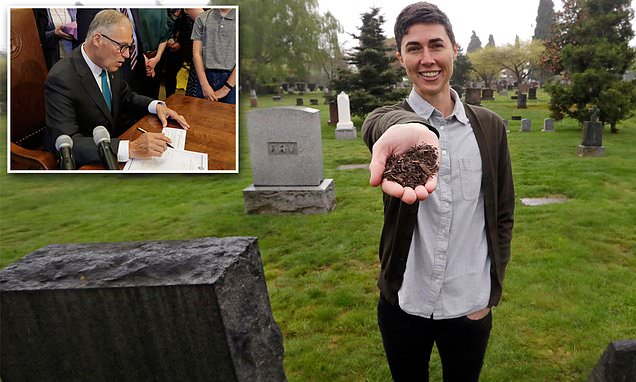


WA - State on cusp of legalizing human composting

  • #21
Western State University (WSU) located in eastern WA has long had a large animal vet program, and home to many ethical, environmental researchers. When neighboring states Oregon, Idaho, and CA started employing cremation by alkaline hydrolysis (remains are mixed with water and a solution made up of corrosive chemicals, such as sodium hydroxide, heated and then dissolved, leaving only bone and metal fragments) researchers at WSU quickly wanted to demonstrate an equivalent livestock composting without the chemicals. Ten plus years later, it was not surprising that the wood chip beds with various composting materials (to determine which mix worked best) was perfected to the point it's now considered for human composting.
MOO

Just to clarify, Spade worked with researchers at Washington State University (WSU) which is located in Pullman, WA, south of Spokane and on the Idaho border, and also with Western Carolina University in North Carolina.

Washington could become the first state to legalize human composting
She worked with researchers at Western Carolina University and the Washington State University to turn her vision, which she dubbed “recomposition,” into reality. The process involves placing unembalmed human remains wrapped in a shroud in a 5-foot-by-10-foot cylindrical vessel with a bed of organic material such as wood chips, alfalfa and straw. Air is then periodically pulled into the vessel, providing oxygen to accelerate microbial activity. Within approximately one month, the remains are reduced to a cubic yard of compost that can be used to grow new plants.

Led
by researcher Lynne Carpenter-Boggs, associate professor of sustainable and organic agriculture at Washington State, the five-month program recomposed six donor bodies in a carefully controlled environment, aiming to allay concerns about spreading pathogens.

 
  • #22
Next step is Soylent Green.
 
  • #23
Next step is Soylent Green.

Hope you are wrong, and if not, that it's not reality in three years! (as in the book / movie). "Human composting" is supposed to preserve land and resources, which would help to prevent such a situation. MOO.

Soylent Green (1973) - Plot Summary - IMDb
  • In 2022, Earth is overpopulated and totally polluted; the natural resources have been exhausted and the nourishment of the population is provided by Soylent Industries, a company that makes a food consisting of plankton from the oceans.
  • Meanwhile, Roth examines Soylent's oceanographic reports at the Supreme Exchange, a library and gathering place for fellow "books." The "books" and Roth finally realize that the reports indicate a "horrible" truth which, despite reading it for themselves, they find nearly impossible to believe; Soylent Green isn't made from plankton, it's made from human bodies. Unable to live with what he has uncovered, Roth opts for assisted suicide at a government clinic (in the former Madison Square Garden, which had been converted to a clinic for mass euthanasia), a process referred to as "going home." As Roth is dying, he watches video clips of Earth long ago when animal (sheep, deer, and horses) and plant life was thriving and there was no pollution, while listening to light classical music.
  • Thorn returns to his apartment and finds a note from Roth that he is "going home." Thorn races to the clinic and forces one staff attendant (Dick Van Patten) to allow him to see and talk to Roth. During Roth's final moments, he tells Thorn the secret of Soylent Green, and begs him to follow his body to the processing center, and report back to the "Supreme Exchange".
  • Thorn sneaks into the basement of the assisted suicide facility, where he sees corpses being loaded onto waste disposal trucks. He secretly hitches a ride on one, which is driven to a heavily guarded waste disposal plant just outside the city. The black-clad sanitation drivers are escorted at gunpoint out of the truck where a white-clad plant worker takes over driving. The sanitation worker is escorted to another truck leaving the fortress-like facility to drive back to the city. Once inside the plant, Thorn sees how the corpses are processed into Soylent Green wafers. They are loaded onto a conveyor belt and driven through a large machine about several hundred yards long, and the Soylent Green wafers come out on the other end.
 
  • #24
"Of all the options for the disposition of human remains, this would be by far the most environmentally friendly," said Sen. Jamie Pedersen, D-Seattle, who first proposed the bill in the Senate. "It's just what used to happen before the arrival of $5,000 caskets covered with ecologically unfriendly varnishes and all the rest."

On Friday [April 19], the state Senate and House of Representatives finalized their approval of bill 5001 (titled "concerning human remains"), which enshrines "organic reduction" and alkaline hydrolysis, a dissolving process sometimes called "liquid cremation," as acceptable alternatives to traditional burial and cremation.

Gov. Jay Inslee's office said the governor hasn't had a chance to review the final legislation. (Once it crosses his desk, he'll have five days to act.) If Inslee signs the bill, the law would take effect May 1, 2020. bbm

Liquid Cremation? Washington State Could Be First to Legalize Human Composting
 
  • #25
Just to clarify, Spade worked with researchers at Washington State University (WSU) which is located in Pullman, WA, south of Spokane and on the Idaho border, and also with Western Carolina University in North Carolina.

Washington could become the first state to legalize human composting
She worked with researchers at Western Carolina University and the Washington State University to turn her vision, which she dubbed “recomposition,” into reality. The process involves placing unembalmed human remains wrapped in a shroud in a 5-foot-by-10-foot cylindrical vessel with a bed of organic material such as wood chips, alfalfa and straw. Air is then periodically pulled into the vessel, providing oxygen to accelerate microbial activity. Within approximately one month, the remains are reduced to a cubic yard of compost that can be used to grow new plants.

Led
by researcher Lynne Carpenter-Boggs, associate professor of sustainable and organic agriculture at Washington State, the five-month program recomposed six donor bodies in a carefully controlled environment, aiming to allay concerns about spreading pathogens.

@elanor rigby - while my post was both MOO, and direct reply to another post, thanks for additional NBC link dated Dec 2018 as this version finally corrected the University Spade worked with from Univ of WA in Seattle to WA State Univ located in Pullman, WA.
 
  • #26
Western State University (WSU) located in eastern WA has long had a large animal vet program, and home to many ethical, environmental researchers. MOO
Snipped for focus

@elanor rigby - while my post was both MOO, and direct reply to another post, thanks for additional NBC link dated Dec 2018 as this version finally corrected the University Spade worked with from Univ of WA in Seattle to WA State Univ located in Pullman, WA.

My reply to your post was meant to correct your reference to "Western State University (WSU) located in eastern WA." The university in eastern Washington, as I think you probably know, is named Washington State University. However, other posters wishing to look up the research may not realize the mistake and waste time searching under the wrong name, so my intention was to be helpful and correct an error, not to disagree with your "opinion." To clarify further, Western Washington State University is in Bellingham, WA, and was not mentioned in the articles reporting on human composting.
 
  • #27
Snipped for focus


My reply to your post was meant to correct your reference to "Western State University (WSU) located in eastern WA." The university in eastern Washington, as I think you probably know, is named Washington State University. However, other posters wishing to look up the research may not realize the mistake and waste time searching under the wrong name, so my intention was to be helpful and correct an error, not to disagree with your "opinion." To clarify further, Western Washington State University is in Bellingham, WA, and was not mentioned in the articles reporting on human composting.

Great -- thanks again! I certainly never meant Western State here.

Spell check -- my blessing and curse all in one! :)
 
  • #28
I have not been able to find an MSM article stating that Inslee signed the "Human Coomposting" legislation. Wasn't that scheduled for May 1? Does anyone know if it happened, or why not, if it hasn't?

The latest article I was able to find was the one at the link below that provides a bit more information on the process, and a rendering of a possible future facility.

From dust to dirt: Human composting is coming to WA
 
  • #29
I have not been able to find an MSM article stating that Inslee signed the "Human Coomposting" legislation. Wasn't that scheduled for May 1? Does anyone know if it happened, or why not, if it hasn't?

The latest article I was able to find was the one at the link below that provides a bit more information on the process, and a rendering of a possible future facility.

From dust to dirt: Human composting is coming to WA
Vaccines, sex ed, clean energy, plastic straws: Here are the bills that lived and died in Olympia

May 5, 2019

OLYMPIA — The Washington Legislature approved a new $52.4 billion two-year state operating budget funded by a revenue package of more than $830 million in new or higher taxes. And it passed a slew of policy bills on topics ranging from affirmative action to vaccines and clean energy to human composting. bbm

ETA: Appears that every bill above that passed is awaiting Inslee signature but he's busy campaigning. However, there's no indication that these bills will not be signed by the Gov.
 
  • #30
Vaccines, sex ed, clean energy, plastic straws: Here are the bills that lived and died in Olympia

May 5, 2019

OLYMPIA — The Washington Legislature approved a new $52.4 billion two-year state operating budget funded by a revenue package of more than $830 million in new or higher taxes. And it passed a slew of policy bills on topics ranging from affirmative action to vaccines and clean energy to human composting. bbm

ETA: Appears that every bill above that passed is awaiting Inslee signature but he's busy campaigning. However, there's no indication that these bills will not be signed by the Gov.

Thanks for the info, @Seattle1! I'm not currently residing in WA, so I didn't realize Inslee was too busy campaigning to sign bills. I was confused by the articles implying the bill was now law, while at the same time unable to find an article confirming that he had signed it.
 
  • #31
I'm not even diligent with my recycling. But, I think human composting is a wonderful option!

This website is a great source of info on death (in general) as well as specific topics (ie: green burial). It's for anyone just "dying" for more details (sad pun intended).

Home | The Order of the Good Death
 
  • #32
Thanks for the info, @Seattle1! I'm not currently residing in WA, so I didn't realize Inslee was too busy campaigning to sign bills. I was confused by the articles implying the bill was now law, while at the same time unable to find an article confirming that he had signed it.

Maybe he took no action? bbm

Washington State Legislature How a Bill Becomes a Law

The governor signs the bill into law or may veto all or part of it. If the governor fails to act on the bill, it may become law without a signature.
 
  • #33
13788288-0-image-a-2_1558482467775.jpg


Gov signed the bill!

Washington becomes the first U.S state to allow 'human composting' | Daily Mail Online
 

Guardians Monthly Goal

Members online

Online statistics

Members online
150
Guests online
2,434
Total visitors
2,584

Forum statistics

Threads
636,114
Messages
18,690,509
Members
243,518
Latest member
magda13
Back
Top