
• #481
  • #482
I feel this case is more complicated than only one day's testimony.
 
  • #483
I feel this case is more complicated than only one day's testimony.
It is when you ignore everything that gets ignored. Im gonna get rage stroke for real.
 
  • #484
Here:
Kältetod am Glockner: „Ich habe Kerstin geliebt“

We can watch live how he (in my opinion) walks free with murder.
Thank you for this link. I sorted by "oldest" and can read the comments in order that way. As we hoped, there is more information here than we had been able to glean.

Here are what I think are the important posts from the journalist at the trial. This is part I of the updates from Schlagabtausch zwischen Verteidiger und Ermittler Updates continued in next post

"Regarding the time delays, Jelinek says that there are certainly "explanations" for this. As far as the emergency call is concerned: "There have been no problems for a long time." Then he talks about injuries that the victim sustained during the tour with a rope commuter - such as a hand injury. "You can also see that he was with his girlfriend for an hour and a half in sub-zero temperatures. She then said to him: 'Go!'"" (BBM, she sustained injuries????)

" "I've been to the Stüdlgrat four times so far, three of them in winter," says the 37-year-old." (BBM, I thought we had catalogued far more than 4 times????)

""You stated during questioning that your girlfriend had an eating disorder," the judge said to the accused. "Yes, but that was before my time, but I knew about it. But during our time together she was healthy," replied the Salzburger."

"If you're fit enough, we'll go on nice tours," the defendant wrote to his girlfriend, according to the judge. And he wanted to know what he meant. "She had the flu at the time, was in bed," answers the Salzburger. Now further chats between the two are being analyzed. "On principle, I would never take you with me on something like that," was another message, referring to a tour by the accused. There were also joint ski tours between the couple." (There is a lot to unpack here.)

"Now the tour planning of the fateful night comes up. "This was planned as a one-day tour," emphasizes the defendant, "she told those around her – such as family and work colleagues – that she was looking forward to the Glockner tour." "

"The judge now questions the defendant about various chat messages and calls that Kerstin G. wrote or made during the tour. For example, she dialed the number 149 at 5:20 p.m. "But because this number does not exist, she could have dialed 140 - the alpine emergency number. The numbers are next to each other," explains Norbert Hofer. The defendant replied: "I didn't notice anything about it.""

"It comes to light that the couple had no food in their backpacks. The victim only had "gummy bears" with him, as the 37-year-old says."

"The defendant had a first aid package including a rescue blanket with him. But not a bivouac bag. "I don't own one," he says, "I just don't have one." Kerstin G. had a rescue blanket and a bivouac bag with her. "She was well equipped," says her boyfriend, "I knew that." She also had heat pads with her."

"Judge Norbert Hofer asks many detailed technical questions. Some spectators – who come from alpine sports – nod in agreement. Again and again the defendant says: "I can't explain some things quite so well anymore." Hofer also suggests various variants of how one could have proceeded - for example with the "rope commuter". And he asks the alpinist why it wasn't done that way."

"The victim lost her glove during the "rope commuter". "I then gave her my spare glove," said the accused. When the police helicopter came, the couple noticed it. "I asked Kerstin if she had made an emergency call - she said no. She also emphasized that she was fine," said her boyfriend. The judge: "It would have seemed logical to me that in this situation I take out my cell phone, actively call 140, tell them that everything is fine, and I don't need any help. Why didn't you do that?" The accused: "Kerstin was fine, so I didn't look at my cell phone.""

"Consequently, the defendant preceded part of the way alone, his girlfriend waited securely. The couple thus did not continue on the running rope. "Why did you make this decision? In view of the overall situation, this is not conclusive for me," said Norbert Hofer. The defendant agreed: "In retrospect, it didn't make sense.""

""Kerstin shouted something up at me four to five times, but I didn't understand her," said the accused. Finally, he was "worried" and "made the emergency call" at 00.35 a.m."

At the time of the 00:35 emergency call: "What was Kerstin's condition? "It was bitterly cold, we wanted to have a tea, but it was all frozen," said the Salzburger. The judge states that the woman was "only crawling on her knees". "We were in an absolutely exceptional situation, we were both completely exhausted," said the Salzburger. Then he describes in detail how he secured himself."

""I agreed with her that I would get help. Because we knew that the whole night up here would not be enough. In this situation, I didn't think about Kerstin's bivouac bag anymore. I lay down next to her and she then screamed loudly: 'Go, now, go!' In doing so, she saved my life," recalls the alpinist."

""She was so exhausted that she was unable to move?" the judge asked. "Yes, that's correct," answers the accused. "Would Kerstin have been able to put on the bivouac bag?" the judge continued. "Yes, it would have been already. I don't know why she didn't tell me about it," said the Salzburger." (he seems to be so ill equiped on the mountain, only gummies to eat, tea that is frozen, doesn't think about the resources they have....)

"
Now the phone call at 00.35 a.m. comes up again. "Why don't you tell the telephone partner that Kerstin can no longer move?" asks Judge Norbert Hofer. "I didn't know then that she couldn't go any further," is the answer.
"So why didn't you make up for it when you noticed the emergency? That would have been the most fundamental information, you need to know that as a mountaineer," the judge continued. The Salzburger's answer to this: "I assumed that the rescue chain was set in motion by the phone call." (Important to note, they were separated at this time, as mentioned above, she kept yelling at him but he couldn't hear here).

"When the defendant left his girlfriend alone, she was "responsive". She was no longer able to move. Now the judge inquires about the procedure in which the Salzburg resident fixed Kerstin - and at the same time shows a photo of the victim at the scene of the accident. "How could she get into such a position if she could no longer move?" the judge asks. And then an important statement by Norbert Hofer: "I find it difficult to reconcile your variant with the pictures I have.""

This is part I of the updates from Schlagabtausch zwischen Verteidiger und Ermittler Updates continued in next post
 
  • #485
This is part II of the updates from Schlagabtausch zwischen Verteidiger und Ermittler Updates continued in next post

Continuing from the last post, "Now the judge inquires about the procedure in which the Salzburg resident fixed Kerstin - and at the same time shows a photo of the victim at the scene of the accident. "How could she get into such a position if she could no longer move?" the judge asks. And then an important statement by Norbert Hofer: "I find it difficult to reconcile your variant with the pictures I have.""
"Judge Norbert Hofer has "an explanation" for how it could have been. "This explanation is more conclusive in my eyes," he says and waits to see what the defendant says about it." (Oh how I wish the reporter had written down the Judge's explanation!!)

"The defendant turns to the judge: "I fully understand you and your possible conceivable scenario, but I did not leave Kerstin behind. I would like to emphasize that very clearly.""

"During his relegation (translate: descent), the Salzburg native was "really bad together". "I had to vomit twice and it took me much longer than usual," he reveals." (This is interesting. Does it coincide with the headlamp images of him up and over the mountain?)

"The alpinist finally arrived at the Adlersruhe: "There was no way I could climb again. I had my cell phone in my pocket the whole time, I didn't notice any calls because I was in an absolutely exceptional situation.""

""Emergency services were on site, one of them took me down to the valley - it was a mountain guide," the defendant testified." (so there were emergency services at the Adlersruhe hut?"

"The judge again refers to the protocol of the first interrogation – it says, for example, that the victim was "disoriented". "No, that's not true. Kerstin was not disoriented, she was responsive," says the accused. It is also mentioned that the GoPro camera of the Salzburg native "no longer appeared"." (Regarding the Go Pro, is this like a police officer who turns off his body camera? Did he turn off the Go Pro or did he not take it with him?)

"The judge has no more questions for the defendant – but prosecutor Johann Frischmann does. "Did Kerstin know anything about knots?" is one of the questions. "Yes, she did," answers the Salzburger, "but she couldn't have done the tour alone." The prosecutor consequently: "But you have completed such tours on your own. So I assume you're better at it?" The accused: "As I said, we were both equal."" (The defendant is REALLY digging his heels in that they were equal. This is his whole defense.)

(Prosecutor is interviewing KG's mother: ) ""Classic winter mix tours - i.e. combined rock and ice - are missing from the list. Can you help me here?" the judge turns to the victim's mother. "I don't know any, no," she answers, "I suppose she wasn't experienced here." The mother states that she always looked at her daughter's routes in advance and gave her tips. "She also told me that she wanted to walk the Glockner - we first talked about it at the end of December 2024.""

""My daughter didn't go climbing directly in winter," says the mother, "she didn't complete any such training courses." The judge wants to know: "Have you ever talked to her about the difficulty of the Stüdlgrat on the Glockner?" The victim's mother denies it. The crampons that her daughter used "she received from her boyfriend (note: the accused)."" (The crampons that the judge described as inadequate earlier, but TP said she had used before with no troubles. HE gave them to her.)

(WHAT!!!!) "Kerstin wrote a message to her mother in the late afternoon saying that she was "well down" again – although according to the protocol this was not the case at that time. "I thought that she and her boyfriend were out of the danger zone," says the mother and then adds: "She probably wanted to calm me down with this news.""

"When asked, the mother reveals that her daughter had the eating disorder in 2021. She was then also in therapy. "When she got together with her later boyfriend (note: the accused), she was healthy," she emphasizes. Kerstin was also a "strong allergy sufferer"."

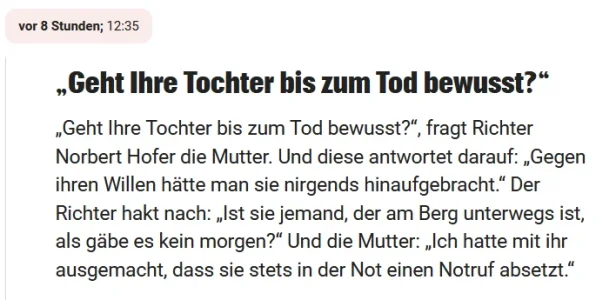
""Does your daughter walk consciously until death?" Judge Norbert Hofer asks the mother. And she answers: "Against her will, she would not have been taken up anywhere." The judge probes: "Is she someone who is out and about on the mountain as if there were no tomorrow?" And the mother: "I had agreed with her that she would always make an emergency call in an emergency."" (I feel like there is something lost in translation here.)
(Father now being interviewed) "And about her daughter he says: "She was very strong-willed. If she set her mind on something, she did everything she could to achieve it."

""Have you ever experienced a significant drop in your daughter's performance?" the judge wants to know. The father's answer: "No, that never happened." He had "not" had contact with Kerstin that day from late afternoon - not until the evening."

End of part II of the reporters comments from the courtroom. Continues on next post.
 
  • #486
Wow. Mom is entitled to her opinion, but none of this explains or justifies him declining to call emergency services and him actively resisting doing so for many, many hours ... along with him declining to try to cover her up or shield her. He was an experienced climber so his actions can't be written off as inexperience either.

If it was a loving mother, she may be in denial. If Kirsten had younger siblings, mom may be protecting them from the trauma. JMO, of course.
 
  • #487
This is part III of the updates from Schlagabtausch zwischen Verteidiger und Ermittler Updates continued in next post.

(Questioning of KG's father continues) "As far as the questioning of the defendant at the time in Kals is concerned, the victim's father emphasizes: "The mood was very charged over time." Now prosecutor Johann Frischmann asks his questions - for example regarding the defendant's cell phone. "My daughter's boyfriend offered his cell phone to the policeman, but he didn't take it or look at it - I don't remember exactly," says the father. His testimony is now over."

(Thomas's father now on the stand) ""My son has been alpine skiing for a while. He was always active in sports," says the father about the accused, who was also a member of the mountain troops. "He didn't take any courses in the alpine area, he learned all that himself," he emphasizes, "he looks at the tours carefully in advance, always keeps an eye on the weather." He had "bought the equipment himself"."

"The father had not known anything about the Glockner tour in advance, nor had his wife. "I was partly present at the interrogation of my son, which was a little strange," he says, "it was mainly about the phone call at 00:35 a.m. - whether this was an emergency call or not."
He had tried "several times" to reach his son by phone during the night - without success. He had had his first contact with him at 7:04 a.m. – he had been called by the accused." (So TP was not answering calls of father, either).

"The father has also walked the Stüdlgrat several times - also together with his son. "We have completed several tours together and have always planned it together," says the father. It turns out that he is very experienced in the high alpine area."

" again from the judge. "Have you ever discussed with your son how to act in an emergency situation, for example on the Stüdlgrat?" asks the judge. Only "superficial", is the answer."

"At 3:45 a.m., a police officer called the father. "Yes, this call appears on the cell phone, but I don't remember the conversation. We couldn't sleep, we were very worried." His interrogation has now ended."

"Now the brother of the accused is being questioned. He has also completed several high-alpine tours with him. "I myself have less experience in this," he says. Everything was always planned "together".
Regarding the Glockner project, he says: "I didn't know that he wanted to climb the Glockner with his girlfriend on this day." There were no joint tours with his brother and girlfriend."

"The judge now emphasizes again that messages were also sent to the couple by the rescuers - content: "Do you have an emergency call???""

"Now Judge Norbert Hofer is more specific about the alleged disputes between the defendant and his ex-girlfriend. There was correspondence – in it, for example, the accusation that the alpinist had "left his ex-girlfriend in an emergency situation". The brother then emphasizes that he himself has never had such problems with the accused." (What? An Ex-girlfriend accused TP of leaving her in an emergency situation? What???)

"He has already spoken to his brother about the Glockner drama itself - for example about the bivouac bag. "But what specifically?" the judge wants to know. "In my opinion, he didn't know that Kerstin had a bivouac bag with her," says the brother. The judge: "But the defendant emphasized to us that he knew that very well." The interrogation of the brother has now ended."

"The expert opinion of forensic medicine is preferred. The coroner speaks up. Her basic statement: "It could be determined that the woman died of hypothermia." She could no longer determine the exact time of death."


"Now an alpinist is being questioned, who was also on the Großglockner on the same day. "It was very windy," he says, "in the morning it was still okay, actually pleasant. But then the wind became stronger and stronger – even extremely strong." He later made an emergency call. "Because I saw a headlamp and heard a voice. I thought that was strange. I'm not sure if it was an emergency or not – but I didn't want to sit idle," says the alpinist. There are no further questions for him."

Another climber who was on the mountain who crossed paths with KG and TP "Also on the same day on the Glockner was another alpinist. "I finally broke off the tour because of the weather," he says. Exciting: He had previously met the defendant and his girlfriend. "We exchanged ideas, even climbed up a part together," says the man, "Kerstin left behind us." The defendant had felt - in other words, he went ahead. "We went at a normal pace. The defendant always looked at his girlfriend, asked her, for example, how she was doing," he recalls."

"And another witness testifies who was on the Glockner on the day in question. He is an experienced alpinist. He was not alone. "I assumed 40 km/h wind from the south," he says, "and I was convinced for a long time that we would reach the summit." The wind had only become "extremely gusty" over time. "Suddenly we had the first problems here," he recalls, "my mountain partner said around 1 p.m. that she was going to break off the tour." The group turned back around 1:45 p.m." (I believe this is visible in the mountain cams, the group going back down)

"The landlord of the Erzherzog-Johann-Hütte, who is also the head of operations of the Kals mountain rescue, is now being questioned as a witness. "I was informed by an alpine policeman at around 9 p.m. He said that lights and voices were seen above. But it was not possible to assign whether it was cries for help," he describes. Therefore, the situation continued to be monitored for the time being - for example via the webcams. At that time, one was "not yet" worried."

"The head of operations continues: "It is not unusual for there to be people on the Glockner in the evening." Based on further information, "it was clear that no deployment was necessary." Also because "no emergency call" had been received from the "climbing party", which is located on the Glockner."

"The head of operations learned that it was a "sharp operation" at around 3.30 a.m. "I immediately alerted my people internally, and around 4 a.m. we had an official alarm triggered." It was clear that the wind at the top would be a problem for the operation. "So it was also clear that it would be difficult for the helicopter crew," he recalls."

""I was there when the victim was rescued," says the head of operations. The team descended from the summit and Kerstin was seen immediately. "It was not where it should have been according to the information. It wasn't a pretty sight, it was all frozen," he says. In the summer after, he had spoken to the defendant about the drama when the latter had visited him at the hut. "We did not talk about how exactly the defendant had secured Kerstin.""

"According to the head of operations, the defendant seemed "very composed" on the Adlersruhe. "I asked him how Kerstin was doing up on the mountain. He told me about her injuries, for example," he describes, "in the summer he told me that he didn't know anything about his girlfriend's bivouac bag.""(Again with the injuries. How much did the injuries contribute to her inability to move?)

This is the end of part III of the comments from the reporter. Part IV continues in next post.
 
  • #488
This is part IV of the updates from Schlagabtausch zwischen Verteidiger und Ermittler Updates continued in next post.

"What did the incident commander see when he arrived at the scene of the accident? "I don't think Kerstin slipped," he emphasizes. Now there are further questions from the prosecutor. "I can't remember whether there was talk of a sudden drop in performance. We had no such information," emphasizes the head of operations. Regarding the wind, he says: "It does affect your ability to make decisions. You are in an extreme situation."" (I feel like there is a lot being missed here. Slipped? )

"Now it continues with a police officer who was also the police pilot: "I received a report around 10 p.m. It was about an unclear situation on the Stüdlgrat. I was asked if we had a way to fly there." This is followed by a "thorough weather check". He had therefore taken the flight with his crew. "The challenge was the very strong wind. We were able to locate the two people quite quickly," he emphasizes, "but there were no signs that help was needed.""

""Would you have risked a rope rescue at that time?" the judge wants to know. "No, I wouldn't have risked that," answers the police pilot."

"Now the police co-pilot is called to the witness stand. He had taken over the aircraft radio during the operation. "We switched on the train headlights – because we didn't know whether the alpinist duo would see us. And every time the train spotlight pointed at the two, they turned away and climbed on," he describes, "there was no emergency signal.""

""How long did you illuminate the section with the spotlight?" the prosecutor wants to know. The co-driver's answer: "We flew around six laps, at least half of which we had the headlights on – so several times for a few seconds."" (So there were multiple times in which TP and KG turned away from the helicopter.)

(Hah, there IS video of this helicopter visit!) "Now the third member of the police crew, the Flir operator, speaks. He is also a mountain guide. The policeman recorded the operation on video and also had visual contact with both people on the mountain. "I saw that there was an upward movement, but it was very slow," he says. The judge speaks for his feeling of "no fluid climbing" in this passage - which indicates problems. "I don't dare to assess the condition of the two on the screen. That's almost impossible," says the Flir operator."

"It continues with a police officer from the Lienz police station. "I am part of the alpine task force and have completed all the training. That means: I'm a high alpinist," he says. He had been called in to the operation. He had first met the defendant in Kals during the mountain rescue. "I therefore questioned him.""

"The defendant had been "rather taciturn". "He made a very reserved impression on me. Physically, he seemed very stable to me – already exhausted, but stable. He was able to answer my questions clearly," the policeman describes."

"The investigator had also asked the accused Salzburg resident whether he had been the tour planner or "guide out of courtesy". "He had said yes at the time," he says, "this information came proactively from him.""

"When asked whether the defendant was familiar with the alpine emergency signs, he also answered "yes". And: "He said that he and his companion were not in an emergency when the police helicopter circled the two at around 10:45 p.m." According to the accused, all the problems then began "after the breakfast place"."

"Some points cause "astonishment" for Judge Norbert Hofer. For example, nothing was documented about the "rope blockade" in the course of the investigations for a long time." (Rope blockade? Is this what TP did to try to protect KG??)

"During the interrogation, according to the investigator, the defendant "hardly spoke in full sentences", but rather always in "keywords". He continued to investigate. "He said he had been with his partner again for a longer period of time. But the details around it were not quite right for me," said the policeman.
A key question on the part of the judge: "Why didn't he put the bivouac bag around her?" The investigator said: "According to the defendant's statement, this was not used." And the judge replied: "If so, why not?""

"The place where the alpinist left his girlfriend behind, "he was able to describe very precisely," according to the investigator. For example, he said that the cross was already visible. "He couldn't really say anything about the late emergency call. He couldn't answer that so concretely," recalls the policeman, "in any case, he didn't obviously formulate it as an emergency call.""

"Now the defense attorney of the Salzburg man takes the floor and puts the investigator to task. An exchange of blows ensues. "When did the questioning end? There is no time stamp here," says Jelinek. The policeman answers: "For me, the questioning stopped when the death of his partner was determined. From that point on, he was considered a suspect.""

"And the defense attorney continues: "Did you read him his rights?" The investigator then: "Don't read aloud, I told him. None of this is present in this file note, it is correct.""

"The defense attorney continues to probe. The investigator then: "This whole file note was not made on the same day, but two days later." He had taken notes on the spot and created the file note on the basis of this. The defense lawyer then: "Can there be mistakes in the file note?" To which the policeman replied: "Minor errors could be included.""

"The defense attorney does not let up and speaks of "the fact that I miss further details in the file note." For example, the investigator did not note down full names. And now he gets really direct: "Do you want to protect your colleague?" A murmur goes through the jury courtroom. The policeman then denies this. The investigator then answers another question rather cynically – and now laughter goes through the courtroom."

"Now Judge Norbert Hofer intervenes and says in the direction of defense lawyer Kurt Jelinek: "I will not allow this question now." The question-and-answer game between Jelinek and the investigator about the nature of the interrogations, including details and possible bias, nevertheless continues cheerfully."

"Now the defense attorney points out that his client had already been awake for "more than 30 hours" at the time of the interrogation. He wants to know more concrete details – and then: "Do you think that my client was actually fit for questioning?""

"Now Judge Norbert Hofer asks the investigator further detailed questions. It is still about questioning the accused. "A formal interrogation as a suspect was not made that day," says the police officer. Hofer argues that a transfer to the police station "would have been quite possible". To which the investigator replied: "Yes, that's true.""

This is the end of Part IV of the reporter's notes. This continues in the next post.
 
  • #489
This is part V of the updates from Schlagabtausch zwischen Verteidiger und Ermittler Updates continued in next post.

"The defendant is now asked by the judge to come forward again. "They will be questioned in addition," Hofer announces. He is now asking specific questions regarding the interrogation. Among other things, it turns out that the defendant "only saw WhatsApp on the part of the rescuers down in Kals". The Salzburg resident had given up his mobile phone "voluntarily" - including a pin code. "I left the mobile phone in Lienz," says the alpinist, "I wasn't told the information that I didn't have to leave it there.""

""It was all very unusual for me," emphasizes the accused, "I wasn't really there either." He is referring to the interrogation. Judge Norbert Hofer asks many more detailed questions, the defendant answers every single question."

"Now defense attorney Kurt Jelinek asks further questions - including about Kerstin's condition. "She was completely exhausted in the end. I thought I was in the wrong movie," said the accused. He will now be released from the witness stand."

(Judge calls back TP's father and brother to inquire if they were told that TP was a suspect. They said no, they didn't recall that, and TP's brother told TP at one point that he didn't have to answer their questions any more.)

"Let's continue with witnesses. Now a woman is being questioned. "I was with the accused, we had a relationship for a short time," she emphasizes, "we also went on tours together." The woman says: "My ex-boyfriend always took the lead. I always inquired, but he always led." There were tours that she would not have been able to master herself without him. "I already had some mountain experience, but he was more experienced," she emphasizes."

And, here it is, what some of us have suspected.....) ""He has always taken good care of me during the tours. When difficulties arose, it wasn't always like that," the ex-girlfriend makes people sit up and take notice, "I was sometimes afraid. In these situations, he tended to get grumpy." And further: "On a high alpine tour on the Glockner, the mood was bad. I was at the end of my rope, I was dizzy, my headlamp was off, I cried and screamed. I also signaled that to him. Then suddenly he was gone, he went ahead, left me behind.""

"The ex-girlfriend always knew what to expect. "Maybe not always completely, but I was mostly aware of what I was getting myself into," she says. There were people in her environment who knew that there had been problems with the joint tours. "They also advised me to go to the police - but I didn't do that," says the ex-girlfriend."

"The public prosecutor probes. "Was that one incident when he left you alone the end of the relationship?" The witness replied: "No, that was the reason why we didn't do any more tours together." The separation of the two had come about "for various reasons"."

They are on a break.
 
  • #490
This is part VI of the updates from Schlagabtausch zwischen Verteidiger und Ermittler Updates continued in next post.

"Now it's the turn of another investigator, he reveals his memories of the said operation on the Glockner. "Among other things, I checked in the parking lot which vehicles were still in the parking lot," he describes, "we quickly knew the owner and were able to find the phone number.""

"The investigator had tried to contact the defendant "through various channels". "First by means of the messenger service," he testifies. After that, when he had the phone number, I called the alpinist several times – without success. "Then I sent him text messages and WhatsApp – before the police helicopter took off from Salzburg," he recalls, "that wasn't successful either.""

"The police helicopter then discovered the duo on the Glockner. "The handling of the radio traffic therefore went through me. We also had the webcam images available - unfortunately they are only updated every 30 minutes at night," says the investigator."

"There were "no" signs of help from the two alpinists. "Of course, I also tried to contact the woman. That didn't work either," he says, "it was clear to us that there was no emergency call on the mountain." The policeman substantiates this with conclusive arguments."

""I had the first contact with the defendant at 00.35 a.m. He actively called me on my mobile phone number," the policeman recalls. He was at home at the time. "He told me that he was the alpinist who was on the Glockner with his girlfriend. I also questioned why he hasn't come forward so far. He said to me: 'We don't need anything up here, everything is fine.'" He then also advised him that "they have to keep doing" to get down to the valley. Then the phone call was over - "I tried twice afterwards to reach him again by phone". There was always a dial tone and then the mobile box. "The same thing happened with the girlfriend's cell phone.""

"The investigator adds: "There was no reaction to any contact attempts on our part. That's why we assumed that the situation was right." At 00:49 a.m., he sent the defendant a WhatsApp message with the content: "Do you need help or not???" "None" answer came back. And the investigator emphasizes again: "There was not a single piece of information that there was an emergency.""

""The defendant did not tell me during the phone call at 00:35 a.m. that he would need help," says the investigator. The Salzburg native presented it differently today before Judge Norbert Hofer."

"The next successful contact happened at 3.30 a.m. "The alpinist told me that they were in the winter room of the Adlersruhe," he says, "at first I thought that everything was fine. But then he told me that he had left his girlfriend behind on the Glockner." As a result, the rescue operation started, and the investigator himself was present at the rescue."

"Now the policeman meticulously describes the operation - including concrete times. "We were dropped off on the Glockner south face and then ascended. We came across the alpinist in the Adlersruhe," he says. The exchange was short and sweet because they wanted to save time. "He emphasized again that he left his girlfriend behind.""

(This is horrible to read, trigger warning) "The emergency services continued up to the summit. "We found the alpinist in a hanging position. She had her backpack on her back, her head stretched backwards. Her eyes were wide open, she wasn't wearing gloves, the boots were open," he says, "for us it was a miracle that she stayed in that position." If the wind had been even stronger, "she would have crashed over the south face"."

"Now photos of the scene of the accident are shown. Once again, Judge Norbert Hofer asks the witness detailed questions. For example: "How does she get into such a position?" the judge asks. The investigator, who is with the Alpine task force, answers: "I can't explain that." Hofer: "Could the victim end up like that due to a fall?" The policeman then: "No, not really." Kerstin did not wear gloves - not on either hand."

"Now the judge again has the defendant describe how he fastened his girlfriend - and again asks many questions."

"The witness questioning with the investigator continues. "Did you talk to the alpinist again after the rescue?" asks the judge. "On January 20, we had telephone contact - shortly before 8 a.m.," he answers. The Salzburg resident asked the policeman whether his GoPro had been found in the course of the rescue."

""Why can't it be clearly said whether the call at 00.35 a.m. was an emergency call or not?" the judge now asks. "I can't say," answers the investigator, pointing out that the entire operation was "very demanding". They had only concentrated "on the essentials". Then the judge: "If it had been an emergency call, would it have changed anything in the procedure?" The policeman replied: "Yes, it would. For example, we would have given him other advice on how to behave, that he should put the bivy bag on his partner and much more.""

This is the end of Part VI of the reporters comments. continues on next post.
 
  • #491
"Regarding the time delays, Jelinek says that there are certainly "explanations" for this. As far as the emergency call is concerned: "There have been no problems for a long time." Then he talks about injuries that the victim sustained during the tour with a rope commuter - such as a hand injury. "You can also see that he was with his girlfriend for an hour and a half in sub-zero temperatures. She then said to him: 'Go!'"" (BBM, she sustained injuries????)

" "I've been to the Stüdlgrat four times so far, three of them in winter," says the 37-year-old." (BBM, I thought we had catalogued far more than 4 times????)
Yes we did. More than 4.

But we, and ANYONE who checked the publicly available surveillance and learned basic math knows that aint no 1,5 hours between 0:40 and ("best" case scenario 1:20) as he's crossing the cross at 1:30.
 
  • #492
Thank you for posting these for us
 
  • #493
Yes we did. More than 4.

But we, and ANYONE who checked the publicly available surveillance and learned basic math knows that aint no 1,5 hours between 0:40 and ("best" case scenario 1:20) as he's crossing the cross at 1:30.
And yet TP said in testimony today that he was quite ill, vomited twice, and it took him much longer to get down than typical...
(Post #485 in this thread Austria - Thomas Plamberger leaves gf, Kerstin Gurtner to freeze to death on Austria's tallest mountain - charged with manslaughter - Jan.19/2025)
 
  • #494
It's now 8 pm in Austria and the court is still in session, having started at 9 am. Impressive.

So many things emerging. TP comes across as a total narcissist.
 
  • #495
""You stated during questioning that your girlfriend had an eating disorder," the judge said to the accused. "Yes, but that was before my time, but I knew about it. But during our time together she was healthy," replied the Salzburger."
But they weren't even living together so how can he know if she had or didnt have.
Im not implying that she still had these issues. Just pointing out his style of narrative.
"Now the tour planning of the fateful night comes up. "This was planned as a one-day tour," emphasizes the defendant, "she told those around her – such as family and work colleagues – that she was looking forward to the Glockner tour." "
I bet she didnt mention Studlgrat specifically...
"It comes to light that the couple had no food in their backpacks. The victim only had "gummy bears" with him, as the 37-year-old says."
So he knew about gummy bears in her backpack but didnt knew about the bivy. But he also did knew about the bivy. But also told that he didn't. And that he did. Such a straightforward man.
"The victim lost her glove during the "rope commuter". "I then gave her my spare glove," said the accused. When the police helicopter came, the couple noticed it. "I asked Kerstin if she had made an emergency call - she said no. She also emphasized that she was fine," said her boyfriend. The judge: "It would have seemed logical to me that in this situation I take out my cell phone, actively call 140, tell them that everything is fine, and I don't need any help. Why didn't you do that?" The accused: "Kerstin was fine, so I didn't look at my cell phone.""
Such an impressive disregard of that pilot's safety.
It was mentioned in earlier KZ articles that they know each other. Thomas & that pilot.
""Kerstin shouted something up at me four to five times, but I didn't understand her," said the accused. Finally, he was "worried" and "made the emergency call" at 00.35 a.m."

At the time of the 00:35 emergency call: "What was Kerstin's condition? "It was bitterly cold, we wanted to have a tea, but it was all frozen," said the Salzburger. The judge states that the woman was "only crawling on her knees". "We were in an absolutely exceptional situation, we were both completely exhausted," said the Salzburger. Then he describes in detail how he secured himself."

""I agreed with her that I would get help. Because we knew that the whole night up here would not be enough. In this situation, I didn't think about Kerstin's bivouac bag anymore. I lay down next to her and she then screamed loudly: 'Go, now, go!' In doing so, she saved my life," recalls the alpinist."

""She was so exhausted that she was unable to move?" the judge asked. "Yes, that's correct," answers the accused. "Would Kerstin have been able to put on the bivouac bag?" the judge continued. "Yes, it would have been already. I don't know why she didn't tell me about it," said the Salzburger." (he seems to be so ill equiped on the mountain, only gummies to eat, tea that is frozen, doesn't think about the resources they have....)

"
Now the phone call at 00.35 a.m. comes up again. "Why don't you tell the telephone partner that Kerstin can no longer move?" asks Judge Norbert Hofer. "I didn't know then that she couldn't go any further," is the answer.
"So why didn't you make up for it when you noticed the emergency? That would have been the most fundamental information, you need to know that as a mountaineer," the judge continued. The Salzburger's answer to this: "I assumed that the rescue chain was set in motion by the phone call." (Important to note, they were separated at this time, as mentioned above, she kept yelling at him but he couldn't hear here).

"When the defendant left his girlfriend alone, she was "responsive". She was no longer able to move. Now the judge inquires about the procedure in which the Salzburg resident fixed Kerstin - and at the same time shows a photo of the victim at the scene of the accident. "How could she get into such a position if she could no longer move?" the judge asks. And then an important statement by Norbert Hofer: "I find it difficult to reconcile your variant with the pictures I have.""
She was screaming for help, crawling on her knees but oh yeah, sure, totally able to get herself into a bivy and responsible for reminding him about it.
1,5 hour earlier he hasnt called emergency neither for help nor to explain that help isnt needed cause allegedly Kerstin was okay, but when she clearly wasnt he also wasnt very focused on reaching for help.
He assumed that the rescue was set in motion but expressed no interest in learning when they may show up.
"During his relegation (translate: descent), the Salzburg native was "really bad together". "I had to vomit twice and it took me much longer than usual," he reveals." (This is interesting. Does it coincide with the headlamp images of him up and over the mountain?)
It means that he left her even earlier than could be approximated by the descend of the climber from Dec 1st, where weather conditions were pretty similar.
""Emergency services were on site, one of them took me down to the valley - it was a mountain guide," the defendant testified." (so there were emergency services at the Adlersruhe hut?"
They were... as they arrived. Hours later. Thats his style of narrative.
"The judge again refers to the protocol of the first interrogation – it says, for example, that the victim was "disoriented". "No, that's not true. Kerstin was not disoriented, she was responsive," says the accused. It is also mentioned that the GoPro camera of the Salzburg native "no longer appeared"." (Regarding the Go Pro, is this like a police officer who turns off his body camera? Did he turn off the Go Pro or did he not take it with him?)
She was "disoriented" when he was painting a picture of hopeless scenario where he had to save himself. Then he dropped that cause it emerged that it really wasnt.
"The judge has no more questions for the defendant – but prosecutor Johann Frischmann does. "Did Kerstin know anything about knots?" is one of the questions. "Yes, she did," answers the Salzburger, "but she couldn't have done the tour alone." The prosecutor consequently: "But you have completed such tours on your own. So I assume you're better at it?" The accused: "As I said, we were both equal."" (The defendant is REALLY digging his heels in that they were equal. This is his whole defense.)
Was Kerstin bragging about her exceptional climbing skills and shaming random people on insta for quitting summiting attempts cause of bad weather? Havent stumbled on that. He did.
""My daughter didn't go climbing directly in winter," says the mother, "she didn't complete any such training courses." The judge wants to know: "Have you ever talked to her about the difficulty of the Stüdlgrat on the Glockner?" The victim's mother denies it. The crampons that her daughter used "she received from her boyfriend (note: the accused)."" (The crampons that the judge described as inadequate earlier, but TP said she had used before with no troubles. HE gave them to her.)
I wonder where did she used them. On these summer climbs where maybe 50m of a route, close to the summit were covered in snow?
""Does your daughter walk consciously until death?" Judge Norbert Hofer asks the mother. And she answers: "Against her will, she would not have been taken up anywhere." The judge probes: "Is she someone who is out and about on the mountain as if there were no tomorrow?" And the mother: "I had agreed with her that she would always make an emergency call in an emergency."" (I feel like there is something lost in translation here.)
1771530064130.webp
He asked if Kerstin was the type of person that would do something she wanted even if it was extremely, deadly risky. If she was strong risk taker.
What mother says means that Kerstin was very strong willed (thats some sort of an idiom or a saying Im not sure) but they had an agreement that in case of emergency/risk/danger she will make an emergency call.
 
  • #496
And yet TP said in testimony today that he was quite ill, vomited twice, and it took him much longer to get down than typical...
(Post #485 in this thread Austria - Thomas Plamberger leaves gf, Kerstin Gurtner to freeze to death on Austria's tallest mountain - charged with manslaughter - Jan.19/2025)
Mind his words. REALLY mind his words.
It took him much longer than usual to get down.
Who in God's green Earth knows whats his usual time to descend such a mountain in Winter darkness except for people WHO DID IT BEFORE MULTIPLE TIMES?
He knows that he did, I know that he did, you know that he did. If prosecutor went well through his socials and surveillances he would know that too.
 
  • #497
This is part IV of the updates from Schlagabtausch zwischen Verteidiger und Ermittler Updates continued in next post.

"What did the incident commander see when he arrived at the scene of the accident? "I don't think Kerstin slipped," he emphasizes. Now there are further questions from the prosecutor. "I can't remember whether there was talk of a sudden drop in performance. We had no such information," emphasizes the head of operations. Regarding the wind, he says: "It does affect your ability to make decisions. You are in an extreme situation."" (I feel like there is a lot being missed here. Slipped? )

"Now it continues with a police officer who was also the police pilot: "I received a report around 10 p.m. It was about an unclear situation on the Stüdlgrat. I was asked if we had a way to fly there." This is followed by a "thorough weather check". He had therefore taken the flight with his crew. "The challenge was the very strong wind. We were able to locate the two people quite quickly," he emphasizes, "but there were no signs that help was needed.""

""Would you have risked a rope rescue at that time?" the judge wants to know. "No, I wouldn't have risked that," answers the police pilot."

"Now the police co-pilot is called to the witness stand. He had taken over the aircraft radio during the operation. "We switched on the train headlights – because we didn't know whether the alpinist duo would see us. And every time the train spotlight pointed at the two, they turned away and climbed on," he describes, "there was no emergency signal.""

""How long did you illuminate the section with the spotlight?" the prosecutor wants to know. The co-driver's answer: "We flew around six laps, at least half of which we had the headlights on – so several times for a few seconds."" (So there were multiple times in which TP and KG turned away from the helicopter.)

(Hah, there IS video of this helicopter visit!) "Now the third member of the police crew, the Flir operator, speaks. He is also a mountain guide. The policeman recorded the operation on video and also had visual contact with both people on the mountain. "I saw that there was an upward movement, but it was very slow," he says. The judge speaks for his feeling of "no fluid climbing" in this passage - which indicates problems. "I don't dare to assess the condition of the two on the screen. That's almost impossible," says the Flir operator."

"It continues with a police officer from the Lienz police station. "I am part of the alpine task force and have completed all the training. That means: I'm a high alpinist," he says. He had been called in to the operation. He had first met the defendant in Kals during the mountain rescue. "I therefore questioned him.""

"The defendant had been "rather taciturn". "He made a very reserved impression on me. Physically, he seemed very stable to me – already exhausted, but stable. He was able to answer my questions clearly," the policeman describes."

"The investigator had also asked the accused Salzburg resident whether he had been the tour planner or "guide out of courtesy". "He had said yes at the time," he says, "this information came proactively from him.""

"When asked whether the defendant was familiar with the alpine emergency signs, he also answered "yes". And: "He said that he and his companion were not in an emergency when the police helicopter circled the two at around 10:45 p.m." According to the accused, all the problems then began "after the breakfast place"."

"Some points cause "astonishment" for Judge Norbert Hofer. For example, nothing was documented about the "rope blockade" in the course of the investigations for a long time." (Rope blockade? Is this what TP did to try to protect KG??)

"During the interrogation, according to the investigator, the defendant "hardly spoke in full sentences", but rather always in "keywords". He continued to investigate. "He said he had been with his partner again for a longer period of time. But the details around it were not quite right for me," said the policeman.
A key question on the part of the judge: "Why didn't he put the bivouac bag around her?" The investigator said: "According to the defendant's statement, this was not used." And the judge replied: "If so, why not?""

"The place where the alpinist left his girlfriend behind, "he was able to describe very precisely," according to the investigator. For example, he said that the cross was already visible. "He couldn't really say anything about the late emergency call. He couldn't answer that so concretely," recalls the policeman, "in any case, he didn't obviously formulate it as an emergency call.""

"Now the defense attorney of the Salzburg man takes the floor and puts the investigator to task. An exchange of blows ensues. "When did the questioning end? There is no time stamp here," says Jelinek. The policeman answers: "For me, the questioning stopped when the death of his partner was determined. From that point on, he was considered a suspect.""

"And the defense attorney continues: "Did you read him his rights?" The investigator then: "Don't read aloud, I told him. None of this is present in this file note, it is correct.""

"The defense attorney continues to probe. The investigator then: "This whole file note was not made on the same day, but two days later." He had taken notes on the spot and created the file note on the basis of this. The defense lawyer then: "Can there be mistakes in the file note?" To which the policeman replied: "Minor errors could be included.""

"The defense attorney does not let up and speaks of "the fact that I miss further details in the file note." For example, the investigator did not note down full names. And now he gets really direct: "Do you want to protect your colleague?" A murmur goes through the jury courtroom. The policeman then denies this. The investigator then answers another question rather cynically – and now laughter goes through the courtroom."

"Now Judge Norbert Hofer intervenes and says in the direction of defense lawyer Kurt Jelinek: "I will not allow this question now." The question-and-answer game between Jelinek and the investigator about the nature of the interrogations, including details and possible bias, nevertheless continues cheerfully."

"Now the defense attorney points out that his client had already been awake for "more than 30 hours" at the time of the interrogation. He wants to know more concrete details – and then: "Do you think that my client was actually fit for questioning?""

"Now Judge Norbert Hofer asks the investigator further detailed questions. It is still about questioning the accused. "A formal interrogation as a suspect was not made that day," says the police officer. Hofer argues that a transfer to the police station "would have been quite possible". To which the investigator replied: "Yes, that's true.""

This is the end of Part IV of the reporter's notes. This continues in the next post.
Thank you. This seems to disprove that he was delirious from the cold or anything like that. I wouldn't expect someone delirious from the cold to be able to converse normally and cogently with LE.

He doesn't seem to have any logical explanation for why he couldn't attempt to warm her or cover her or expeditiously direct emergency services to her location.

Literally *no* reasonable explanation for not attempting to warm her up.

He truly sounds like a cruel individual that wanted to punish her for not being able to endure the climb, or didn't think her life was worth the hassle of engaging rescue services.
 
  • #498
(This is horrible to read, trigger warning) "The emergency services continued up to the summit. "We found the alpinist in a hanging position. She had her backpack on her back, her head stretched backwards. Her eyes were wide open, she wasn't wearing gloves, the boots were open," he says, "for us it was a miracle that she stayed in that position." If the wind had been even stronger, "she would have crashed over the south face"."
Hanging on what?
There is nothing to hang on on the last 50m of the route and on the rampe that she was allegedly on.
She had to be there, cause on the other hand there is NOTHING to walk on knees on BEFORE that rampe. Its a wall, that horrible vertical wall with fixed ropes when climbers had to pull themselves up over, then walk few metres on the side of the stone to the rampe.
She would have crashed over the south face? SOUTH FACE? South face is Studlgrat, its whats visible from Lucknerhaus-Lucknerhutte. Side of the rampe is North face, part of it is obscured from view from Luckner... so she had to be totally totally down the rampe or not even there yet. And that's literally just metres from where they were when heli showed up.
Thats hard, hard part of the route with the hardest spot on the route but come on.
 
  • #499
This is part VII of the updates from Schlagabtausch zwischen Verteidiger und Ermittler Updates continued in next post.

""Was there any discussion at any point about waiting with the investigations - because of the condition of the accused?" the judge wants to know from the investigator. He "didn't really deal with that," he answers.
Then the judge addresses the "emotional questioning" again. "Why did it escalate so much in the valley?" he asks. The investigator: "When I arrived at the bottom, my colleague told me that the further investigations would be taken over by the LKA - on the order of the public prosecutor's office. I was a little surprised, but also a bit scarred and tired from the mission."" (I would say it escalated and was emotional in the valley because the team who found KG was reporting what they found!!!!!)

"Public prosecutor Johann Frischmann now asks his questions to the police officer. Then the defense lawyer follows. He wants to know details, such as the investigator's work cell phone. "Why do you continue questioning my client when he learns that his girlfriend is dead? And that after more than 30 hours that he was awake? Why don't you continue this the next day?" the defense lawyer now wants to know. The investigator emphasizes: "Every single colleague is well trained for these situations. I can't give more details."" (So the defense is that the interrogation needed to be put off and that the inconsistencies and issues with TP's testimony are due to his fatigue and emotional overwhelm?)

"The defense files several motions for evidence. These will now be presented in detail. Judge Norbert Hofer must decide on the motions for evidence filed. These have just been sent to him by e-mail by the defense. Since the applications have not yet arrived, there is a five-minute break."

"All motions for evidence submitted by the defense are "dismissed". Judge Norbert Hofer gives detailed reasons for his decision. The suggestion on the part of the defense to postpone the hearing is also rejected."

"In summary, the alpine technical expert now presents his report. "The defendant has climbed the Großglockner many times," he says, "his high alpinistic and physical performance should be emphasized." The victim, on the other hand, did not start such tours until "2024". "She was very fit and very motivated, but in terms of such wintry high alpine tours, she is considered a 'beginner'," says the expert."

""All the tours already mentioned today, which the couple has completed together, are significantly easier than the wintry ascent over the Stüdlgrat on the Glockner. That has to be said very clearly," emphasizes the expert. And further: "The soft boots and the splitboard are basically suitable for such a tour, but the possible uses in the mountaineering sector are significantly limited.""

"The approach is "much more difficult" with softboard boots and splitboard, as are the "climbing passages." "You simply have much less stability," emphasizes the expert. A photo shows that Kerstin used the defendant's track on the approach, but she also made a track with a ski. "You shouldn't underestimate that, it's much more exhausting.""

"The expert states: "The equipment was unsuitable for the alpinist, as she was and what she could do. The defendant should have pointed this out to her.""

"The expert notes a high degree of fitness in both. He could not say anything about Kerstin's state of health on the day in question. "The fact that this tour was chosen as the first route in this high alpine area for the alpinist is questionable," he says. This tour should have been "ruled out" from the outset on January 18, 2025 due to all the circumstances."

""It would have been essential to take into account in the planning that headlamps would be needed in January from 6 p.m. at the latest," the expert continued. Such planning - i.e. the 9 p.m. summit planning - "is definitely not recommended"."

""The equipment of both can be described as incomplete and not very useful," the expert continues. Regarding the emergency equipment, "the two had no avalanche equipment" with them. "This has nothing to do with the present case, because no avalanche went off, but it shows that the two did not expect an emergency," he is convinced." (As people had discussed on thread before, TP was used to getting through on his strength/endurance alone. He was a 'beast.')

"The weather forecasts in the north "were not a mandatory stop". Nevertheless, worrying harbingers were "ignored" by this two-person rope team. According to the court report, general hypothermia is fatal. "But local frostbite is also relevant - for example of fingers. You can no longer hold on like this. That was all given," emphasizes the expert."

"Reversal is a central point for the expert. "At the latest at the Frühstücksplatzl you should have realized that an ascent of the Großglockner is no longer possible. The defendant should have reacted imperatively - after all, he was the experienced one." If you fail to turn back, you have to "make an emergency call in good time" - "because the chance of rescue is higher," the expert clarifies."

"The defendant sits in his seat, listens to the expert, shows no emotion. This is how he has behaved so far in the entire trial."

This is the end of Part VII of the reporters notes from the trial. Will continue in next post.
 
  • #500
Thank you. This seems to disprove that he was delirious from the cold or anything like that. I wouldn't expect someone delirious from the cold to be able to converse normally and cogently with LE.

He doesn't seem to have any logical explanation for why he couldn't attempt to warm her or cover her or expeditiously direct emergency services to her location.

Literally *no* reasonable explanation for not attempting to warm her up.

He truly sounds like a cruel individual that wanted to punish her for not being able to endure the climb, or didn't think her life was worth the hassle of engaging rescue services.

Anyone literally ANYONE who would be delirious from cold or altitude would not survive that descend alone in these conditions. Said by people with Gross, Alpine and Himalayan climbing experience.
His and his defenders response is literally saying to THEM that they dont know what theyre talking about.
And he did NOT required immediate medical attention, no mention of him being hospitalized at all. People who are getting on the level of losing their minds due to hypothermia do. Theyre in terrible shape right after.
 

Guardians Monthly Goal

Members online

Online statistics

Members online
214
Guests online
3,959
Total visitors
4,173

Forum statistics

Threads
643,336
Messages
18,797,301
Members
245,117
Latest member
Still_Waters
Top