- Joined
- Aug 21, 2008
- Messages
- 3,871
- Reaction score
- 15,063
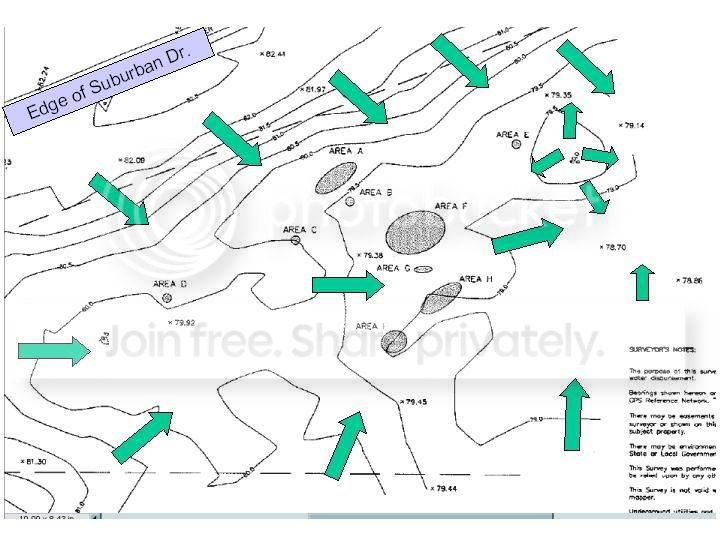
Rough view of how water would drain into and away from the disposal site based on the elevations in the topographical survey (for those not familiar w/ reading them).




That still implies flowing water. I need an explanation of why the water would be moving with force. We are not even talking about smooth ground where things can slide and roll from water movement. That area has a high-relief surface with lots of tangles, roots, root masses and living foliage. All of that stuff will hold small objects (unless they are bouyant) in place even with some water movement.
This water accumulates from rain. Water "seeks its own level" and you end up with something like a big puddle. There is stays, and it begins to recede by soaking into the ground and by evaporation. But those processes don't involve water flowing laterally across the land; it's a gradual shrinkage of standing water.
IMO, the patterned scattering of bones suggests wholesale movement of body parts (prior to full skeletonization) by agents (animals and/or humans) - not natural forces.
This is a very nice job, BJB. I've been reading topos since I was in grade school (my father was a geography professor) so I don't think twice about interpreting them, and tend to forget that other people may have more of a struggle.Rough view of how water would drain into and away from the disposal site based on the elevations in the topographical survey (for those not familiar w/ reading them).

It would be good if we could determine the extent of the "path" into the underbrush beyond the discovery spot. This possibly could have provided a canal of sorts to effect the distribution you propose.
Another area of interest you point out is the question of just how much water was actually at the site and when. I've been thinking about this for a while, and keep letting it slide to the back of my mind. Discussions keep cropping up about when there was water, how much water there was, and where the water level was in relation to the remains.
Bond - Awesome work!! Are you saying (by using the term "transport") that an animal moved her torso to a different area??? <shudder>
This is a very nice job, BJB. I've been reading topos since I was in grade school (my father was a geography professor) so I don't think twice about interpreting them, and tend to forget that other people may have more of a struggle.

I find your hypothesis to be very plausible. My main concern is the effects of undergrowth on transfer. I feel the same way that Hot Dogs does, that the density of the growth in the area would be a major obstacle.
It would be good if we could determine the extent of the "path" into the underbrush beyond the discovery spot. This possibly could have provided a canal of sorts to effect the distribution you propose. I haven't spent as much time reviewing the site photos as I probably should have. There may be additional info there that I've overlooked..
 ) I also remember wading in what appeared to be still backwater as a kid only to find a deceivingly strong current under the surface...full disclosure and all
 When watching the first TV reports of the discovery I immediately noticed the total station that had been set up (because I've spent so many hours behind one). We now know that they have detailed elevation records of each piece of evidence as located.
What caught my attention is the close proximity of a storm water retention and sedimentation basin on the adjacent construction site. Google Earth scales that sed. basin at approx. 700 ft. from the remains.
Whenever I performed these inspections I always took photos. Lots of photos. It has occurred to me that if the contractor on that project did the same thing then features in the photos could be surveyed to get a quite accurate record of water levels in that area.
Potentially it could be possible to generate a fairly exact mapping of the water levels at the remains. This would address many puzzling issues.
I wonder if LE has done this already?
Unfortunately, IIRC, the Google sat image we're referencing is quite dated...circa 2006, IIRC, and I don't trust my memory all that well.

The skull would not have been white. Bones left out in the sun in the desert end up sort of bleached white, but not bones in a florida swamp.
Click here to see a muddy skeleton(kinda graphic, btw), this will give you a better idea of the color of bones you are looking for in these crime scene photos.
I had never heard this before either but on NG tonight they stated that the shoes were in a paper bag. I want to know if it is true or not.

Shoes were collected around the time of first arrest. There were threads on most items like knives and KC's trousers etc. I suspect there is a shoe thread?Thank you, BuffaloPI. It is graphic, but it actually helped settle things in my mind. The outdoors above ground skeleton is BROWN before bleaching to white. It's not black. Not even dark grey. It's brown.
:blowkiss: Nancy not only said the two pair of shoes were in a paper bag, she elaborated that they were "sealed in a paper bag." We might as well give her credit for her whole bombshell!
I wanna know if it's true, too.
As you do, I tend to lean toward the idea of animal transport. But I'm very much on the fence about it. Perhaps (probably) both mechanisms are in play. At any rate it is largely an exercise in morbid curiosity. The other alternative is human agent transport after the original disposal, and I think that is obviously not a plausible scenario.Any "path" may also be used by an animal(s) transporting parts.
FWIW, I believe that Kronk told OCSO that in August the water edge allowed a person to be only 4-10 feet away from the "round white something". If you want to assume that was the skull, it might be usable info to plot out the water situation.
There are also storm drains alongside Suburban on the remains side.
.
Any "path" may also be used by an animal(s) transporting parts.
FWIW, I believe that Kronk told OCSO that in August the water edge allowed a person to be only 4-10 feet away from the "round white something". If you want to assume that was the skull, it might be usable info to plot out the water situation.
There are also storm drains alongside Suburban on the remains side.
.
Rats. You would have to remind me about the Google Earth age issue. The concept remains valid though. I'll bet that there are a lot of photos out there that could provide helpful referents....in addition to my pre-disposition to water transport (see admission to INTN above
JWG collected temperature data (in 5 minute increments) from the local area via the weather underground website in a very detailed ADD calculation exercise. The site also provides rainfall/date if one wanted to dive in and collect the data for consideration.
*respectfully snipped for space*
Excellent observation! They now have essentially everything they need to reconstruct the water history @ the crime scene, save for the overwhelming volume it saw mid-August from Fay...that would have certainly had a more dynamic impact than a simple model might handle.
*also respectfully snipped for space*
Wouldn't that be a nice plum to pull outta the pie!
...now...I should go look-up that pic I promised to look-up earlier.
My apologies to anyone that feels I may have snuffed out the "Crime Scene Photo's" topic drilling into this topography stuff. I'll grab that pic to bring this puppy back around :bang:
The effects of the ebb and flow of water levels, though interesting to follow, are likely to be overriden by the effects of hurricaine (thingy). That was strong enough to move complete latino reporters several feet in an instant. high winds, localized twisters etc could lift and transport plastic, cardboard and cloth, if not whole bags of bodies over the top of terrain and underbrush?Rats. You would have to remind me about the Google Earth age issue. The concept remains valid though. I'll bet that there are a lot of photos out there that could provide helpful referents.
I don't think recorded rainfall totals would be sufficient or very accurate. There are too many other variables. Local topo containment, engineered drainage, soil perc., etc. come to mind. It would require records of the immediately local drainage plain.
I certainly agree about subsurface currents. Active floodwater recession can do a good job of imitating undertows and riptides at the beach. I almost lost one of my crew on one project when... but that's another story. This does lend even more weight to your suggestions.
I think this discussion is very on-topic. It would be great if we could harness the eagle eyes of our fellow sleuths for poring over these thousands of pics for site conditions. They're probably tired of kitties by now, anyway.
Rats. You would have to remind me about the Google Earth age issue. The concept remains valid though. I'll bet that there are a lot of photos out there that could provide helpful referents.
I don't think recorded rainfall totals would be sufficient or very accurate. There are too many other variables. Local topo containment, engineered drainage, soil perc., etc. come to mind. It would require records of the immediately local drainage plain.
I certainly agree about subsurface currents. Active floodwater recession can do a good job of imitating undertows and riptides at the beach. I almost lost one of my crew on one project when... but that's another story. This does lend even more weight to your suggestions.
I think this discussion is very on-topic. It would be great if we could harness the eagle eyes of our fellow sleuths for poring over these thousands of pics for site conditions. They're probably tired of kitties by now, anyway.
*snipped*Bring back the kitties!
This used to be a crime scene picture thread?*snipped*
OK...that's two ref's...guess I missed somethin' 'bout "kitties". :waitasec:

*snipped*
OK...that's two ref's...guess I missed somethin' 'bout "kitties". :waitasec:
Sadly that looks like it confirms poor kiity's last moments.Kitty better watch out for alligator.
.
Seriously why not continue the topography/water levels in a new thread?