

NJ NJ, Rahway, WhtFem Doe Network 1211UFNJ, 18-22, March 1887

HmmMysterious

Well-Known Member
Joined
Dec 30, 2021
Messages
2,161
Reaction score
14,041
  • #1
1211UFNJ

Oldest case on the Doe Network. There has been talk of identifying this Jane Doe through DNA and the family tree method AKA genetic genealogy.

Rahway Jane Doe.jpg


Date of discovery: March 25, 1887
Location of discovery: Rahway, Union County, New Jersey
Estimated date of death: Either March 24 or March 25, 1887
State of remains: Recognizable face
Cause of death: Homicide by blunt and sharp force

Physical Description​

Estimated age: 18-22 years old
Race: White
Sex: Female
Height: 5'2
Weight: Unknown
Hair color: Brown (Alleged)
Eye color: Blue (Alleged)

Identifinders​

DNA: Unknown
Fingerprints: Unknown
Dentals: Unknown

Clothing and Personal Items​

Clothing: Dark green cashmere dress trimmed with green feathers, yellow kid gloves, foreign good shoes, bonnet, black straw hat with red velvet trimmings, black dotted veil, and a fur cape.
Jewelry: Jewelry of unknown description (possibly rings)
Additional personal items: Small satchel, small basket of eggs, and an umbrella

Circumstances of Discovery​

Four brothers traveling to work at the felt mills by Bloodgood's Pond in Clark, New Jersey found the decedent's body lying off Central Avenue near Jefferson Avenue several hundred feet from the Central Avenue Bridge over the Rahway Bridge. Her body lay at the side of the road in a pool of blood that had frozen due to cold weather. Her throat had been cut twice from ear to ear and the right side of her face was extensively bruised from a severe beating. Her torn cape was found next to her and her body was surrounded by large footprints.

An officer found a small black bag near the river that contained small articles, some that might've belonged to a man. The young woman's basket had 9 eggs of which 6 were broken. Across the fence, a pen knife with a turquoise handle was found.

The young woman was embalmed and photographed dressed in the clothes she was found in. Rahway Police allegedly still have these photos. Rahway Jane Doe's murder was the subject of national headlines and many viewed her body, but she (and her killer) still remains unidentified.

She is buried in Rahway's Cemetery.

Sources:​

Rahway murder of 1887 - Wikipedia
The Rahway Jane Doe from March 25, 1887 (New Jersey)

Investigating Agency​

Agency Name: Rahway Police Department
Agency Contact Person: N/A
Agency Phone Number: 732-827-2200
Agency E-Mail: N/A
Agency Case Number: Unknown
 

Attachments

  • Rahway Jane Doe.jpg
    Rahway Jane Doe.jpg
    44.3 KB · Views: 15
  • #2
 
Last edited:
  • #3
 
Last edited:
  • #4
@MadMcGoo I was about to say I wasn't sure this girl was positively Mary Maltby until I saw your second post. Thank you for taking the time to find these articles :)
 
  • #5
@MadMcGoo I was about to say I wasn't sure this girl was positively Mary Maltby until I saw your second post. Thank you for taking the time to find these articles :)
I tried posting everything in the same post to avoid confusion, but it wouldn't let me attach more than 10 images! :DThese have a few more details about her murder. I've been trying to find a photo of Mary since she resembled the woman, but I've had no luck so far.

 
  • #6
Says here that a postmortem photograph is available in the March 30, 1887 edition of New York World.
 
  • #7
Researching, Rahway today's a suburb of NYC, basically. It has a history as an artisinal city and in the 1880s was diversifying in terms of manufacturing as it had been a leader in carriage production, and carriages werre in decline. Rahway PD (and pretty sure Rahway as such itself?) was created in 1858, Nobody recognized this woman, so I'm guessing she wasn't local. Rahway was along established rail lines and one could reach Rahway from NYC in just over a half an hour even back then, per one source. Per another source, someone at the rail station had said they saw a young woman heading off from there towards (I think?) Elm Street. I saw another source noting a peculiar man noted at the rail station. I'm wondering if she was perhaps coming into the area looking for or interviewing for some position. I know she had some feathers on her clothing, but if it was minimal (and it says it was "trim"), I'm wondering if she might have been trying to acquire a job as a governess, perhaps she is from abroad and she is going to be teaching a language. The fur cape in that climate at that time probably wouldn't be considered so much extravagent as fashionably functional. But I think if she already had an interview arranged, the family receiving her would have put two and two together and she'd be identified now. She's about average height for her era. She's also of marrying age for her era, and I'm seeing there were a lot of German, Irish, Italian and British immigrants to NJ at the time and some were bringing brides in from abroad, this wasn't just a Western regional phenomenon in this period. She's pretty, "sturdily built" per one source, brown hair & blue eyes. She had the foreign made shoes and generally European clothing, so I think she emigrated. Don't think she came over with parents because she'd likely (?) have been identified.

Where was she going to stay? As a young woman traveler in this period, they might be asking for letters of reference as young unescorted women travelers were looked upon with suspicion. She might have had a letter of reference so she could secure lodging. Maybe that's why the bloody hand dug into her pocket, maybe the writer of that letter was the murderer, who drew her to the area in the first place. Researching further, I'm seeing that men in the British Empire fleeing romantic partners came over to the US in big numbers, some even leaving women with actual wedding dates arranged. This is a documented "thing" in the 1870s onward through the turn of the century. What if this is an abandoned fiancee or even daughter of the murderer, someone left behind in a European country? Maybe a fiancee who has some dirt on the killer, or some hold, perhaps something financial. She's nicely dressed, maybe she has given him money, maybe quite a lot of money, something she acquired through inheritance, expecting to finally be brought out there to marry. The NJ laws were changing right in this timeframe regarding women's property rights. If he's been stringing her along the whole time and in fact was spending all her money while he in reality has married someone else, the victim's presence might have become enough of a "thorn in his side" to bring her out and kill her.

Horrible regardless of the motives or anything else. RIP.
 
Last edited:
  • #8
Looking at 1887 news article right now for a NY newspaper, April 23 1887 Rockland County Journal, when they were actively conducting this investigation, in the months and I would take it years that followed, there were dozens upon dozens of women suspected to have been the victim. I'm looking at the list right now. A lot of servants/domestics, but also sisters, daughters, granddaughters, acquaintances, factory girl, someone discharged from her hotel position... Danish, Scottish, German, Hungarian, Polish, Swedish... One name is jumping out, though Mina Noorz. Native of Saxony, landed from the Westernland January 14.

Seeing that surname "Noorz" on there... jmo that could legitimately be a lead because the victim's valise (per one source) had a "gaudy blue and red dotted handkerchief" embroidered with initials and name resembling K.M. Noorz. They're not sure if it's Noorz or Noory.

That Mina Noorz on the list in light of the embroidering on the handkerchief is really interesting. I don't see Mina Noors coming up in any other searches, though. I'm lucky I went back to check that spelling in that old article because at first I thought it was "Noors," but it is indeed "Noorz" with a Z.

1770633222549.webp


Also, seeing an Apr 5 1887 Sun article discussing the surname Noorz and mentioning part of the woman's wardrobe was Danish
1770633748244.webp
 
Last edited:
  • #9
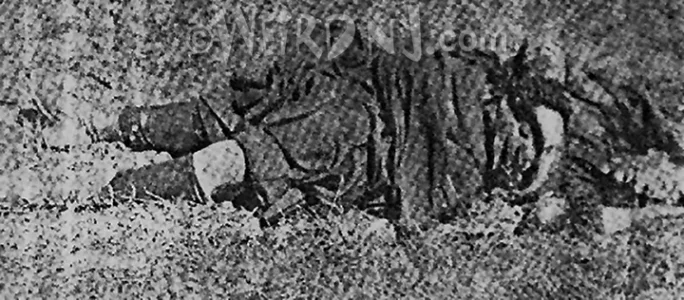
Weird N.J. has an article about this woman and has what apears to be a photo of the body.
They did not lost their sources so I don't know where it came from.
Murdered-rahway-Body.webp
 
  • #10
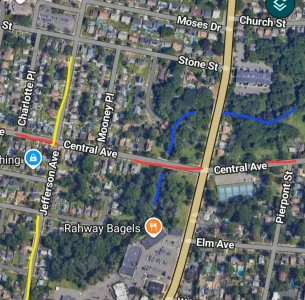
Correct me if I'm wrong, but I believe this is the area she was found. Yellow is Jefferson Ave, red is Central ave, and blue is a river with a bridge where it crosses the road.
Her body was found off of Central, near Jefferson and several hundred feet from a bridge.
Rahway.webp
 
Last edited:
  • #11
Doing some more research. That Westernland, I was thinking that was some region of Saxony, but I think it's a ship, an immigrant ship. And it's associated (at least tangentially) with-- Jack the Ripper. The SS Westernland. (How weird is that??) I'm reading an article by someone trying to use records from Westernland to determine if George Chapman could have been the Ripper (writer building a pretty involved scenario based on passage dates). Westernland made her maiden voyage from Antwerp to NY in 1883.

I found a Mina Noor (no "z" or "s") in the Statue of Liberty/Ellis Island Foundation passenger records, from Netherlands 15yo at NY 1880 arrival. Hmm. That sounds like the same person, and that would make her 22yo in 1887, but it's different spelling. My guess is the "Noorz" for Mina that was in the newspaper might actually be correct; the reporter saw what was probably an actual passenger list in cursive, which I know exists, but I didn't see it. And that reporter's viewing would have been much closer to the time of the actual event than the record I saw, and the reporter probably saw the original record.

I'm wondering if being from Saxony, Mina was a Sorb. Sorbs are indigenous West Slavic peoples inhabiting German Saxony and Brandenburg. Why do I think she may be a Sorb? Apparently, Sorbs can be quite fair, often with blue eyes. Sorbs have their own flag, and have been using these colors for quite some time. Saxony blue (some might consider it "gaudy," it can be very striking) and a very red... red. And I was looking up surnames for Sorbs, I saw "Starz." And I thought it was fairly similar in certain respects to Noorz. So the victim had that "gaudy" kerchief, described with red and blue dots. I mean, how's red and blue dots "gaudy"? Then it occurred to me, maybe it's the striking Saxon blue that someone felt was "gaudy" because it's certainly very noticeable. If she's a Saxon, she may be a Sorb, and these are colors associated over time with the Sorbs (and yellow, too, and she had the yellow gloves). Maybe we're not talking Union Jack blue, but Saxony blue. Here are the colors I'm seeing:
1770723053830.webp

With that said, though, I also wondered if she might have been for a time in the UK, it was customary for working class women to wear these bright "gaudy" kerchiefs in the north of England in place of bonnets at this time, from what I read. But based on the victim's otherwise smart outfit, I tend towards the Saxony colors. The "gaudy" kerchief sounds at odds with her horseshoe brooch, very stylish for the Victorian era, and fur cape and feather trim.

Also, from what I saw in one article, they ascertained that she had to have been brought to this area by someone fairly local because it would be too remote for someone NOT from the area to find alone. The article also noted she'd run from her attacker, they could tell by the markings on the ground she ran some distance from the attacker, who'd already torn off her cape, but he caught up with her.
Correct me if I'm wrong, but I believe this is the area she was found. Yellow is Jefferson Ave, red is Central ave, and blue is a river with a bridge where it crosses the road.
Her body was found off of Central, near Jefferson and several hundred feet from a bridge.
View attachment 643190
The article I saw did mention her proximity to Jefferson. I'm going to wade back in there at some point, and if I can retrieve it again, I'll paste in the info with the link.
 
Last edited:
  • #12
So found that link here:

And sifted through some more articles. One article says she moved from Westfield Ave to Jefferson and then to Central. At some point on/near Central (think on), this woman's footprints turned to strides. Putting all the articles together, it seems like attacker tore her cape off initially. I think one article says on Jefferson, but another seems to think it happened on Central. She definitely was walking FROM Jefferson, that much is clear. So she (depending on article and my subjective understanding of them) either ran or was dragged from that point of first contact (looks like ran to me, and the distance run is around fifty feet). He pursues her, he's in the middle of the road, she's near the rail fence, he moves in towards her and he knocks her to the ground and delivers a blow to the head with his bootheel. (They found matching nail marks in the side of this poor woman's face.) And then I think they're saying he cut the woman's throat. Here's the map I was using as I tried to navigate on the routes:
1770793157545.webp

Red dot's the rail station. I mean if she's coming from Jefferson (and especially from Westfield to Jefferson) onto Central, she's going towards (?) the station, not away from it. And I just viewed yet another article, and this seems to be confirmed. They're speculating this woman was going TO the train station, not from it.

So other points of interest in these articles. This woman evidently wore no earrings, I can see why, they did piercings back then, and I have no doubt there were plenty of infections as a result. She had three rings, one with a cluster of amethysts. That's a February birthstone, and she's got that horseshoe brooch, maybe she's superstitious. In terms of the area, a girl named Phoebe Paulin evidently met the same fate in roughly the same area as the unknown woman a few years prior (this evidently was at Eagle Rock outside Newark, murderer never caught). Seeing name on handkerchief K.M. Noorse, Noorz, etc. White collar of the day, Norfolk brand no16, man's detachable I'd guess, left at CS with initial "N" sewn in black/gold,

Woman's valise had had a New York & New Jersey Express Co. label, 60 Cortlandt St. NY. Am researching this now and this appears like it could be of interest because they transport freight via rivers/railroad. It's like part of a freight network. Am seeing that the New Jersey Express was servicing Rahway as early as 1860. They delivered valuables, they're like precursor courier services. Jewelry, bank notes, cash... Researching on why a woman in this timeframe would have such a label on a valise, they're saying it implies this woman is in business, transporting valuables that need to get where they're going safely. So... she's not local, she's dressed pretty well, she has a nice and professional valise. Maybe she took the train in, but had to rely on a hired coach/carriage from that point on. Whatever about the carriage industry in decline in the 1880s, one would kind of have no choice but rely on a coach/carriage/"hack" for transport from the station based on what I read.
1770796193762.webp

So the killer's knife handle, they found the hulls of oats, so they think he was connected with farming or a stable. Based on the label on the victim's valise, my guess now is a stable. And evidently, these express companies kept lists of their active stables for use, and there were loads of them around at the time. Maker of the killer's knife was Elbon/stamped "maker's mark." I don't see an Elbon knife company, Elbon can be all kinds of things, a first name, last name, location name... Watch company name...

They're estimating murder occurred between 9 and midnight, she was out walking herself at that time? Or did someone force her out of a carriage? I know they can see all these footprints, but surely there had to be carriage prints as well? Were the marks present but not revealing? Or were there no such marks at the site?

That collar left at the CS, the killer had a men's detachable collar of the era and the reason it may have had the initial ("N") is because it would be frequently laundered by a professional laundress, and that initial and the sizing mark (no16?) would serve to make sure he received back the right collar. A lot of people of modest means (maybe someone working at stable/with horses?) used these collars so as to avoid frequent washings of actual shirts. So wondering if this man spent a lot of time in boarding houses, where such laundry mix-ups can evidently be an issue.

What I wish I could know was what the soles of the victim's shoes were like, they were pebble goat, which is I guess leather, functional fashion for the day. Was this woman out trotting around all over the place on a daily basis? Because those shoes would reflect that. As it is, I really wonder if that woman was actually walking at all. She's got a silk parasol with her, I mean why, if she's out walking at 9, 10, 11pm at night, which is when they're projecting the murder occurred?? And that's the type of item, a parasol, someone who's a little more comfortable financially would have.

That parasol and the label on the valise make me think this woman had money/valuables, the killer knew it, the killer took what was of real value, and probably high value, and nobody knew to miss it. Just because he left articles behind doesn't mean he didn't take anything. And since Newark was a pretty important place on these express routes, my guess is that the Phoebe Paulin case might really be related because the killer might have some association with one of these express services, perhaps as a short-haul coach driver. I don't know enough about the structure of the transportation system of that period to make a better guess, unfortunately.
 

Guardians Monthly Goal

Members online

Online statistics

Members online
179
Guests online
3,164
Total visitors
3,343

Forum statistics

Threads
641,336
Messages
18,771,254
Members
244,782
Latest member
tmacdonald
Back
Top