• #361
  • The leaders of the UK, France, Germany, Canada and Italy expressed “grave concern” after Israel launched a ground invasion of Lebanon. They called for meaningful engagement by Israeli and Lebanese representatives to negotiate a sustainable political solution. A significant Israeli ground offensive would have devastating humanitarian consequences, they warned in a joint statement, adding that it could lead to a protracted conflict with “devastating humanitarian consequences”.
 
  • #362
Middle East crude benchmarks soared to all-time highs, becoming the most expensive oil in the world, according to the latest data compiled by the Reuters news agency.

Cash Dubai was assessed at a record $153.25 per barrel on Monday for May-loading cargoes, surpassing Brent futures’ LCOc1 all-time high of $147.50 in 2008, while Oman crude futures hit a record of $147.79 a barrel.

 
  • #363
Thailand’s foreign minister said that Bangkok is discussing with Moscow the possibility of purchasing crude oil, amid tight supply due to the ongoing US-Israel war on Iran.

 
  • #364
"In a State Department-wide cable today, all U.S. diplomats were directed to tell foreign governments, “at the highest appropriate level,” that they “must move expeditiously to diminish the capabilities of Iran” because of an “elevated risk of attack” on their own countries."

 
  • #365
  • #366
Article from 17 March 2026 - Swedish journalist in Beirut:

Ahmed, 13: “I am relieved when I realize I am not dead”​

BEIRUT. They are people who lack.Drinking water, garbage collection and right now also schooling and employment.But most of all, the residents of Shatila lack security.
Translated into English with Google Translate:
 
  • #367
"Iran and Iraq are holding talks about allowing transit of Iraq’s oil tankers through the strait of Hormuz, Iraq’s oil minister Hayan Abdul-Ghani was quoted by the country’s state-run Iraqi news agency as having said.

“There is communication with Iran regarding allowing the passage of some Iraqi oil tankers,” the oil minister said.

The news agency said Iraq’s oil production has been reduced to 1.2m barrels daily, down from 4.3m barrels daily prior to the war. Iraq is also reported to be trying to restart ‌exports through ⁠the Kirkuk-Ceyhan pipeline to Turkey."

 
  • #368
"Israel’s health ministry has said 3,530 people have been taken to hospital since the start of the US-Israeli war on Iran on 28 February, with 86 currently hospitalised, eight of whom are reported to be in a serious condition.

Over the past day, 70 injured people were admitted to hospitals, including four in moderate condition, the ministry said."


  • #369
"If you’ve ever wondered what three billion dollars buys in bombs and missiles, wonder no more. In the first hundred hours of Operation Epic Fury, the United States flung munitions costing about that much at Iran, striking nearly two thousand targets. This won the U.S. and Israel nearly “complete control” of Iran’s airspace, allowing them to unleash “death and destruction from the sky all day long,” Pete Hegseth, the Secretary of Defense, crowed. “We are punching them while they’re down.”

The United States has been freaking out about Iran since 1979. That was the year revolutionaries overthrew the U.S.-backed monarch, established an Islamic republic, and took dozens of people hostage inside the U.S. Embassy.
...

Although enmity between Washington and Tehran sprang up in 1979, the seeds were planted in the nineteen-fifties. That was when Iran’s Prime Minister, Mohammad Mosaddegh, made headlines by nationalizing Iran’s oil, reclaiming profits that had flowed overwhelmingly to Britain. In 1952, Time named Mosaddegh its Man of the Year.
...

Having helped Israel kill Iran’s Supreme Leader, Trump has only the vaguest notion of what should come next. Perhaps the Islamic Revolutionary Guard Corps should hand over its weapons and “surrender to the people,” or perhaps the Corps and the people should make a revolution together. Alternatively, the defanged Islamic Republic could remain intact and Trump could choose a leader from its ranks. He mentioned “three very good choices,” though it now seems that these candidates may have been killed. “Everybody that seems to want to be a leader, they end up dead,” Trump mused, with unconcealed relish. Iran’s government, meanwhile, has made its own choice: Mojtaba Khamenei, the dead Ayatollah’s son, who was himself reportedly wounded by the air strikes. Trump called this choice “unacceptable” and warned the new Supreme Leader that he would not last long without Washington’s approval. Which is to say, Trump has no plan but reserves the right to reject everyone else’s.
...

Past Presidents, for all their destructive crusades and covert actions, stopped short of invading Iran out of regard for the global chessboard. They worried about Iran blocking oil flows, attacking allies, or imploding and sending refugees streaming through the region. Trump has unburdened himself of such concerns. He’s not playing chess and doesn’t ultimately mind if pieces are captured.

After Trump seized Maduro, Defense Secretary Hegseth summed up Maduro’s story: “He effed around and he found out.” In a larger sense, though, it’s Trump who effs around. His life has been an unbroken string of outrageous “what if?” experiments. What if I stiff this contractor? Pocket this cash? Reject this election?

Or bomb this country? Trump effed around, and we’re all finding out. He has shrugged off the imperial mantle, the force that propelled his predecessors into ruinous meddling. From another President, that could have been welcome, but from a wrathful tyrant like Trump it’s terrifying. Because the quest for global control was never just a compulsion. It was also, in hindsight, a constraint. ♦"

https://www.newyorker.com/magazine/2026/03/23/whats-behind-trumps-new-world-disorder


 
  • #370
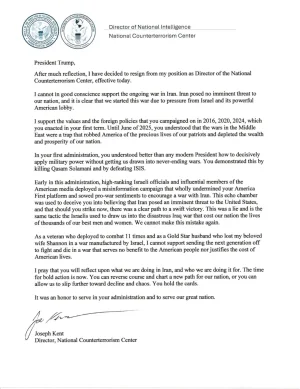
@joekent16jan19


After much reflection, I have decided to resign from my position as Director of the National Counterterrorism Center, effective today.I cannot in good conscience support the ongoing war in Iran.
Iran posed no imminent threat to our nation.
It has been an honor serving under @POTUS and @DNIGabbard and leading the professionals at NCTC.
May God bless America.


Attachments

  • IMG_1091.webp
    IMG_1091.webp
    149.3 KB · Views: 9
Last edited:
  • #371
From 16 March 2026:
Beirut, March 16 (QNA) - The death toll from the Israeli aggression on Lebanon since March 2, has risen to 886 dead, in addition to 2,141 wounded.

The Disaster Risk Management Unit at the Lebanese Prime Minister's Office issued the daily toll, recording 36 deaths and 36 injuries.
 
  • #372

War is ugly, but the war strategy is working​

None of this minimises the human costs. More than 1,400 civilians have been killed in Iran, a moral burden the US and Israel will carry. Oil price spikes are hurting every economy on Earth. At least 11 US service members have been killed. I live with these sirens every day, as does everyone across the Gulf. The costs are real, they are serious, and any accounting that ignores them is dishonest.

But the critics are making a different error: They are treating the costs of action as if the costs of inaction were zero. They were not. They were measured in the slow accretion of a threat that, left unchecked, would have produced exactly the crisis everyone claims to fear: a nuclear-armed Iran capable of closing the Strait of Hormuz at will, surrounded by proxy forces that could hold the entire region hostage indefinitely.

Seventeen days in, Iran’s supreme leader is dead, his successor is reportedly wounded and every principal instrument of Iranian power projection – missiles, nuclear infrastructure, air defences, the navy, proxy command networks – has been degraded beyond near-term recovery. The campaign’s execution has been imperfect, its public communication poor and its post-conflict planning incomplete. War is never clean. But the strategy – the actual strategy, measured in degraded capabilities rather than cable news cycles – is working.
 
  • #373


Sponsored

CBS News

Why the death of Iran's top security official is significant​


Top Iranian security official Ali Larijani was killed in overnight strikes, Israel said Tuesday, marking a significant moment for the Islamic Republic in the conflict.

Israeli defense minister Israel Katz said in a statement that Larijani was "eliminated." There was no immediate confirmation out of Iran on his apparent killing.

Larijani, the head of Iran's Supreme National Security Council, was among the most senior leaders of the regime still alive in Iran after top leaders — including Supreme Leader Ali Khamenei — were killed at the start of the war. He was one of the regime's most experienced insiders and deeply trusted by the late Khamenei. He was also among a very small group of people who could manage both the war and the politics around it.
 
  • #374
BBC Verify has been sent images showing the UK Royal Navy Type-45 destroyer HMS Dragon in Gibraltar this morning as it makes its way to Cyprus on the eastern side of the Mediterranean.

HMS Dragon was deployed following a suspected drone attack by the Iran-backed Lebanese group Hezbollah on the Royal Air Force base at Akrotiri in Cyprus on the second day of the US-Israel war with Iran. Two more drones were intercepted the following day.

The UK government says the ship, which is armed with Sea Viper missiles that can intercept aerial threats, will bolster existing defences at Akrotiri.

According to Gibraltar-based photographer David Parody, who took these pictures, the destroyer is expected to take on fuel and supplies while docked at the British overseas territory on the southern tip of Spain.

A side-on view of HMS Dragon in Gibraltar

 
  • #375
  • #376
Asia is the most exposed since it relies heavily on imported fuel, much of it shipped through the now-blocked Strait of Hormuz. The narrow passage offshore from Iran is the main route for shipping a fifth of global trade in crude oil and liquified natural gas.

Governments in the region are scrambling to adjust — tallying oil reserves, conserving energy, competing for supplies and trying to blunt prices. That brings difficult trade-offs: saving power may slow business activity. Prioritizing cooking gas for households can hurt restaurants and other businesses.

"Even relatively modest constraints on energy use can create a drag on industrial activity," said Linh Nguyen, with the consultancy Control Risks. She pointed to Vietnam's energy-intensive export industries and warned that higher fuel costs or conservation measures could quickly raise production costs or slow factory output.

Analysts warn the same hard choices could soon spread beyond Asia to fuel-importing economies in Africa and elsewhere as countries compete for scarce supplies.

"The situation is common across the board," said Putra Adhiguna of the Jakarta-based Energy Shift Institute. "There is no easy decision for the short term."
 
  • #377
"While the war rages in Iran, the situation in neighboring Iraq is deteriorating rapidly. American forces and pro-Iranian militias are attacking each other in an increasing number of places. Iran is also bombarding targets in the country.

The government in Baghdad is trying to keep its relations with both Iran and the US intact. A difficult balancing act. Relations with the US, in particular, are under pressure.
...

The fighting in Iraq began on February 28, the same day that Israel and the US launched their offensive against Iran. In a—presumably American—rocket attack on a base of the pro-Iranian militia Kata'ib Hezbollah, south of Baghdad, at least two people were killed. The militia quickly began retaliatory attacks.

In early March, northern Iraq became involved when Iran attacked a Kurdish militia . The Kurds had reportedly agreed with the Americans to cross the border to destabilize Iran. Since then, Kurdish targets have been constantly bombarded. They also attacked the American consulate in Erbil.
...

"The ethnic, religious, and political groups in Iraq are so intertwined that the Americans are starting to claim victims among people who have nothing to do with Iran. Those people are going to turn against the Americans."

 
  • #378
  • #379
What do we call a war that includes these countries: United States, Canada, Europe, Britain, China, Australia, Japan and South Korea?

Why allies aren't leaping to Trump's aid in Strait of Hormuz

"U.S. President Donald Trump is struggling to persuade other nations to help protect commercial shipping through the Strait of Hormuz — a development that analysts say is partly the result of treating allies with contempt since returning to the White House last year.
...

Trump specifically said NATO countries should be helping, as well as China, Australia, Japan and South Korea. He called on countries to "get involved quickly and with great enthusiasm," and while he claimed "a couple" were on board, he did not name them.
"There are some countries that greatly disappointed me," he said during an event at the White House on Monday afternoon. "What does surprise me is that they're not eager to help."
...

"Iran is not going to agree to a ceasefire as long as they control the Strait of Hormuz," he said.
...

"The U.S. and Israel have launched a war of choice by attacking Iran. The aftermath of that does not seem to have been particularly well thought through."
...

"The Trump White House has continuously insulted and alienated our allies, including with indiscriminate tariffs," Beyer said in a post on X. "Now, they want those same allies to bail them out of an energy crisis of their own making. A completely self-inflicted failure."

 
  • #380

Iran may not ‘stop fighting’ even as Trump says U.S. could leave Iran soon: Fmr. CIA analyst:​


Guardians Monthly Goal

Members online

Online statistics

Members online
111
Guests online
1,283
Total visitors
1,394

Forum statistics

Threads
646,626
Messages
18,863,280
Members
246,083
Latest member
MelissaRabbit
Top