





You are using an out of date browser. It may not display this or other websites correctly.
You should upgrade or use an alternative browser.
You should upgrade or use an alternative browser.
UT - Kouri Richins, 33, Author, wife, mom, charged in husband’s unexpected death last year, May 2023 #3
- Thread starter gitana1
- Start date
- Featured
-
 UK UK - Janice Weston, 36, Murdered, A1 Layby, Brampton, Cambs. / London, 10 September 1983
- Latest: Professor Moriarty
-





- Joined
- Oct 28, 2009
- Messages
- 49,978
- Reaction score
- 417,730
leg stretch break as they figure out how to get the defense expert there remotely to listen to the state's next witness.
good gravy this trial is the most plodding thing I think I have ever watch.
good gravy this trial is the most plodding thing I think I have ever watch.
@NateNewsNow
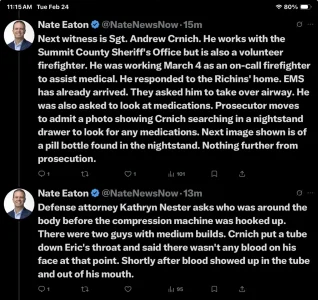
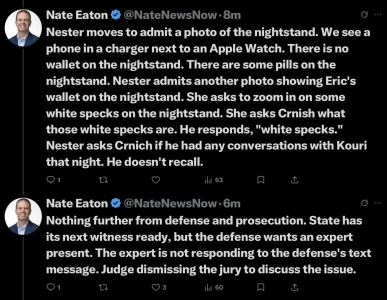
Nester moves to admit a photo of the nightstand. We see a phone in a charger next to an Apple Watch. There is no wallet on the nightstand. There are some pills on the nightstand. Nester admits another photo showing Eric's wallet on the nightstand. She asks to zoom in on some white specks on the nightstand. She asks Crnish what those white specks are. He responds, "white specks." Nester asks Crnich if he had any conversations with Kouri that night. He doesn't recall.
1:07 PM · Feb 24, 2026
Nester moves to admit a photo of the nightstand. We see a phone in a charger next to an Apple Watch. There is no wallet on the nightstand. There are some pills on the nightstand. Nester admits another photo showing Eric's wallet on the nightstand. She asks to zoom in on some white specks on the nightstand. She asks Crnish what those white specks are. He responds, "white specks." Nester asks Crnich if he had any conversations with Kouri that night. He doesn't recall.
1:07 PM · Feb 24, 2026
- Joined
- Oct 28, 2009
- Messages
- 49,978
- Reaction score
- 417,730
defense is whining that they were not given enough notice that ME would be testifying today. Pros. says we told them at 5 yesterday that we would be landing on ME as witness sometime today.
State offers to slip in the morgue clerk Maggie prior to putting on the ME if that satisfies defense. Defense counters with what about Gibson. Pros. doesn't want to put Gibson on first because they anticipate her cross will take too long and then the ME won't get done today.
State offers to slip in the morgue clerk Maggie prior to putting on the ME if that satisfies defense. Defense counters with what about Gibson. Pros. doesn't want to put Gibson on first because they anticipate her cross will take too long and then the ME won't get done today.
@NateNewsNow
Nothing further from defense and prosecution. State has its next witness ready, but the defense wants an expert present. The expert is not responding to the defense's text message. Judge dismissing the jury to discuss the issue.
1:09 PM · Feb 24, 2026
Nothing further from defense and prosecution. State has its next witness ready, but the defense wants an expert present. The expert is not responding to the defense's text message. Judge dismissing the jury to discuss the issue.
1:09 PM · Feb 24, 2026



- Joined
- Jan 15, 2021
- Messages
- 212
- Reaction score
- 1,602
In the bodycam shown yesterday she (Kouri) claimed that the 911 operator had told her to pull him off the bed to do compressions.Did not think of this until this witness. ER was at the foot of the bed, on the floor. How did she do that, why did she do that? She said he was lying in the bed when she found him, presumably on his side of the bed. So she pulled him off the bed lengthwise? How????
Witness noted it as odd.
JMO
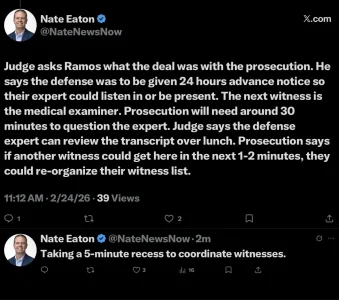
Judge asks Ramos what the deal was with the prosecution. He says the defense was to be given 24 hours advance notice so their expert could listen in or be present. The next witness is the medical examiner. Prosecution will need around 30 minutes to question the expert. Judge says the defense expert can review the transcript over lunch. Prosecution says if another witness could get here in the next 1-2 minutes, they could re-organize their witness list.
@NateNewsNow
Taking a 5-minute recess to coordinate witnesses.
1:13 PM · Feb 24, 2026
@NateNewsNow
Taking a 5-minute recess to coordinate witnesses.
1:13 PM · Feb 24, 2026
Court back in session.


It could just be because of my training, but I would also think it was odd if I saw someone pulled off to the bottom of the bed versus off to the side. The unconscious person is dead weight so it makes the most sense that most people are going to yank them off the side of the bed by their arm versus trying to drag them down off the foot of the bed.In the bodycam shown yesterday she (Kouri) claimed that the 911 operator had told her to pull him off the bed to do compressions.
@brian_schnee
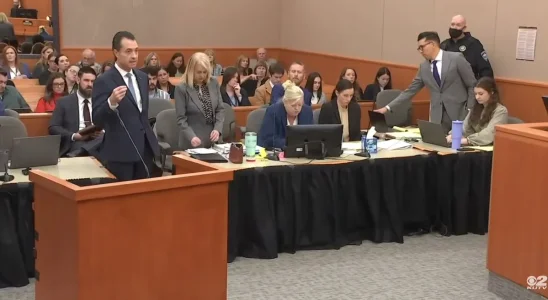
I'll be in the media room for a bit until we share a quick live update on @KUTV2News at noon. Also, I'm in the corner of this photo wearing the green shirt. I can assure you I'm not sleeping... BUT, looking down at my phone and laptop (since they cannot be above the railing).
1:19 PM · Feb 24, 2026
I'll be in the media room for a bit until we share a quick live update on @KUTV2News at noon. Also, I'm in the corner of this photo wearing the green shirt. I can assure you I'm not sleeping... BUT, looking down at my phone and laptop (since they cannot be above the railing).
1:19 PM · Feb 24, 2026
@NateNewsNow
Next witness is Maddy Mobley. She works for the Utah Office of Medical Examiner. She worked as a morgue clerk in 2022. Shs explains the process when collecting and transporting a body.
1:28 PM · Feb 24, 2026
Next witness is Maddy Mobley. She works for the Utah Office of Medical Examiner. She worked as a morgue clerk in 2022. Shs explains the process when collecting and transporting a body.
1:28 PM · Feb 24, 2026
@NateNewsNow
Mobley's job was to break the seal on the body bag. If there are belongings in the bag, they go in the freezer with the body. She breaks the seal with scissors. They will write down the seal number on records, record the clothing the decedent is wearing, any medications with the decedent and any identification. Driver's licenses are copied and will stay with the paperwork. Medication bottles are put in a locker as evidence.
1:32 PM · Feb 24, 2026
Mobley's job was to break the seal on the body bag. If there are belongings in the bag, they go in the freezer with the body. She breaks the seal with scissors. They will write down the seal number on records, record the clothing the decedent is wearing, any medications with the decedent and any identification. Driver's licenses are copied and will stay with the paperwork. Medication bottles are put in a locker as evidence.
1:32 PM · Feb 24, 2026
@NateNewsNow
Prosecution has no further questions. Defense attorney Ramos will now ask questions. He asks about the medications in the body bag. He asks if she remembers the medicine names. She says that isn't her job.
Defense moves to admit an exhibit entitled medications found with body. No further questions. Prosecution has nothing more. Mobley is released.
Next witness is Dr. Pamela Uhlmer. She's a retired medical examiner and forensic pathologist. She was working in 2022. She explains the process of when a body is transferred from a scene to the office. Clerks document the body intake and put the details in a computer.
Uhlmer performed the autopsy on Eric Richins. It started around 7:30 a.m. She is asked about her medical training.
Uhlmer explains what an autopsy is - an external and internal exam of the body. Identifying features are documented. Scars and injuries are noted. Once all the external items are documented, the doctor does a Y shape incision on the chest. The rib cage is removed and all the organs in the chest are examined. They are then removed and weighed to make sure they are within range of normal weight. An incision is made across the top of the head. The brain is examined, then removed and weighed. "Everything is sliced so we can make sure there is no natural disease on the inside" like a heart attack or stroke.
Blood and other body fluid samples are collected. Eric died during the COVID era, so he was swabbed. Other testing can be performed on a body based on why they think a person may have died.
Prosecution moves to admit the autopsy report. Uhlmer explains that Eric had defibrillator pads on him. There was blood on his face. She explains when someone is given CPR, it's not unusual to have blood seeping out of the lungs and having it come out of the mouth. It's also possible someone could have their mouth injured when a tube is inserted.
There were no external injuries that contributed to Eric's death, Uhlmer says. Eric's ribs were broken, likely from the CPR. Eric had the beginning stages of coronary heart disease. This is a common finding in adult men. There was no indication that he had a blood clot form in his heart to cause a heart attack. There was no damage to the heart muscle.
Since Eric had no return of circulation during CPR, the majority of the fluid and foam was from the drug overdose. CPR could still contribute to it, Uhler explains. There were little white nodules on the surface of his lungs. "His work employment history he was a stone mason so all that dust that's created when you're cutting bricks or blocks if you're not wearing a respirator or mask," she says. When asks if this contributed to his death, Uhlmer says she doesn't believe so. It was significant and there was no scar tissue in his lungs.
Eric had 700 ml of pink fluid and food particles in his digestive system. Part of it was detained for testing. Eric's kidneys, bladder and genitals looked fine.
Nothing abnormal about the muscular, skeletal or endocrine system, Uhlmer says. Samples were sent to the health department. Uhlmer says it would be helpful to look at her report. The prosecutor retrieves it.
Uhlmer lists several tests that were performed. Eric did test positive for COVID, but had no evidence of pneumonia, like someone who is dying from COVID. We are taking lunch break until 1 p.m.
Prosecution has no further questions. Defense attorney Ramos will now ask questions. He asks about the medications in the body bag. He asks if she remembers the medicine names. She says that isn't her job.
Defense moves to admit an exhibit entitled medications found with body. No further questions. Prosecution has nothing more. Mobley is released.
Next witness is Dr. Pamela Uhlmer. She's a retired medical examiner and forensic pathologist. She was working in 2022. She explains the process of when a body is transferred from a scene to the office. Clerks document the body intake and put the details in a computer.
Uhlmer performed the autopsy on Eric Richins. It started around 7:30 a.m. She is asked about her medical training.
Uhlmer explains what an autopsy is - an external and internal exam of the body. Identifying features are documented. Scars and injuries are noted. Once all the external items are documented, the doctor does a Y shape incision on the chest. The rib cage is removed and all the organs in the chest are examined. They are then removed and weighed to make sure they are within range of normal weight. An incision is made across the top of the head. The brain is examined, then removed and weighed. "Everything is sliced so we can make sure there is no natural disease on the inside" like a heart attack or stroke.
Blood and other body fluid samples are collected. Eric died during the COVID era, so he was swabbed. Other testing can be performed on a body based on why they think a person may have died.
Prosecution moves to admit the autopsy report. Uhlmer explains that Eric had defibrillator pads on him. There was blood on his face. She explains when someone is given CPR, it's not unusual to have blood seeping out of the lungs and having it come out of the mouth. It's also possible someone could have their mouth injured when a tube is inserted.
There were no external injuries that contributed to Eric's death, Uhlmer says. Eric's ribs were broken, likely from the CPR. Eric had the beginning stages of coronary heart disease. This is a common finding in adult men. There was no indication that he had a blood clot form in his heart to cause a heart attack. There was no damage to the heart muscle.
Since Eric had no return of circulation during CPR, the majority of the fluid and foam was from the drug overdose. CPR could still contribute to it, Uhler explains. There were little white nodules on the surface of his lungs. "His work employment history he was a stone mason so all that dust that's created when you're cutting bricks or blocks if you're not wearing a respirator or mask," she says. When asks if this contributed to his death, Uhlmer says she doesn't believe so. It was significant and there was no scar tissue in his lungs.
Eric had 700 ml of pink fluid and food particles in his digestive system. Part of it was detained for testing. Eric's kidneys, bladder and genitals looked fine.
Nothing abnormal about the muscular, skeletal or endocrine system, Uhlmer says. Samples were sent to the health department. Uhlmer says it would be helpful to look at her report. The prosecutor retrieves it.
Uhlmer lists several tests that were performed. Eric did test positive for COVID, but had no evidence of pneumonia, like someone who is dying from COVID. We are taking lunch break until 1 p.m.
Last edited:
- Joined
- Oct 28, 2009
- Messages
- 49,978
- Reaction score
- 417,730
ME is being sworn.
forensic pathologist.
forensic pathologist.


- Joined
- Feb 25, 2013
- Messages
- 45,980
- Reaction score
- 477,156
Nate Eaton, reporter for East Idaho News is providing a live trial blog that I found easier to follow and refresh than the tweets/posts on X. (Especially if you can't watch the trial live while at work)!
Kouri Richins, a Utah mother of three boys, is accused of fatally poisoning her husband, Eric Richins, in 2022. She is on trial in Summit County, Utah, on charges of aggravated murder, attempted aggravated murder, insurance fraud and forgery.
Today is the second day of the trial. It is scheduled to begin each day at 8:30 a.m. East Idaho News will be posting live written updates all day. Please excuse typos. You can watch the livestream here. The most recent updates are at the top of this page.
8:27 a.m. We are on the record. Jury is not in the room yet. Members of the media are seated and the public is being escorted in. Judge Richard Mrazik is asking defense attorney Kathryn Nester about the chain of custody issues with a phone. Nester says they need the person who took the phone and the person who did the extraction on the phone.

 www.eastidahonews.com
LIVE UPDATES | Day 2 of Kouri Richins murder trial
Kouri Richins, a Utah mother of three boys, is accused of fatally poisoning her husband, Eric Richins, in 2022. She is on trial in Summit County, Utah, on charges of aggravated murder, attempted aggravated murder, insurance fraud and forgery.
Today is the second day of the trial. It is scheduled to begin each day at 8:30 a.m. East Idaho News will be posting live written updates all day. Please excuse typos. You can watch the livestream here. The most recent updates are at the top of this page.
8:27 a.m. We are on the record. Jury is not in the room yet. Members of the media are seated and the public is being escorted in. Judge Richard Mrazik is asking defense attorney Kathryn Nester about the chain of custody issues with a phone. Nester says they need the person who took the phone and the person who did the extraction on the phone.
LIVE UPDATES | Day 2 of Kouri Richins murder trial - East Idaho News
Kouri Richins, a Utah mother of three boys, is accused of fatally poisoning her husband, Eric Richins, in 2022. She is on trial in Summit County, Utah, on charges of aggravated murder, attempted aggravated murder, insurance fraud and forgery. Today is the second day of the trial. It is scheduled...
www.eastidahonews.com
- Joined
- Oct 28, 2009
- Messages
- 49,978
- Reaction score
- 417,730
darn it. I will be missing key parts of ME's testimony because I have a 1pm estate plan finalization appointment with clients. grrr, hers is the testimony I was waiting for 
Prosecutors portrayed 35-year-old Kouri Richins, a Utah mother and children’s book author, as a money-hungry killer on the first day of a murder trial in her husband’s death.
2/23/2026
Prosecutors say she slipped five times the lethal dose of the synthetic opioid into a cocktail that he drank. She is also accused of trying to poison him a month earlier on Valentine’s Day with a fentanyl-laced sandwich that made him break out in hives and black out, according to court documents.
LIVE UPDATES | Day 1 of Kouri Richins murder trial
WATCH LIVE | Day 1 of Kouri Richins murder trial
Linked earlier todayNate Eaton, reporter for East Idaho News is providing a live trial blog that I found easier to follow and refresh than the tweets/posts on X. (Especially if you can't watch the trial live while at work)!
LIVE UPDATES | Day 2 of Kouri Richins murder trial
Kouri Richins, a Utah mother of three boys, is accused of fatally poisoning her husband, Eric Richins, in 2022. She is on trial in Summit County, Utah, on charges of aggravated murder, attempted aggravated murder, insurance fraud and forgery.
Today is the second day of the trial. It is scheduled to begin each day at 8:30 a.m. East Idaho News will be posting live written updates all day. Please excuse typos. You can watch the livestream here. The most recent updates are at the top of this page.
8:27 a.m. We are on the record. Jury is not in the room yet. Members of the media are seated and the public is being escorted in. Judge Richard Mrazik is asking defense attorney Kathryn Nester about the chain of custody issues with a phone. Nester says they need the person who took the phone and the person who did the extraction on the phone.
LIVE UPDATES | Day 2 of Kouri Richins murder trial - East Idaho News
Kouri Richins, a Utah mother of three boys, is accused of fatally poisoning her husband, Eric Richins, in 2022. She is on trial in Summit County, Utah, on charges of aggravated murder, attempted aggravated murder, insurance fraud and forgery. Today is the second day of the trial. It is scheduled...
Similar threads

- Locked
- Replies
- 997
- Views
- 114K

- Locked
- Replies
- 1,011
- Views
- 123K

Guardians Monthly Goal

Goal Reached! We hit our target of 75 new Guardians!
New stretch goal: 100!
Our goal for the month is 75 new Guardians members to sign up. Have you been thinking about becoming a member?
Click here to find out how!


Online statistics
- Members online
- 264
- Guests online
- 2,685
- Total visitors
- 2,949
Totals may include hidden visitors.
Forum statistics
Community Rules
-
Be CivilTreat all members with respect. No personal attacks, harassment, or inflammatory language.
-
Victim FriendlyAlways show respect for victims and their families. No victim blaming or insensitive speculation.
-
Fact-based SourcingProvide credible sources for claims. Distinguish between verified facts and personal theories.
-
Social Media UseDo not post direct links to personal social media profiles of private individuals.
-
Copyright and PaywallsDo not copy full articles. Summarize and link to the original source instead.
-
Privacy and Personal InformationDo not post personal information such as addresses, phone numbers, or workplaces.
-
Registered Sex-OffendersDo not name or speculate about RSOs unless officially named in connection to a case.
-
Stay On TopicKeep discussions relevant to the case or topic at hand. Avoid off-topic tangents.
-
Accounts, Moderation, and DisputesOne account per person. Contact moderators privately for disputes or concerns.
-
Solicitation and FundraisingNo solicitation, fundraising, or promotion of personal ventures without approval.