

• #41
Some working hypotheses:

Was the perp:

  • A known acquaintance, casual pickup during transit -- like a friend saw her standing at the bus stop?
  • A slightly older contact (work/area), arranged ride -- like someone she met at her apartment building? Painter, etc. ?
  • An opportunistic contact such as choosing to hitchhike rather than wait for the bus?

    Route:
  • In 1980, no saying the bus route was this. Hypothesis, that the perp picked her up where she was waiting at a bus stop for the transfer.

    View attachment 653806

    Vehicle Hypotheses: If indeed a van...

  • Work van (trades/service) – painter, contractor, repair; common in 1980, mobile during daytime
  • Personal/custom “shag” van – owned by younger male, used socially. These might have curtains and tinted windows.
  • Borrowed/shared van – family or business vehicle used by someone else
  • Vehicle type uncertain / misidentified – did anyone actually see it? Could have been a van or another type of vehicle

Thanks for sharing these details. This lines up well with an older post's details

<div class="js-xf-embed" data-url="https://websleuths.com" data-content="post-14935155"></div><script defer src="https://websleuths.com/js/xf/external_embed.js?_v=953e7492"></script>
 
  • #42
Button and garment speculation from online research
  • A cardigan, sweater-jacket, vest, or pocket button
  • Possibly wearing a garment from the late 60s or early 70s,
Used heavily for years, producing the deep wear on button.

This type of clothing commonly worn by male 35–60 years old
• working-class
• practical dresser
• not fashion-conscious
• wearing older clothing until it wore out
• doing physical or outdoor work

May have been purchased from:
-Canadian Tire (outerwear + workwear)
-Small-town menswear shops in Bolton, Orangeville, Brampton
-Catalogue shopping (Sears, Eaton’s, Simpson’s
-Woolco (Brampton, Mississauga, or other nearby suburbs)

Men in rural Ontario often bought clothing from hardware stores, feed stores, general stores, and farm-supply shops, and these stores routinely carried wool cardigans, sweater-jackets, work vests, generic metal buttons, and private-label outerwear. (Archival inventories from the Archives of Ontario, the Wellington County Museum, the Dufferin County Museum, and rural retail studies in the Canadian Historical Review all document this.)

Based on the button, the most likely wearer in 1980:
• A working-class man, 35–60
• Living in or near rural Caledon/Orangeville
• Wearing a well-used cardigan, vest, or sweater-jacket
• Purchased locally in the late 60s or early 70s
• Worn for years, producing the deep scratches
 
  • #43
Thanks for sharing these details. This lines up well with an older post's details

<div class="js-xf-embed" data-url="https://websleuths.com" data-content="post-14935155"></div><script defer src="https://websleuths.com/js/xf/external_embed.js?_v=953e7492"></script>


The details from 2019 post by Snively:

There is a person of interest, but no suspect. The man, 45-years-old at the time Veronica was killed, would not face investigators in the interview room. He died in 2001, and there isn't enough physical evidence to say definitively that he was responsible for snuffing out the life of 18-year-old Veronica, or even to officially label him a suspect. He was 45-years-old, lived in Caledon, and he was working in Mississauga or Toronto. Police said that this man was married and had children. He lived in the Caledon area for about four or five years and was an active hunter. The suspect has died, and unless there's a witness or evidence, it's over.
 
  • #44
The Ouroboros symbol, be it as a circle, or as the infinity symbol (as in this case), exists in many religions and mythologies, as well as among Gnostic orders.
I was looking at the Ouroboros symbol as well. The only issue I see is the snake in the Ouroboros is usually eating its tail, whereas in the one we have doesn't seem quite like that. The meaning of the Ouroboros is curious and somewhat ominous ... representing the circle of life, death, rebirth, unity, infinity and self-reflection. Have to ponder if it came off a garment in a struggle or was left intentionally.
 
  • #45
Button and garment speculation from online research
  • A cardigan, sweater-jacket, vest, or pocket button
  • Possibly wearing a garment from the late 60s or early 70s,
Used heavily for years, producing the deep wear on button.

This type of clothing commonly worn by male 35–60 years old
• working-class
• practical dresser
• not fashion-conscious
• wearing older clothing until it wore out
• doing physical or outdoor work

May have been purchased from:
-Canadian Tire (outerwear + workwear)
-Small-town menswear shops in Bolton, Orangeville, Brampton
-Catalogue shopping (Sears, Eaton’s, Simpson’s
-Woolco (Brampton, Mississauga, or other nearby suburbs)

Men in rural Ontario often bought clothing from hardware stores, feed stores, general stores, and farm-supply shops, and these stores routinely carried wool cardigans, sweater-jackets, work vests, generic metal buttons, and private-label outerwear. (Archival inventories from the Archives of Ontario, the Wellington County Museum, the Dufferin County Museum, and rural retail studies in the Canadian Historical Review all document this.)

Based on the button, the most likely wearer in 1980:
• A working-class man, 35–60
• Living in or near rural Caledon/Orangeville
• Wearing a well-used cardigan, vest, or sweater-jacket
• Purchased locally in the late 60s or early 70s
• Worn for years, producing the deep scratches

I’m doing another deep dive into the button because I showed the images to some people aged 75+ who worked in the film and tv industry in the 70s and they said such buttons were on speciality leather jackets and vests made by a designer, Marc Buchanan from Detroit, Michigan. He founded his first company Gandalf and Company in 1971 was which he rebranded as Pelle Pelle in 1978.

The jackets were sold in small urban speciality stores in Detroit, Chicago, Philadelphia and New York City. Possibly even Toronto.

Hopefully I can source samples. It could lead to a POI who was into fashion, rock and roll.
 
  • #46
  • #47
I originally thought the button was larger which made me think these vest snaps were too small. However, after checking the ruler in the official police image, the evidence button is actually only 17mm like on your vest afterall. Were these vest buttons sewn on or pressed / snapped on?
 
Last edited:
  • #48
The details from 2019 post by Snively:

There is a person of interest, but no suspect. The man, 45-years-old at the time Veronica was killed, would not face investigators in the interview room. He died in 2001, and there isn't enough physical evidence to say definitively that he was responsible for snuffing out the life of 18-year-old Veronica, or even to officially label him a suspect. He was 45-years-old, lived in Caledon, and he was working in Mississauga or Toronto. Police said that this man was married and had children. He lived in the Caledon area for about four or five years and was an active hunter. The suspect has died, and unless there's a witness or evidence, it's over.
Yep, the problem with this Cold Case in that I guess LE hoping for a deathbed confession, or someone who knew more would spill the beans. Kind of late now that so many years have passed IMO. But I understand how family want closure so badly.
 
  • #49
I’m doing another deep dive into the button because I showed the images to some people aged 75+ who worked in the film and tv industry in the 70s and they said such buttons were on speciality leather jackets and vests made by a designer, Marc Buchanan from Detroit, Michigan. He founded his first company Gandalf and Company in 1971 was which he rebranded as Pelle Pelle in 1978.

The jackets were sold in small urban speciality stores in Detroit, Chicago, Philadelphia and New York City. Possibly even Toronto.

Hopefully I can source samples. It could lead to a POI who was into fashion, rock and roll.
Have at it if you like. I scrolled a lot of clothing photos yesterday and came up with nothing. I am still going with the low-income mid-income farm living type painter, factory worker, whatever who wore an old coat. I feel the button is quite worn from rough handling, not fashion. The Caledon creep you mentioned or the painter the police had interviewed and could not tie with enough evidence.

I ran photos of the buttons photos with the measurement tools through 3 AI programs and learned even though the button is from 1980, the forensic/photo scale underneath it is modern and uses millimetres. They all suggested: Based on the ruler shown in the image, the button is approximately 17 millimeters (mm) in diameter. This would be comparable to:

a Canadian dime
slightly larger than a mens shirt button
 
Last edited:
  • #50
Have at it if you like. I scrolled a lot of clothing photos yesterday and came up with nothing. I am still going with the low-income mid-income farm living type painter, factory worker, whatever who wore an old coat. I feel the button is quite worn from rough handling, not fashion. The Caledon creep you mentioned or the painter the police had interviewed and could not tie with enough evidence.

I ran photos of the buttons photos with the measurement tools through 3 AI programs and learned even though the button is from 1980, the forensic/photo scale underneath it is modern and uses millimetres. They all suggested: Based on the ruler shown in the image, the button is approximately 17 millimeters (mm) in diameter. This would be comparable to:

a Canadian dime
slightly larger than a mens shirt button
Small brass buttons of this size were used on uniform sleeves, pockets, vests, epaulets, and even on frame cover hats.

The idea of it being used on a leather vest seems a good possible lead.
 
  • #51
Small brass buttons of this size were used on uniform sleeves, pockets, vests, epaulets, and even on frame cover hats.

The idea of it being used on a leather vest seems a good possible lead.

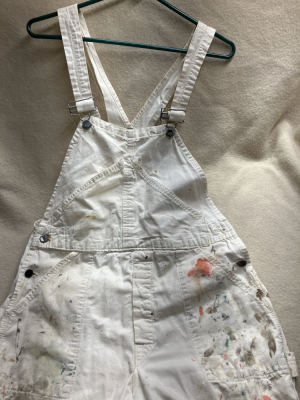
Were they used on overalls and coveralls?
Courdory jackets of the 70s?
 
  • #52

Attachments

  • 1774156342788.png
    1774156342788.png
    2.3 MB · Views: 0
  • #53
The buttons on the painter's jacket and overalls were more like the sort of "rivet" buttons found on some types of blue jeans. Those were not sewn on, but rather attached with a sort of rivet or nail punched into them. The back of them would look different from the uniform type button which had a brass loop attached. They were more of a work style than the fancy type of brass button found near the girl's body. They would probably be about the same size in diameter, however.
 

Guardians Monthly Goal

Staff online

Members online

Online statistics

Members online
117
Guests online
3,516
Total visitors
3,633

Forum statistics

Threads
645,109
Messages
18,834,186
Members
245,557
Latest member
Nicole Gee
Top