


• #541
Sort of suspicious that it matches the isotope analysis, lol. That is proof that this may be a made up identification.
I mean, possible she may be identified by now and european LE is very slow to confirm identification but isotopes are and were very regularly wrong.

jmoo
Totally agreed on the isotope analysis issue in terms of testing for actual human beings, there's no way I trust it. In any case I look at it, but warily, jmo.

I'm reading, though, that isotope analysis on an inanimate object can be considerably more accurate as there are fewer variables involved. So I really am wondering if isotope analysis on her jewelry might yield some reliable information. Based on what I saw, they could even perform it for costume jewelry.

I'd say "some information is better than no information," but I won't. Because agreed the isotope analysis is notoriuosly unrelaible with human beings, and bad information is worse than none at all sometimes, jmo. So unless it were confirmed this isotope testing's more reliable with something like a piece of jewelry, it seems as dubious as the full isotope testing of an actual human being.
While I love your analysis I have to say that the ring strikes me as rather Viking-like with a cruel streak. More goth than hippie to me. Right down my alley.

Looking at the original picture it is also clear the stone is quite unsymmetrical- the stone is not perfect - which makes me think it’s custom made.
Apologies on misleading anyone, I totally agree with this, with what you just said I think that's an older piece of jewelry both in its manufacture/craftsmanship and design. And think the earrings are Ottoman rose design. Now, is the earring design kind of "timeless," because @Sor Juana mentioned the Mumbai pieces... where someone could come by something "like that" (the earrings) in the 60s and incorporate it into the swinging groovy outfit overall? Possibly. But IW doesn't have anything particularly hip or groovy on that day jmo, and I don't see anything hip or groovy about either the ring or earrings by themselves. They look old school, old world, and conservative. I'm guessing Ottoman rose style jewelry/southeast Europe. Turkey/Romania/Slovenia (?), picture that jewelry in line with someone in tune with Istanbul or Bucharest, but there's so, so much speculation about where IW came from.

And agreed, I think that ring is much older and quite possibly the earrings as well, I don't think there's anything hippie chic about it in and of itself. But at the same time, have to agree that this Ottoman rose design with the earrings-- it's sort of classic and timeless. But again, that aside, when I look at IW's ring, I am getting old world vibes for sure, and my guess is the pieces are older, but jmo. And that ring looks large and heavy, which is channeling "older" in my mind, but again, jmo. And while I definitely get stylish from IW's overall ensemble that day, I'm in no way getting "hippie."
 
Last edited:
  • #542
The jewelry is fairly common 1960s style, originally inspired by Persian, Afghan and Indian designs but not hippie style. Just regular elegant business and everyday stuff. My grandma had very similar earrings and rings.

I still believe it is likely that IW was a local. She had local prescription meds. The shoe seller described her as having “body odor from bad hygiene mixed with perfume” which he later thought to be possibly “garlic”, despite not having been familiar with garlic.
I believe she was local, possibly estranged from family and mentally ill, she probably planned to end her life earlier during her hotel stays under various exotic aliases but did not do it until she reached icevalley, a tranquil, remote place. Sort of like the Christmas Tree Lady suicide.
I would be surprised if she was foreign, let alone a spy or criminal. The Somerton Man was also believed to be a Spy, American and having had an affair with a local nurse. Turned out he was a local engineer named Charles Webb, who after leaving his wife, dropped off the radar and spent a semi-transient life (apparently in hotels, he was not homeless) until he ended up dead at a beach.

jmoo
 
  • #543
The jewelry is fairly common 1960s style, originally inspired by Persian, Afghan and Indian designs but not hippie style. Just regular elegant business and everyday stuff. My grandma had very similar earrings and rings.

I still believe it is likely that IW was a local. She had local prescription meds. The shoe seller described her as having “body odor from bad hygiene mixed with perfume” which he later thought to be possibly “garlic”, despite not having been familiar with garlic.
I believe she was local, possibly estranged from family and mentally ill, she probably planned to end her life earlier during her hotel stays under various exotic aliases but did not do it until she reached icevalley, a tranquil, remote place. Sort of like the Christmas Tree Lady suicide.
I would be surprised if she was foreign, let alone a spy or criminal. The Somerton Man was also believed to be a Spy, American and having had an affair with a local nurse. Turned out he was a local engineer named Charles Webb, who after leaving his wife, dropped off the radar and spent a semi-transient life (apparently in hotels, he was not homeless) until he ended up dead at a beach.

jmoo
Again, jmo, the ring is quite sizey, it's jmo more rustic than elegant, looking at it in profile. It's the size of the watch face. That's (again, all jmo) an older piece of jewelry, and likely has no maker's mark because that would be common for the timeframe with artisan pieces. Looking at the earrings in tandem with the ring, I am getting Ottoman rose style from those earrings and think there may be a regional aspect to the fashion choices, along with the fur. I am not a jewelry expert and may well be wrong. But my mother also had jewelry of this style in the 1960s and '70s, but it wasn't this large and solid/heavy, it was more light But totally agreed, that does not exclude it from being from any timeframe. I would hope they can further test that jewelry in some way, and based on what I see, it might actually be possible. When I search for the stone on this ring, it says there is no stone. But if you look at the images, it appears to me there is a flat stone of some sort. It's definitely not bulbous, but it appears pretty large in terms of its length and width.

In light of the fact that it was apparently the practice of drug mules even in that era to consume large numbers of pills enclosed in plastic (didn't believe it myself), I would surmise still that she may well have been a drug mule because there were so many textiles intermingled with her remains that it would be impossible to detect such packaging after the burning of IW's body.

And if she were a drug mule, there are trafficking patterns that might support the idea of her being from the regions noted with Romania/Slovenia/Turkey. I've got no idea if that's the case right now, but based on the fact that there is this issue with ingestion of packaged drugs in this timeframe as a mechanism used by drug runners, this theory to me is making the most sense. That doesn't mean it's the correct theory, obviously.

I hope we find out what exactly happened there. Decades later and still no answers.
 
  • #544
Again, jmo, the ring is quite sizey, it's jmo more rustic than elegant, looking at it in profile. It's the size of the watch face. That's (again, all jmo) an older piece of jewelry, and likely has no maker's mark because that would be common for the timeframe with artisan pieces. Looking at the earrings in tandem with the ring, I am getting Ottoman rose style from those earrings and think there may be a regional aspect to the fashion choices, along with the fur. I am not a jewelry expert and may well be wrong. But my mother also had jewelry of this style in the 1960s and '70s, but it wasn't this large and solid/heavy, it was more light But totally agreed, that does not exclude it from being from any timeframe. I would hope they can further test that jewelry in some way, and based on what I see, it might actually be possible. When I search for the stone on this ring, it says there is no stone. But if you look at the images, it appears to me there is a flat stone of some sort. It's definitely not bulbous, but it appears pretty large in terms of its length and width.

In light of the fact that it was apparently the practice of drug mules even in that era to consume large numbers of pills enclosed in plastic (didn't believe it myself), I would surmise still that she may well have been a drug mule because there were so many textiles intermingled with her remains that it would be impossible to detect such packaging after the burning of IW's body.

And if she were a drug mule, there are trafficking patterns that might support the idea of her being from the regions noted with Romania/Slovenia/Turkey. I've got no idea if that's the case right now, but based on the fact that there is this issue with ingestion of packaged drugs in this timeframe as a mechanism used by drug runners, this theory to me is making the most sense. That doesn't mean it's the correct theory, obviously.

I hope we find out what exactly happened there. Decades later and still no answers.
If she was a “swallower”, they certainly would have found the packs in her gut, charred flesh on the outside but the intestines are commonly unaffected by the fire if someone self ignites by gasoline or alcohol.
And she would not swallow a boatload of tranquilizing pills if she was a drug mule, i guess.

jmo
 
  • #545
If she was a “swallower”, they certainly would have found the packs in her gut, charred flesh on the outside but the intestines are commonly unaffected by the fire if someone self ignites by gasoline or alcohol.
And she would not swallow a boatload of tranquilizing pills if she was a drug mule, i guess.

jmo
Trigger warning.

IW's body was literally shrouded in textile materials as it burned. There's melting/dripping, there is potentially penetration into body cavities. I remember one reseacher specifically mentioning all the textiles that had burned with the body in this case. There is what is called the "wick effect," there can be deep tissue damage. They found the tablets intact, but that in itself does not mean there was no form of packaging, packaging which has either itself dissolved, and/or become undetectable in its form/purpose due to residue from other textiles. There could potentially be too many other sources of residual textiles/intermingling. It would depend on a multitude of factors, including the type of packaging, temperature, and beyond, and it would be a long list.

They likely weren't considering this idea of ingestion for transport in this timeframe when they performed this autopsy. That is a concern.

And if she's scratching off prescription from eczema medications, I doubt there's a prescription for barbiturates. This could potentially pose a real issue at border crossings in this timeframe.

With all her knowledge of languages, the coding of the log, all the travel, the multiple passports, wigs, removal of identifiers... There is no disputing she is a planner. Am finding it difficult to believe her plans included engulfing herself in flames on a day where she was so uncertain of rain that she took an umbrella. That doesn't mean it didn't happen, but jmo it makes the idea of it difficult to accept logically.
 
  • #546
I have wonder about her often. I have taken to calling her different names. First a South African name when everyone thought she was from that part of the world, then “Elisabeth” when isotope analysis determined she grew up in the border area between France and Germany. I wonder if she was the daughter of people who were directed to move to Alsace as part of the Nazis plans of “re-germanification” of Alsace and if so what happened to her parents. I feel like that Alsace is the key to her true name, her identity, her history. If we can find “Elisabeth’s” parents among the people of Alsace who moved from Germany at the time then theoretically we could trace back her life from there.
 
  • #547
Trigger warning.

IW's body was literally shrouded in textile materials as it burned. There's melting/dripping, there is potentially penetration into body cavities. I remember one reseacher specifically mentioning all the textiles that had burned with the body in this case. There is what is called the "wick effect," there can be deep tissue damage. They found the tablets intact, but that in itself does not mean there was no form of packaging, packaging which has either itself dissolved, and/or become undetectable in its form/purpose due to residue from other textiles. There could potentially be too many other sources of residual textiles/intermingling. It would depend on a multitude of factors, including the type of packaging, temperature, and beyond, and it would be a long list.

They likely weren't considering this idea of ingestion for transport in this timeframe when they performed this autopsy. That is a concern.

And if she's scratching off prescription from eczema medications, I doubt there's a prescription for barbiturates. This could potentially pose a real issue at border crossings in this timeframe.

With all her knowledge of languages, the coding of the log, all the travel, the multiple passports, wigs, removal of identifiers... There is no disputing she is a planner. Am finding it difficult to believe her plans included engulfing herself in flames on a day where she was so uncertain of rain that she took an umbrella. That doesn't mean it didn't happen, but jmo it makes the idea of it difficult to accept logically.
This lady seems pretty sophisticated. It’s almost unbelievable someone had to kill a woman with her level of education - at this time when highly educated women were SO uncommon.

IMHOO
 
  • #548
This lady seems pretty sophisticated. It’s almost unbelievable someone had to kill a woman with her level of education - at this time when highly educated women were SO uncommon.

IMHOO
Was it her ability to speak several languages (French, German, English, Flemish) that makes you think she was highly educated? I don't think it would have been that uncommon for a woman in central Europe in the 1950s and 1960s to speak three or four languages, especially if she was from Belgium, as three of those languages are official languages there.
 
  • #549
Was it her ability to speak several languages (French, German, English, Flemish) that makes you think she was highly educated? I don't think it would have been that uncommon for a woman in central Europe in the 1950s and 1960s to speak three or four languages, especially if she was from Belgium, as three of those languages are official languages there.
It’s her notes that makes me think that. More than the languages. But maybe that’s premature. It’s easy to romanticise a bit I suppose. And having three official languages doesn’t necessarily mean everyone in that country is fluent in all three languages. Just like one official language in most of Europe still today often means at least two fluent (+1 being Russian, German, French or English). I know three natural languages myself, though my German hardly reaches the level of being fluent these days.

I guess my thought was that we only scraped the surface of her knowledge/skill set. But it sure wouldn’t hold up in the court of law.
 
Last edited:
  • #550
I have wonder about her often. I have taken to calling her different names. First a South African name when everyone thought she was from that part of the world, then “Elisabeth” when isotope analysis determined she grew up in the border area between France and Germany. I wonder if she was the daughter of people who were directed to move to Alsace as part of the Nazis plans of “re-germanification” of Alsace and if so what happened to her parents. I feel like that Alsace is the key to her true name, her identity, her history. If we can find “Elisabeth’s” parents among the people of Alsace who moved from Germany at the time then theoretically we could trace back her life from there.
It is possible, but as is possible that they wanted to distance themselves from the Nuremberg as it is. Other reasons why she is missing could be lack of next kin, or disappeared willingly among others. It is possible that she moved further in France at some point and didn't stay long in anywhere. We do have her DNA profile (according to the official news sources and so), but since this is Europe, things don't happen as smoothly - including DNA comparisons. And since Norway isn't part of EU either, it can possibly a bit complicate things further. I've been trying to go through all newspapers I could possibly find, but it's quite slow work. Extremely when I have to try to focus on what's written. I admit, while my German is strong enough to read news and so, my French is so and so. But slowly I sleuth.
 
  • #551
It is possible, but as is possible that they wanted to distance themselves from the Nuremberg as it is. Other reasons why she is missing could be lack of next kin, or disappeared willingly among others. It is possible that she moved further in France at some point and didn't stay long in anywhere. We do have her DNA profile (according to the official news sources and so), but since this is Europe, things don't happen as smoothly - including DNA comparisons. And since Norway isn't part of EU either, it can possibly a bit complicate things further. I've been trying to go through all newspapers I could possibly find, but it's quite slow work. Extremely when I have to try to focus on what's written. I admit, while my German is strong enough to read news and so, my French is so and so. But slowly I sleuth.
Good. Keep up the good work. I suspect we will find her in the records. Somewhere there has to be a record of families moving from Bavaria to Alsace, the Rhineland and Saarland in the 1930s. One of those families has to be “Elisabeth’s” family.
 
  • #552
latest

Composite image of the Unidentified "Isdalen Woman" deceased 29 November 1970.
 
  • #553
It’s striking how much can be inferred from a few pieces of jewelry. Gothic rings were fashionable in mid‑20th century Europe, especially in Germany and France, so her ring would fit with continental antique or bohemian tastes. The earrings with floral, geometric motifs, point toward Indian, Turkish, or Balkan designs commonly found in bazaars and artisan workshops from Istanbul to Belgrade and across South Asia. If she truly worked as an antiquities dealer, she would have had easy access to gothic rings in markets and shops across Germany, France, or Belgium. Earrings with Turkish or Balkan character could have been bought in Istanbul’s Grand Bazaar or in Yugoslav markets, both popular with travellers in the 1960s–70s. If the earrings were Indian‑inspired, they might also have been acquired in Paris or Brussels, where imported South Asian jewelry circulated among bohemian and cosmopolitan circles. Wearing this mix of European gothic and Eastern ornamental styles suggests a deliberate, worldly image. Such pieces could signal cultivated taste, provide a subtle cultural cover while travelling under aliases, or simply be sentimental keepsakes - either way, they reinforce the impression of someone who moved through diverse markets and social worlds.
 
  • #554
It’s tempting to look at those small details and imagine a different story: not a spy, but a high‑stakes thief. The mix of gothic ring and exotic, floral‑patterned earrings fits someone who moved through antique markets and bazaars, buying or fencing pieces that could be sold quickly across borders. Claiming to be an antiquities dealer would be a perfect cover for that kind of life - easy access to collectors, plausible reasons to travel, and a ready explanation for handling unusual objects. The deliberate removal of clothing labels and the use of multiple identities also make more sense if the goal was to erase provenance and avoid being traced back to stolen goods.

If she worked alone, those habits could be practical tradecraft for a professional fence; if she was part of a ring, they could be standard operating procedure for a group moving valuable items around Europe and beyond. The violent and mysterious circumstances of her death could then be read as the worst outcome of that world: exposure, a falling out over loot, or a decision by partners to silence someone who had become a liability. None of this proves she was a thief, but the material evidence (false papers, stripped labels, and the kind of jewelry that’s easy to move through international markets) fits that explanation as neatly as it fits the spy theory, and in some ways explains the more criminal‑looking details better than an intelligence narrative would. JMO
 
  • #555
It’s tempting to look at those small details and imagine a different story: not a spy, but a high‑stakes thief. The mix of gothic ring and exotic, floral‑patterned earrings fits someone who moved through antique markets and bazaars, buying or fencing pieces that could be sold quickly across borders. Claiming to be an antiquities dealer would be a perfect cover for that kind of life - easy access to collectors, plausible reasons to travel, and a ready explanation for handling unusual objects. The deliberate removal of clothing labels and the use of multiple identities also make more sense if the goal was to erase provenance and avoid being traced back to stolen goods.

If she worked alone, those habits could be practical tradecraft for a professional fence; if she was part of a ring, they could be standard operating procedure for a group moving valuable items around Europe and beyond. The violent and mysterious circumstances of her death could then be read as the worst outcome of that world: exposure, a falling out over loot, or a decision by partners to silence someone who had become a liability. None of this proves she was a thief, but the material evidence (false papers, stripped labels, and the kind of jewelry that’s easy to move through international markets) fits that explanation as neatly as it fits the spy theory, and in some ways explains the more criminal‑looking details better than an intelligence narrative would. JMO
There seems to be different opinions about the quality of the jewellery she was wearing. While some English-language sites claims 'the jewelry appeared to be of a high quality or expensive', Scandinavian sources describe them as 'costume jewellery', that is not made of gold or silver. Well made, but not worth much.
 
  • #556
Depending on her financial status it could suggest she wanted to create an “impressive image” but on a tight budget. Then again her clothes suggest designer brands (although the tags were removed if I recall) but I don’t know if they were the latest fashion trends or timeless pieces made earlier. Ugh…damnit “Elisabeth” why do you have to be so confusing? I really need to go over the clothes she was found with and make comparisons with pieces by designers active at the time.
 
  • #557
OK I looked up what clothes were found connected to her…
One dark blue bubble jacket fastened by a belt with two rings
One blue knitted sweater
A green and clue (I assume they mean blue) checked (checkered?) wool shawl
A brown fake fur cape
And blue rubber boots as well as an assortment of “stylish” clothing in the suitcase found at Bergen.
Unfortunately the only image of an item of clothing available is the shawl.
😑
Damnit…I was hoping to have images of the clothes without the labels to see what they looked like and so I could do a search of archived runway images from designers and then compare them with the clothes connected to “Elisabeth” thus creating a hypothetical timeline of when each piece could have been bought and allowing for future investigators to contact the couture houses about if they have archives of what pieces went to which stores and thus, hypothetically, looking to see if there are sales records dating back to the 60s which could be combed through. 😖 If anyone can find images of the clothes without labels that will be a big help.
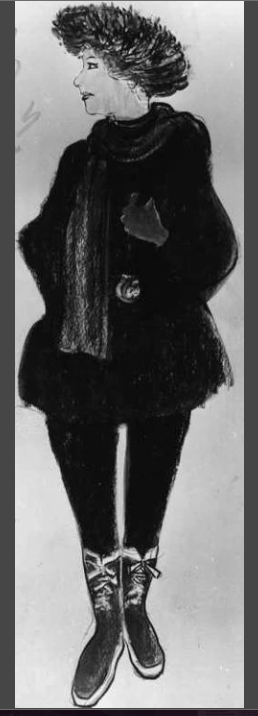
Now excuse me while I scream mentally about the lack of photos of the clothes without labels.
 
  • #558
OK I looked up what clothes were found connected to her…
One dark blue bubble jacket fastened by a belt with two rings
One blue knitted sweater
A green and clue (I assume they mean blue) checked (checkered?) wool shawl
A brown fake fur cape
And blue rubber boots as well as an assortment of “stylish” clothing in the suitcase found at Bergen.
Unfortunately the only image of an item of clothing available is the shawl.
😑
Damnit…I was hoping to have images of the clothes without the labels to see what they looked like and so I could do a search of archived runway images from designers and then compare them with the clothes connected to “Elisabeth” thus creating a hypothetical timeline of when each piece could have been bought and allowing for future investigators to contact the couture houses about if they have archives of what pieces went to which stores and thus, hypothetically, looking to see if there are sales records dating back to the 60s which could be combed through. 😖 If anyone can find images of the clothes without labels that will be a big help.

Now excuse me while I scream mentally about the lack of photos of the clothes without labels.
This is what I'm seeing online, she's very stylish with good fashion sense, jmo. Apologies, though, because I'm guessing you may already have seen these:
1774774359769.png
1774774258406.png
1774774469897.png
 
  • #559
Pretty much. That’s all I got. No photos of the clothes with labels though
 
  • #560
I remember reading somewhere that the fur hat she had, was thought to be possibly from Uzbekistan/Kazakhstan or any closeby area. [Police report] Also the golden crowns on her teeth are unusual and I think them are thought to be pointed towards Turkish/Eastern Mediterranean Origin. It was also pointed out, that the golden crowns were made extremely well.

I can understand very well, why she is so enchanting and mysterious.

I also spoke previously of the honey pot lures, and came across mention that they weren't necessarily always anyone standing out back in the day, but more common women and someone whom could walk among people rather unnoticed. Also the exploitation was possible, if the woman was young, naive or so. So it could be easy to lure someone to just simply deliver something to someone, or just pick something up from somewhere.

Also, we cannot forget the infamous case of Mata Hari, where someone managed to fool so many. More you learn about her, more she captivates, at least me.

Bit off the rails again, but felt like adding tid bits a slightly more from my sleuthing.
 

Guardians Monthly Goal

Staff online

Members online

Online statistics

Members online
130
Guests online
8,576
Total visitors
8,706

Forum statistics

Threads
645,749
Messages
18,847,550
Members
245,783
Latest member
JusticeShallReign
Top