UK UK - Jill Dando, 37, Fulham, London, 26 Apr 1999

  • #1,001
First and foremost they would have to know that Jill knew this man. She certainly did not advertise all her brief flings and one night stands, even to her friends, and her friends might be reluctant to tell the investigators about them, wanting to protect her reputation.

There is also a possibility this man is someone who appeared on the fringes of Jill's life, someone she met briefly at work, someone who was performing some service for her, someone introduced to her on some social occasion, or tried to flirt with her one time in a bar. Someone who did not have real contact with her, but developed unhealthy obsession. Such a person would not get on the police radar that easily.
Exactly this - she travelled extensively for her job, she was quite literally all over the world, and moved in social circles where money isn't much of a problem, so long distance connections can take place quite easily. Being in the public eye, she also would've been quite adept at keeping a low profile when needed, away from the awaiting press and photographers. The amount of people who she would've come into contact with , ands in the days when you didn't have all your contacts electronically, would've been near impossible for the Police to identify.
 
  • #1,002
Yes he was a nutter and he took her by surprise.
You've kinda ignored my point.

You said him being investigated for rape now means he was capable of murder. So, you believe every rapist could shoot someone in the head, in broad daylight?
 
  • #1,003
Exactly this - she travelled extensively for her job, she was quite literally all over the world, and moved in social circles where money isn't much of a problem, so long distance connections can take place quite easily. Being in the public eye, she also would've been quite adept at keeping a low profile when needed, away from the awaiting press and photographers. The amount of people who she would've come into contact with , ands in the days when you didn't have all your contacts electronically, would've been near impossible for the Police to identify.
She never once rang him from her home phone/mobile (if she had one)?

Not a single postcard?

No letters?

Didn't tell a single friend?
 
  • #1,004
She never once rang him from her home phone/mobile (if she had one)?

Not a single postcard?

No letters?

Didn't tell a single friend?
Well that is the big question - I'm sure the Police did research her phone records, but of course how many numbers were there? As for letters - if it was a secret liaison then letters may have been destroyed after being read, and the same with telling friends. People do have secrets. And probably even more so if you're in the public eye and don't want the press to know. Also I'm sure a lot of famous people don't always trust everyone around them. IIRC, in documentaries about JD, you don't really hear from lifelong friends - they all seem to be people connected with her professional life. Of course all of this is JMO, but it could explain it if this is what happened.
 
  • #1,005
Well that is the big question - I'm sure the Police did research her phone records, but of course how many numbers were there? As for letters - if it was a secret liaison then letters may have been destroyed after being read, and the same with telling friends. People do have secrets. And probably even more so if you're in the public eye and don't want the press to know. Also I'm sure a lot of famous people don't always trust everyone around them. IIRC, in documentaries about JD, you don't really hear from lifelong friends - they all seem to be people connected with her professional life. Of course all of this is JMO, but it could explain it if this is what happened.
I agree people have secrets, but evidence of those secrets usually remain in their homes. I don't believe she systematically removed all evidence of a relationship from her own personal space and it didn't feature in phone records etc.

Let's say its true.... she had a secret relationship with someone and they were obsessed to the point of killing her.

They were that obsessed but they didn't tell a single friend whilst they were seeing her?

In terms of probability:

-The probability she was having a secret relationship in the past
-The probability he never mentioned it to his friends
-The probability the police could not find a single reference to the guy
-The probability the guy had access to a gun

To me it seems unlikely
 
  • #1,006
I agree people have secrets, but evidence of those secrets usually remain in their homes. I don't believe she systematically removed all evidence of a relationship from her own personal space and it didn't feature in phone records etc.

Let's say its true.... she had a secret relationship with someone and they were obsessed to the point of killing her.

They were that obsessed but they didn't tell a single friend whilst they were seeing her?

In terms of probability:

-The probability she was having a secret relationship in the past
-The probability he never mentioned it to his friends
-The probability the police could not find a single reference to the guy
-The probability the guy had access to a gun

To me it seems unlikely
I think it's unlikely too - but there are certain elements that could be likely. Secret affairs are by their nature very much that. I'm not actually stating that this person could've murdered JD (or hired someone) but just that we don't know everything about someone's life. As others have posted, there seems to be stories that there were other people in her life, presumably checked by the police, but did they know everyone.
 
  • #1,007
We need to get rid of this idea of a 'professional hitman' that comes from Hollywood movies. Hitmen are not in the job just because they're mysterious and dressed in black - it's actually having the mentality of being able to execute someone, maybe up close, maybe even face-to-face. The majority of hardened criminals will tell you, this isn't an easy task - or even one they would entertain. That, again JMO, is what makes it a professional killing.
I think it's important to distinguish between two types of 'hitman' here. If you're talking about the sort of people that have carried out contract killings for British organised crime groups - people like Thomas Cashman or Mark Fellows - then I agree, you're talking about people whose main quality is willingness to carry it out, and who have no serious training. Their access to weapon quality will vary and be opportunistic. They would generally spend most of their time engaged in other criminal acts and might carry out a handful of killings over a criminal career. They are very different to people with a military or other day to day training in weapons and operations - which would presumably be the model for state-sanctioned or serious paramilitary organisations.

But I don't think either model fits this case. As I said before the whole shoddy opportunistic MO pretty much rules out anyone with training. And I know that conclusion was reached pretty quickly (and rightly) by the police. And while a gangster might have done it in such a sloppy way, people like Cashman and Fellows only worked for crime bosses - there wasn't a plausible marketplace whereby a jilted lover or jealous partner could have hired these guys for 5 grand.
 
  • #1,008
You've kinda ignored my point.

You said him being investigated for rape now means he was capable of murder. So, you believe every rapist could shoot someone in the head, in broad daylight?

Yes, it’s quite the leap imo.

Barry George was, to put it bluntly, an idiot. A person of low intelligence. Had few skills and lived in a world of fantasy.

He was also a danger to women. But men from all walks of life can be dangers. Smart men rape. Stupid men rape. And all kinds of men in-between. Smart men don’t always make for smart criminals. The reverse is also true.

Very few women in the UK are raped at gunpoint by a stranger. Even fewer are shot dead through the head on their doorstep in the middle of the day.
 
Last edited:
  • #1,009
Yes, it’s quite the leap imo.

Barry George was, to put it bluntly, an idiot. A person of low intelligence. Had few skills and lived in a world of fantasy.

He was also a danger to women. But men from all walks of life can be dangers. Smart men rape. Stupid men rape. And all kinds of men in-between. Smart men don’t always make for smart criminals. The reverse is also true.

Very few women in the UK are raped at gunpoint by a stranger. Even fewer are shot dead through the head on their doorstep in the middle of the day.
I don't think it's a leap he hid in the bushes with a knife and rope waiting for Diana and alot of rapist/abusers eventually escalate to murder so I wouldn't rule him out.
 
  • #1,010
Sure, though in that instance he was caught red-handed - hardly proof that he was capable of pulling off this particular crime, imo. This almost comically amateurish business at Kensington Palace occurred in the early 1980s - by 1999 there’s some evidence that while his behaviour was still deeply odd and sometimes frightening, he was actually de-escalating. In any case, even if we were to assume he spent the 1990s working himself up to the point of murder, there’s still the small problem of there being zero evidence he had the means to commit this crime.
 
  • #1,011
I don't think it's a leap he hid in the bushes with a knife and rope waiting for Diana and alot of rapist/abusers eventually escalate to murder so I wouldn't rule him out.
This I feel was more linked to his delusions of being a special forces soldier, than acting out a potential murder
 
  • #1,012
This I feel was more linked to his delusions of being a special forces soldier, than acting out a potential murder
Well because he was caught we will never know for sure but you could be right.
 
  • #1,013
This I feel was more linked to his delusions of being a special forces soldier, than acting out a potential murder
100%

I was re-watching the Netflix doc last night. This wasn't a struggle. It wasn't a proposal: "go for a drink? No? Then I'm killing you". It was a straight-up execution.

If it was someone besotted with her, their first act would have been to reach out and that would have left some evidence. A letter etc.
 
  • #1,014
But I don't think either model fits this case. As I said before the whole shoddy opportunistic MO pretty much rules out anyone with training. And I know that conclusion was reached pretty quickly (and rightly) by the police.
What made you/police lean this way?
 
  • #1,015
They are very different to people with a military or other day to day training in weapons and operations - which would presumably be the model for state-sanctioned or serious paramilitary organisations.

A writer called Leo Murray has written a book called Brains and Bullets which looks at the difficulties of getting soldiers to kill people. Most don't want to kill anyone or risk getting killed themselves. The majority of the killing is done by fewer than 5% of the men. Not remote killing by pulling the lanyard of a howitzer or launching a missile, but the kind that involved standing in front of someone and shooting them. It is very hard indeed to get people to do this.
 
  • #1,016
What made you/police lean this way?
Principally, the poor nature of the weapon and the MO involving physical contact. Also time and place.
 
  • #1,017
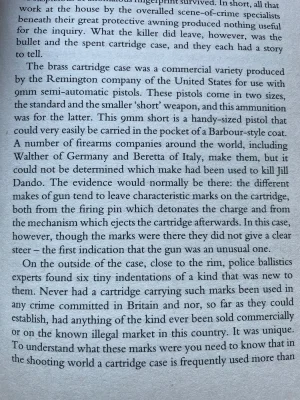
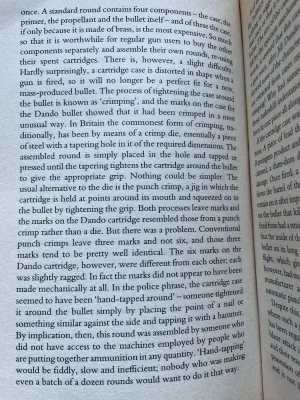
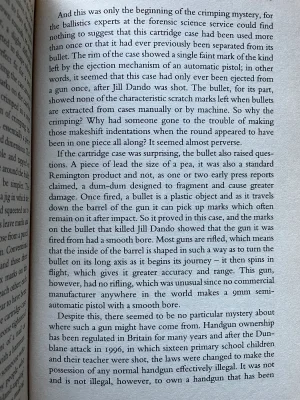
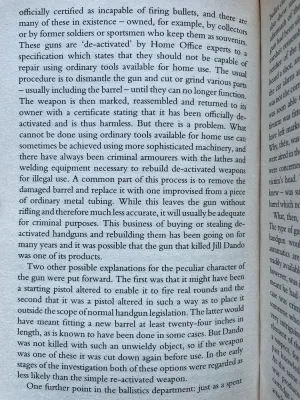
A bit long, this post, but earlier I was going over this bit from BC’s book (pages 159-162) on the gun and the round that was used to kill Jill Dando, thought it might be worth sharing.

On the cartridge:

The brass cartridge case was a commercial variety produced by the Remington company of the United States for use with 9mm semi-automatic pistols. These pistols come in two sizes, the standard and the smaller 'short' weapon, and this ammunition was for the latter. This 9mm short is a handy-sized pistol that could very easily be carried in the pocket of a Barbour-style coat. A number of firearms companies around the world, including Walther of Germany and Beretta of Italy, make them, but it could not be determined which make had been used to kill Jill Dando. The evidence would normally be there: the different makes of gun tend to leave characteristic marks on the cartridge, both from the firing pin which detonates the charge and from the mechanism which ejects the cartridge afterwards. In this case, however, though the marks were there they did not give a clear steer - the first indication that the gun was an unusual one.

On the outside of the case, close to the rim, police ballistics experts found six tiny indentations of a kind that was new to them. Never had a cartridge carrying such marks been used in any crime committed in Britain and nor, so far as they could establish, had anything of the kind ever been sold commercially or on the known illegal market in this country. It was unique. To understand what these marks were you need to know that in the shooting world a cartridge case is frequently used more than once. A standard round contains four components - the case, the primer, the propellant and the bullet itself - and of these the case, if only because it is made of brass, is the most expensive. So much so that it is worthwhile for regular gun users to buy the other components separately and assemble their own rounds, re-using their spent cartridges. There is, however, a slight difficulty. Hardly surprisingly, a cartridge case is distorted in shape when a gun is fired, so it will no longer be a perfect fit for a new, mass-produced bullet. The process of tightening the case around the bullet is known as 'crimping', and the marks on the case for the Dando bullet showed that it had been crimped in a most unusual way. In Britain the commonest form of crimping, traditionally, has been by means of a crimp die, essentially a piece of steel with a tapering hole in it of the required dimensions. The assembled round is simply placed in the hole and tapped or pressed until the tapering tightens the cartridge around the bullet to give the appropriate grip. Nothing could be simpler. The usual alternative to the die is the punch crimp, a jig in which the cartridge is held at points around its mouth and squeezed on to the bullet by tightening the grip. Both processes leave marks and the marks on the Dando cartridge resembled those from a punch crimp rather than a die. But there was a problem. Conventional punch crimps leave three marks and not six, and those three marks tend to be pretty well identical. The six marks on the Dando cartridge, however, were different from each other; each was slightly ragged. In fact the marks did not appear to have been made mechanically at all. In the police phrase, the cartridge case seemed to have been 'hand-tapped around' - someone tightened it around the bullet simply by placing the point of a nail or something similar against the side and tapping it with a hammer. By implication, then, this round was assembled by someone who did not have access to the machines employed by people who are putting together ammunition in any quantity. 'Hand-tapping' would be fiddly, slow and inefficient; nobody who was making even a batch of a dozen rounds would want to do it that way.

And this was only the beginning of the crimping mystery, for the ballistics experts at the forensic science service could find nothing to suggest that this cartridge case had been used more than once or that it had ever previously been separated from its bullet. The rim of the case showed a single faint mark of the kind left by the ejection mechanism of an automatic pistol; in other words, it seemed that this case had only ever been ejected from a gun once, after Jill Dando was shot. The bullet, for its part, showed none of the characteristic scratch marks left when bullets are extracted from cases manually or by machine. So why the crimping? Why had someone gone to the trouble of making those makeshift indentations when the round appeared to have been in one piece all along? It seemed almost perverse.


On the gun:

If the cartridge case was surprising, the bullet also raised questions. A piece of lead the size of a pea, it was also a standard Remington product and not, as one or two early press reports claimed, a dum-dum designed to fragment and cause greater damage. Once fired, a bullet is a plastic object and as it travels down the barrel of the gun it can pick up marks which often remain on it after impact. So it proved in this case, and the marks on the bullet that killed Jill Dando showed that the gun it was fired from had a smooth bore. Most guns are rifled, which means that the inside of the barrel is shaped in such a way as to turn the bullet on its long axis as it begins its journey - it then spins in flight, which gives it greater accuracy and range. This gun, however, had no rifling, which was unusual since no commercial manufacturer anywhere in the world makes a 9mm semi-automatic pistol with a smooth bore.

Despite this, there seemed to be no particular mystery about where such a gun might have come from. Handgun ownership has been regulated in Britain for many years and after the Dunblane attack in 1996, in which sixteen primary school children and their teacher were shot, the laws were changed to make the possession of any normal handgun effectively illegal. It was not and is not illegal, however, to own a handgun that has been officially certified as incapable of firing bullets, and there are many of these in existence - owned, for example, by collectors or by former soldiers or sportsmen who keep them as souvenirs. These guns are de-activated by Home Office experts to a specification which states that they should not be capable of repair using ordinary tools available for home use. The usual procedure is to dismantle the gun and cut or grind various parts - usually including the barrel - until they can no longer function. The weapon is then marked, reassembled and returned to its owner with a certificate stating that it has been officially deactivated and is thus harmless. But there is a problem. What cannot be done using ordinary tools available for home use can sometimes be achieved using more sophisticated machinery, and there have always been criminal armourers with the lathes and welding equipment necessary to rebuild de-activated weapons for illegal use. A common part of this process is to remove the damaged barrel and replace it with one improvised from a piece of ordinary metal tubing. While this leaves the gun without rifling and therefore much less accurate, it will usually be adequate for criminal purposes. This business of buying or stealing deactivated handguns and rebuilding them has been going on for many years and it was possible that the gun that killed Jill Dando was one of its products.

Two other possible explanations for the peculiar character of the gun were put forward. The first was that it might have been a starting pistol altered to enable it to fire real rounds and the second that it was a pistol altered in such a way as to place it outside the scope of normal handgun legislation. The latter would have meant fitting a new barrel at least twenty-tour inches in length, as is known to have been done in some cases. But Dando was not killed with such an unwieldy object, so if the weapon was one of these it was cut down again before use. In the early stages of the investigation both of these options were regarded as less likely than the simple re-activated weapon.
 

Attachments

  • IMG_5037.webp
    IMG_5037.webp
    512.6 KB · Views: 0
  • IMG_5038.webp
    IMG_5038.webp
    484.7 KB · Views: 0
  • IMG_5039.webp
    IMG_5039.webp
    554 KB · Views: 0
  • IMG_5040.webp
    IMG_5040.webp
    503.5 KB · Views: 0
  • #1,018
The crimping of the cartridge is incredibly interesting, to me. I think @Hexe has talked before about the possibility some propellant had been removed from the round in order to reduce the sound of the shot. AIUI, to do this you’d first need to open up the cartridge, then afterwards crimp it back together.

Or, was the crimping done simply to misdirect and confuse?

And as for the gun itself, if you were acting out some violent sexual fantasy, why go to the bother / take the risk of fashioning / sourcing a working firearm when almost anyone would freeze with the barrel of a replica pointed at their head?

IMO, I think whoever had the expertise to modify the gun and possibly the round - or, whoever took the risk of sourcing a modified gun and round - went to Jill Dando’s doorstep that morning with the very clear intention of ending her life.
 

Guardians Monthly Goal

Members online

Online statistics

Members online
71
Guests online
1,856
Total visitors
1,927

Forum statistics

Threads
636,252
Messages
18,693,334
Members
243,581
Latest member
MrsWilwy69
Back
Top