

No apologies needed, I had to double check it myself, so it's all good.Fair enough. I must have missed that bit. I apologise.



You are using an out of date browser. It may not display this or other websites correctly.
You should upgrade or use an alternative browser.
You should upgrade or use an alternative browser.
UK UK- Joy Hewer, 50, Teacher/church volunteer, sexually assaulted & fatally stabbed in chest, apartment set on fire, Walthamstow, 17 Oct.1995 *REWARD*
- Thread starter dotr
- Start date


The black male may be unrelated to the murder, but, if so, it's highly suspicious behaviour in any case. It probably does make your two man job more viable, which if it was, would to my mind make some sort of conspiracy re the London Healing Mission more plausible.No apologies needed, I had to double check it myself, so it's all good.

That means that if the killer was the man who made the call at 23.18pm, the very latest he could have started the fires would have been at 23.15pm. That's 3 minutes to run down the stairs, run across the road and then up Fulborne Road to the phone box on the other side of the road.
Also, the man who was seen running out the building was a 6ft 4" black male, whereas the man in the CCTV is definitely NOT the same man.
Hence why I believe there were 2 men involved. The white man on CCTV being the killer, and the black male who ran down the stairs, who nearly got hit by a car and then IMO ran and made the 999 phone call, was the man who started the fires after the killer had already left the flats around 15 minutes earlier, in order for the killer to give himself an alibi.
Regarding the phone caller, DC Sean McLeary said "All we know of him is that he's around 6ft 4ins tall and slim".
The black male seen running was also described as being slim and around 6ft 4 tall.
The local press said the running man was witnessed at 10.45pm, which if accurate would mean that (if he's also the caller) he took over half an hour to reach the phonebox.
Thanks for the heads up. Will need to watch that again as I have clearly missed things first time round.Regarding the phone caller, DC Sean McLeary said "All we know of him is that he's around 6ft 4ins tall and slim".
The black male seen running was also described as being slim and around 6ft 4 tall.
The local press said the running man was witnessed at 10.45pm, which if accurate would mean that (if he's also the caller) he took over half an hour to reach the phonebox.

I can see where the idea of two people involved works, I just don't see the overall logic of it. Majority of murderers wouldn't involve another person as they don't want the added risk of more people knowing what happened. But this tall black man has ran out of the flat having killed Joy, gone got his white friend to go in and set fire to the flat, made an awful job at trying to hide the evidence (Though ironically is currently still successful) before running down the stairs and making a call to report the fire he has started. I struggle to believe it.Hence why I believe there were 2 men involved. The white man on CCTV being the killer, and the black male who ran down the stairs, who nearly got hit by a car and then IMO ran and made the 999 phone call, was the man who started the fires after the killer had already left the flats around 15 minutes earlier, in order for the killer to give himself an alibi.
To me it seems like an unplanned murder and a panicked attempt to hide his tracks. Originally I believed the caller was the killer but the more I listen to the call the less convinced I become. The problem is there are anomaly's with the call. "Flames coming out of one of the floors" Would you really see that 6 floors up whilst driving along? Was it a curtain ablaze that he saw? The damage in the flat and the fire officers I believe said it was more a smouldering fire. Maybe curtains on fire could look like flames were coming out? In that case why did no one else report a fire in a block of flats barring in mind he was driving along, had to park up, see what building the fire was in etc. Surely someone else must of seen flames even at that time of night? Assuming he was using the only phonebox nearby then surely someone would have approached and said about the fire to ensure it was being reported? He was on the phone for over 2 1/2 minutes so plenty of time for other passers by to see it. However, when I listen to the voice I get the impression of an anxious chap who has planned in his head what to say (Driving along, seen flames, it's at St David's Court) and when the operator starts asking more questions about where he is it throws him as he is not overly familiar with the area. He is quick to ask a random person for help so wouldn't have any inhibitions about doing that whereas a more introverted person (thinking about myself) would probably start 'erring and arring' and looking around for road names or some other clue. Not sure where I am going with this but though the call doesn't completely add up he don't sound like he has just killed or attempted to cover up a murder scene.
The running man in the Crimewatch report was suggested "some time just after 10.30".Regarding the phone caller, DC Sean McLeary said "All we know of him is that he's around 6ft 4ins tall and slim".
The black male seen running was also described as being slim and around 6ft 4 tall.
The local press said the running man was witnessed at 10.45pm, which if accurate would mean that (if he's also the caller) he took over half an hour to reach the phonebox.
I don't believe there has ever been a description of the caller?
Surely if Joy had some kind of association with a 6ft 4 black man then it would of cropped up in investigations at some point? If he was a paid killer, or under duress to do it, how has he got himself into her flat?
There's a very high probability that the man who made the 999 call at 23.18pm and who called to have just driven past the flats, was driving west to east along Forest road with the flats on his right.
He then drives past only 1 of 2 signs for the building that reads "St David's Court." (one on Forest road, the other at the back in Parkstone Road that isn't visible from the main road.)
As he approaches the building he sees the flames and reads the sign on the frontage of the building that reads "St David's Court."
He then gets to the traffic lights and almost certainly turns LEFT into Fulbourne Road which leads northward to Chingford; a location that the caller mentions specifically in the full 999 call.
The reason IMO why he doesn't continue east along Fulbourne Road, park up and then walk 4 minutes up Fulbourne Road to the public phone box, is because there was ANOTHER public phone box less than half the distance from the Fulbourne Road phone box, that was directly next to the first layby on the left after you pass the traffic lights (just before the Bus Stop that heads eastbound.)
So if the 999 caller had driven past, seen the fire, driven straight across the lights and parked up on his left (facing east) then he would have used the phone box next to him; which has a perfect line of sight to the flats.
If he did continue along Forest Road, and chose not use the phone box next to him, he would have instead needed to have walked back towards the traffic lights, turned right and then up Fulbourne Road to the phone box in which the 999 call was made.
The idea of the man continuing east along Forest Road therefore makes no logical sense.
That IMO proves that he turned LEFT at the lights, and then as he drove north up Fulbourne Road, he notices the phone box on the other side of the road, so he parks up on his left and then crosses the road and goes in to use the phone box to make the call.
Afterwards, he then crosses the road, gets into his car and continues his onward journey towards Chingford.
That would explain why he knew the name of the flats, but not the names of the roads, why he mentions Chingford, and why he uses the Fulbourne Road phone box instead of the other phone box in Forest Road that would have been less than half the distance to make the call.
That is of course based on the man being an innocent party who just so happens to drive past St David's Court and look up to see the flames up on the 6th floor.
If he was lying about driving, and he was to blame for the fires and/or the murder, then he would have needed to walk from the flats all the way up to the phone box, which would have been risky without a vehicle.
I believe that he had a vehicle regardless of whether he was guilty or innocent. IF the former, then he needed to have parked up somewhere close by. He may have started the fires, then run down and got into a vehicle, which he then drove north up Fulbourne Road, but as he approached the phone box, he gets out and makes the 999 call so that he isn't responsible for being a mass murderer from the whole building going up in flames.
So when he says that he was driving, I think that's true whether he was involved with starting the fires or not.
Interesting to note that the phone box was located directly outside a building called Cedar Wood House, which at the time and up until circa 2019, was a building that dealt with social housing and homelessness for the local area. It could be implied that the man who made the 999 call may have been familiar with the fact there was a phone box located there.
Cedar Wood House closed circa 2020, but is still there today
Interesting also that the phone box (as well as the one in Forest Road) were both removed sometime between late 2020 to early 2021.
if you look on Google street view, and look at previous dates, it takes you back to as early as 2008. When you scroll through the dates in reverse chronological order, you will see a timeline of the area that really builds a picture of the location. You can also see how the flats have changed since 2008.
You can also observe a CCTV camera on the external wall of the building that faces the door. It is easy to circumvent around to the back of the building and enter Parkstone road, without needing to use the main road.
He then drives past only 1 of 2 signs for the building that reads "St David's Court." (one on Forest road, the other at the back in Parkstone Road that isn't visible from the main road.)
As he approaches the building he sees the flames and reads the sign on the frontage of the building that reads "St David's Court."
He then gets to the traffic lights and almost certainly turns LEFT into Fulbourne Road which leads northward to Chingford; a location that the caller mentions specifically in the full 999 call.
The reason IMO why he doesn't continue east along Fulbourne Road, park up and then walk 4 minutes up Fulbourne Road to the public phone box, is because there was ANOTHER public phone box less than half the distance from the Fulbourne Road phone box, that was directly next to the first layby on the left after you pass the traffic lights (just before the Bus Stop that heads eastbound.)
So if the 999 caller had driven past, seen the fire, driven straight across the lights and parked up on his left (facing east) then he would have used the phone box next to him; which has a perfect line of sight to the flats.
If he did continue along Forest Road, and chose not use the phone box next to him, he would have instead needed to have walked back towards the traffic lights, turned right and then up Fulbourne Road to the phone box in which the 999 call was made.
The idea of the man continuing east along Forest Road therefore makes no logical sense.
That IMO proves that he turned LEFT at the lights, and then as he drove north up Fulbourne Road, he notices the phone box on the other side of the road, so he parks up on his left and then crosses the road and goes in to use the phone box to make the call.
Afterwards, he then crosses the road, gets into his car and continues his onward journey towards Chingford.
That would explain why he knew the name of the flats, but not the names of the roads, why he mentions Chingford, and why he uses the Fulbourne Road phone box instead of the other phone box in Forest Road that would have been less than half the distance to make the call.
That is of course based on the man being an innocent party who just so happens to drive past St David's Court and look up to see the flames up on the 6th floor.
If he was lying about driving, and he was to blame for the fires and/or the murder, then he would have needed to walk from the flats all the way up to the phone box, which would have been risky without a vehicle.
I believe that he had a vehicle regardless of whether he was guilty or innocent. IF the former, then he needed to have parked up somewhere close by. He may have started the fires, then run down and got into a vehicle, which he then drove north up Fulbourne Road, but as he approached the phone box, he gets out and makes the 999 call so that he isn't responsible for being a mass murderer from the whole building going up in flames.
So when he says that he was driving, I think that's true whether he was involved with starting the fires or not.
Interesting to note that the phone box was located directly outside a building called Cedar Wood House, which at the time and up until circa 2019, was a building that dealt with social housing and homelessness for the local area. It could be implied that the man who made the 999 call may have been familiar with the fact there was a phone box located there.
Cedar Wood House closed circa 2020, but is still there today
Interesting also that the phone box (as well as the one in Forest Road) were both removed sometime between late 2020 to early 2021.
if you look on Google street view, and look at previous dates, it takes you back to as early as 2008. When you scroll through the dates in reverse chronological order, you will see a timeline of the area that really builds a picture of the location. You can also see how the flats have changed since 2008.
You can also observe a CCTV camera on the external wall of the building that faces the door. It is easy to circumvent around to the back of the building and enter Parkstone road, without needing to use the main road.
Excellent post. I get what you're saying re the phone box, which is a decent bit down Fulbourne Road and why wouldn't he use a nearer box but as you have ascertained it is only a 4 minute walk from St David's Court to 2A Fulbourne Road so roughly a 30 second drive to get there, park up on the left and run across to the box.There's a very high probability that the man who made the 999 call at 23.18pm and who called to have just driven past the flats, was driving west to east along Forest road with the flats on his right.
He then drives past only 1 of 2 signs for the building that reads "St David's Court." (one on Forest road, the other at the back in Parkstone Road that isn't visible from the main road.)
As he approaches the building he sees the flames and reads the sign on the frontage of the building that reads "St David's Court."
He then gets to the traffic lights and almost certainly turns LEFT into Fulbourne Road which leads northward to Chingford; a location that the caller mentions specifically in the full 999 call.
The reason IMO why he doesn't continue east along Fulbourne Road, park up and then walk 4 minutes up Fulbourne Road to the public phone box, is because there was ANOTHER public phone box less than half the distance from the Fulbourne Road phone box, that was directly next to the first layby on the left after you pass the traffic lights (just before the Bus Stop that heads eastbound.)
So if the 999 caller had driven past, seen the fire, driven straight across the lights and parked up on his left (facing east) then he would have used the phone box next to him; which has a perfect line of sight to the flats.
If he did continue along Forest Road, and chose not use the phone box next to him, he would have instead needed to have walked back towards the traffic lights, turned right and then up Fulbourne Road to the phone box in which the 999 call was made.
The idea of the man continuing east along Forest Road therefore makes no logical sense.
That IMO proves that he turned LEFT at the lights, and then as he drove north up Fulbourne Road, he notices the phone box on the other side of the road, so he parks up on his left and then crosses the road and goes in to use the phone box to make the call.
Afterwards, he then crosses the road, gets into his car and continues his onward journey towards Chingford.
That would explain why he knew the name of the flats, but not the names of the roads, why he mentions Chingford, and why he uses the Fulbourne Road phone box instead of the other phone box in Forest Road that would have been less than half the distance to make the call.
That is of course based on the man being an innocent party who just so happens to drive past St David's Court and look up to see the flames up on the 6th floor.
If he was lying about driving, and he was to blame for the fires and/or the murder, then he would have needed to walk from the flats all the way up to the phone box, which would have been risky without a vehicle.
I believe that he had a vehicle regardless of whether he was guilty or innocent. IF the former, then he needed to have parked up somewhere close by. He may have started the fires, then run down and got into a vehicle, which he then drove north up Fulbourne Road, but as he approached the phone box, he gets out and makes the 999 call so that he isn't responsible for being a mass murderer from the whole building going up in flames.
So when he says that he was driving, I think that's true whether he was involved with starting the fires or not.
Interesting to note that the phone box was located directly outside a building called Cedar Wood House, which at the time and up until circa 2019, was a building that dealt with social housing and homelessness for the local area. It could be implied that the man who made the 999 call may have been familiar with the fact there was a phone box located there.
Cedar Wood House closed circa 2020, but is still there today
Interesting also that the phone box (as well as the one in Forest Road) were both removed sometime between late 2020 to early 2021.
if you look on Google street view, and look at previous dates, it takes you back to as early as 2008. When you scroll through the dates in reverse chronological order, you will see a timeline of the area that really builds a picture of the location. You can also see how the flats have changed since 2008.
You can also observe a CCTV camera on the external wall of the building that faces the door. It is easy to circumvent around to the back of the building and enter Parkstone road, without needing to use the main road.
Perhaps he had traffic directly behind him at a nearer box and this was his first opportunity to stop?
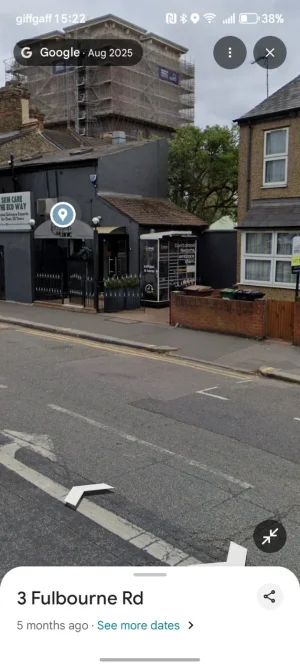
If you look at Google Maps on Fulbourne Road at the junction with Wood St and Forest Road there is an Amazon drop off/collection box in the direction of the driver's route. I wonder if that was a phone box back in the day?
Edited by me. Screenshot added.
Attachments
Last edited:
That Amazon drop off/collection box was only built there sometime between March-July 2021, but I like your thought process on that.Excellent post. I get what you're saying re the phone box, which is a decent bit down Fulbourne Road and why wouldn't he use a nearer box but as you have ascertained it is only a 4 minute walk from St David's Court to 2A Fulbourne Road so roughly a 30 second drive to get there, park up on the left and run across to the box.
Perhaps he had traffic directly behind him at a nearer box and this was his first opportunity to stop?
If you look at Google Maps on Fulbourne Road at the junction with Wood St and Forest Road there is an Amazon drop off/collection box in the direction of the driver's route. I wonder if that was a phone box back in the day?
Edited by me. Screenshot added.
I've not heard that DC McCleary had attributed the 6ft 4" reference to that of the 999 caller?Regarding the phone caller, DC Sean McLeary said "All we know of him is that he's around 6ft 4ins tall and slim".
The black male seen running was also described as being slim and around 6ft 4 tall.
The local press said the running man was witnessed at 10.45pm, which if accurate would mean that (if he's also the caller) he took over half an hour to reach the phonebox.
I thought it was solely regarding the man seen running from the building and into the road.
If DC McCLeary was indeed describing the man in the phone box, then that for me would surely confirm that it was the same man who was seen running from the building?
There's a very high probability that the man who made the 999 call at 23.18pm and who called to have just driven past the flats, was driving west to east along Forest road with the flats on his right.
He then drives past only 1 of 2 signs for the building that reads "St David's Court." (one on Forest road, the other at the back in Parkstone Road that isn't visible from the main road.)
As he approaches the building he sees the flames and reads the sign on the frontage of the building that reads "St David's Court."
He then gets to the traffic lights and almost certainly turns LEFT into Fulbourne Road which leads northward to Chingford; a location that the caller mentions specifically in the full 999 call.
The reason IMO why he doesn't continue east along Fulbourne Road, park up and then walk 4 minutes up Fulbourne Road to the public phone box, is because there was ANOTHER public phone box less than half the distance from the Fulbourne Road phone box, that was directly next to the first layby on the left after you pass the traffic lights (just before the Bus Stop that heads eastbound.)
So if the 999 caller had driven past, seen the fire, driven straight across the lights and parked up on his left (facing east) then he would have used the phone box next to him; which has a perfect line of sight to the flats.
If he did continue along Forest Road, and chose not use the phone box next to him, he would have instead needed to have walked back towards the traffic lights, turned right and then up Fulbourne Road to the phone box in which the 999 call was made.
The idea of the man continuing east along Forest Road therefore makes no logical sense.
That IMO proves that he turned LEFT at the lights, and then as he drove north up Fulbourne Road, he notices the phone box on the other side of the road, so he parks up on his left and then crosses the road and goes in to use the phone box to make the call.
Afterwards, he then crosses the road, gets into his car and continues his onward journey towards Chingford.
That would explain why he knew the name of the flats, but not the names of the roads, why he mentions Chingford, and why he uses the Fulbourne Road phone box instead of the other phone box in Forest Road that would have been less than half the distance to make the call.
That is of course based on the man being an innocent party who just so happens to drive past St David's Court and look up to see the flames up on the 6th floor.
If he was lying about driving, and he was to blame for the fires and/or the murder, then he would have needed to walk from the flats all the way up to the phone box, which would have been risky without a vehicle.
I believe that he had a vehicle regardless of whether he was guilty or innocent. IF the former, then he needed to have parked up somewhere close by. He may have started the fires, then run down and got into a vehicle, which he then drove north up Fulbourne Road, but as he approached the phone box, he gets out and makes the 999 call so that he isn't responsible for being a mass murderer from the whole building going up in flames.
So when he says that he was driving, I think that's true whether he was involved with starting the fires or not.
Interesting to note that the phone box was located directly outside a building called Cedar Wood House, which at the time and up until circa 2019, was a building that dealt with social housing and homelessness for the local area. It could be implied that the man who made the 999 call may have been familiar with the fact there was a phone box located there.
Cedar Wood House closed circa 2020, but is still there today
Interesting also that the phone box (as well as the one in Forest Road) were both removed sometime between late 2020 to early 2021.
if you look on Google street view, and look at previous dates, it takes you back to as early as 2008. When you scroll through the dates in reverse chronological order, you will see a timeline of the area that really builds a picture of the location. You can also see how the flats have changed since 2008.
You can also observe a CCTV camera on the external wall of the building that faces the door. It is easy to circumvent around to the back of the building and enter Parkstone road, without needing to use the main road.
Thanks. So the nearer phone box would be on Forest Road as you crossover the junction of Wood St/Fulbourne Road?That Amazon drop off/collection box was only built there sometime between March-July 2021, but I like your thought process on that.
Yes, that's correctThanks. So the nearer phone box would be on Forest Road as you crossover the junction of Wood St/Fulbourne Road?
I haven't checked Wood Street though, so there may have been another phone box to the south east of the building also.
Hilarious.Yes, that's correct
I haven't checked Wood Street though, so there may have been another phone box to the south east of the building also.
There was a phone box opposite the flats in Wood Street, just as you turn the corner on the other side of the road!
It was located outside the public toilets
THAT phone box was even closer!
So we can be almost certain that the man who made the 999 call didn't see or choose to not use the phone box just around the corner in Wood Street, meaning he MUST have driven east along Forest Road and then turned left into Fulbourne road as I suspected.
Otherwise, how did he miss the phone box in Wood Street just around the corner from the flats?
That phone box was removed some time between 2008 to 2011 when the public toilets were demolished
Interesting indeed
Here it was.
In Wood Street
Directly opposite the flats
And here's the Forest Road phone box
Excellent sleuthing.
And here's the Forest Road phone box
Totally a team effort. It's what happens when people with a shared interest work together as a collective.Excellent sleuthing.
So, there were 2 phone boxes nearer to the one at 2a Fulbourne Road that he made the 999 call from.
Difficult to get into the driver's mind re his decision. Unless he knew for definite there was a box on Fulbourne Road and knew it would be less than a minute's drive so was single minded/blinkered to the other boxes nearby.
Assuming that though would mean he knew the area better than he let on during the 999 call.
Curiouser and curiouser.
Difficult to get into the driver's mind re his decision. Unless he knew for definite there was a box on Fulbourne Road and knew it would be less than a minute's drive so was single minded/blinkered to the other boxes nearby.
Assuming that though would mean he knew the area better than he let on during the 999 call.
Curiouser and curiouser.
There's
It's a direct quote from one of the investigating officers about the phone caller being 6ft4 and slim.
I guess it's possible that DC McLeary was misquoted (the newspaper report contains some inaccuracies) or that he was quoted correctly, but mixed up his POIs.
It does seem a massive coincidence if the running man and the caller are both slim and 6ft4, but who knows?
The running man was seemingly seen at either 10.45pm, or at just after 10.30pm. The phone call wasn't until 11.18 pm, so there appears to be a big gap between the two sightings.
I've not heard that DC McCleary had attributed the 6ft 4" reference to that of the 999 caller?
I thought it was solely regarding the man seen running from the building and into the road.
If DC McCLeary was indeed describing the man in the phone box, then that for me would surely confirm that it was the same man who was seen running from the building?
It's a direct quote from one of the investigating officers about the phone caller being 6ft4 and slim.
I guess it's possible that DC McLeary was misquoted (the newspaper report contains some inaccuracies) or that he was quoted correctly, but mixed up his POIs.
It does seem a massive coincidence if the running man and the caller are both slim and 6ft4, but who knows?
The running man was seemingly seen at either 10.45pm, or at just after 10.30pm. The phone call wasn't until 11.18 pm, so there appears to be a big gap between the two sightings.
So, there were 2 phone boxes nearer to the one at 2a Fulbourne Road that he made the 999 call from.
Difficult to get into the driver's mind re his decision. Unless he knew for definite there was a box on Fulbourne Road and knew it would be less than a minute's drive so was single minded/blinkered to the other boxes nearby.
Assuming that though would mean he knew the area better than he let on during the 999 call.
Curiouser and curiouser.
Maybe he was deciding whether to call it in, or just leave it for someone else to report, and after a minute or two his conscience got the better of him?
Similar threads
- Replies
- 3
- Views
- 849

- Replies
- 6
- Views
- 2K

- Replies
- 1
- Views
- 2K

- Replies
- 3
- Views
- 2K

Guardians Monthly Goal

Goal Reached! We hit our target of 75 new Guardians!
New stretch goal: 100!
Our goal for the month is 75 new Guardians members to sign up. Have you been thinking about becoming a member?
Click here to find out how!


Online statistics
- Members online
- 65
- Guests online
- 3,427
- Total visitors
- 3,492
Totals may include hidden visitors.
Forum statistics
Community Rules
-
Be CivilTreat all members with respect. No personal attacks, harassment, or inflammatory language.
-
Victim FriendlyAlways show respect for victims and their families. No victim blaming or insensitive speculation.
-
Fact-based SourcingProvide credible sources for claims. Distinguish between verified facts and personal theories.
-
Social Media UseDo not post direct links to personal social media profiles of private individuals.
-
Copyright and PaywallsDo not copy full articles. Summarize and link to the original source instead.
-
Privacy and Personal InformationDo not post personal information such as addresses, phone numbers, or workplaces.
-
Registered Sex-OffendersDo not name or speculate about RSOs unless officially named in connection to a case.
-
Stay On TopicKeep discussions relevant to the case or topic at hand. Avoid off-topic tangents.
-
Accounts, Moderation, and DisputesOne account per person. Contact moderators privately for disputes or concerns.
-
Solicitation and FundraisingNo solicitation, fundraising, or promotion of personal ventures without approval.