

UK - Nurse Lucy Letby, Faces 22 Charges - 7 Murder/15 Attempted Murder of Babies #27

Status
Not open for further replies.
  • #721
12:30pm

The judge says Dr David Harkness noted, at 11.40pm, Child E had a desaturation, with colour changes on the abdomen - "a strange pattern over the tummy which didn't fit with poor perfusion" The legs and upper arms were 'pink in normal colour'. he said the only other time he had seen this was with Child A, and not since. The patches were 1-2cm big, and he carried out an emergency intubation.
Letby said there was a 'purple block' on the abdomen for Child E at 11.40pm. She said it was not like Dr Harkness had described. She said she found Child E's death "very traumatic", and filed a Datix form. She said the medical team were late administering a blood transfusion.
The defence challenged the decision not to give a blood transfusion earlier. A doctor had said she did not believe the collapse was due to blood loss, and that blood transfusion had its risks. She said she did not believe, "even with hindsight", Child E should have had a blood transfusion at that point.
The mother had contact with Letby after Child E died. She said Letby bathed Child E. In Letby's evidence, she said the parents bathed Child E.
A doctor said at the time, she believed Child E had died of NEC, and that a post-mortem examination would not tell the parents any more, and would delay their transfer back home. She had said NEC was the most likely cause of the gastro-intestinal bleed. No post-mortem examination was carried out.
She completely agreed, that with hindsight, she should have requested a post-mortem examination. She apologised to the parents for not pushing for that, having wanted to avoid further distress for them.
Letby said in messaging with Jennifer Jones-Key, in response to the unit being 'on a terrible run', that Child E had a haemhorrhage, and could have happened to anyone.
She said the searches for the parents of Child E and Child F more than once on Facebook was part of a normal pattern of behaviour for her, as was taking a picture of the card for the parents. She said it was something for her to remember, as was a photo of her shift pattern.

 
Last edited:
  • #722
I have to go out, so I hope someone else will take over the Chester Standard.
 
  • #723
I am in a different time zone, so the times are shown differently. Would it be too confusing for me to post what I have?
 
  • #724
12:44pm

The judge says Prof Arthurs said there was no evidence on the radiograph image for Child E of an air embolus, but that did not exclude it may have happened. He said there were no features of NEC on the x-ray.
Professor Sally Kinsey said Child E did not have a blood clotting problem.
Dr Evans said Child E was "incredibly stable", at increased risk of NEC, but suitable treated. He said if a baby had NEC, they would become "gradually unwell" and Child E would not have coped with handling in any way, and have a distended abdomen, along with other observations. He said NEC was not a viable explanation.
He said there was a significant haemorrhage and something must have caused this. He noted the 'unusual' discolouration, which prior to this case he had only seen in literature as evidence of an air embolus. He said there must have been some sort of trauma caused by a piece of equipment, such as an introducer. He said there was no "innocent explanation" for it. He said he has never seen an ulcer cause this type of bleed. He said the haemhorrhage was caused by trauma.
Dr Bohin says she formed her opinion on the case, and refuted 'going along' with Dr Evans' conclusions. She said the decision not to hold a post-mortem examination was "a poor decision".
Dr Bohin said babies with NEC do not go from being well one minute to very unwell the next. The 16ml aspirate before the 9pm feed "struck her" as being odd, and did not match Child E's clinical picture at that point, and was "at a loss" to describe where that had come from.
She said the NGT insertion can sometimes cause "very minor bleeding" in a baby, but not a haemhorrhage. The blood vomit was "an extremely unusual feature". Dr Bohin had never seen a baby have a gastric haemhorrhage in this way, the court is told.
She believed Child E died of an air embolus.

 
Last edited:
  • #725
12:53pm

The judge refers to the case of Child F.
On July 31, 2015, Child F was given a dose of insulin to treat high blood sugar levels, and he stabilised.
On the day of August 3, other than a minor respiratory issue when Child F was taken off CPAP, all was well, and he was tolerating feeds.
The prosecution allege Child F was given insulin via a nutrition bag hung up on August 4-5, and that the next bag hung up at noon on August 5, a stock bag from the fridge, had a similar amount of insulin put in it.
The jury is reminded of the relationship between insulin and insulin c-peptide levels, naturally occurring in the body, and the relationship between those two in synthetic insulin.
The defence say the proof is on the prosecution, that the jury must be sure that Child F and Child L received synthetic insulin, and that it was Letby who administered that. They ask if Letby was intent on harming Child F, why she did not attack that baby on subsequent shifts.

 
Last edited:
  • #726
1:01pm

A new TPN [fluid nutrition] bag was hung at 12.25am on August 5 for Child F.
Yvonne Griffiths said the fridge contains stock bags for Babiven and start-up Babiven, and insulin. That fridge was kept locked, with one set of keys, initially in the hands of the shift leader but available on request. There was no system for signing the keys in or out.
Child F was the only baby on that night shift of August 4-5 who was receiving TPN.

 
Last edited:
  • #727
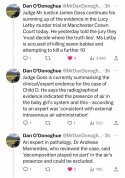
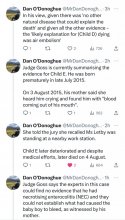
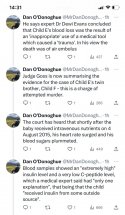
From Twitter today
B121DDF1-0F66-4C0B-B410-9245E0A2F0D8.jpeg
 

Attachments

  • 1651932E-91D6-43C6-94F0-624F64096A1A.jpeg
    1651932E-91D6-43C6-94F0-624F64096A1A.jpeg
    121.2 KB · Views: 12
  • 23DAF7D9-C4EE-4185-B12A-221FBE483830.jpeg
    23DAF7D9-C4EE-4185-B12A-221FBE483830.jpeg
    119.8 KB · Views: 12
  • #728
2:20pm

The trial judge clarifies a matter from this morning, and says during the cross-examination of Prof Arthurs, it was said that gas could be recirculated in the body in the event of vigorous resuscitation.
He continues with the case of Child F. He says a nurse was "really happy" with Child F from 10pm-1am. There was "no way of knowing" who had got the bags out of the fridge.
Prof Peter Hindmarsh says the bag administered at 12.25am had insulin in.
Dr Harkness attended the unit that night and noted Child F had vomits and tachycardiac, with a heart rate of 200bpm, but otherwise well. Prof Hindmarsh said these were signs of hypoglycaemia.
Doses of dextrose and salt water were administered.

2:32pm

Kate Bissell and band 4 nurses said they had never added anything to a TPN bag.
Dr Gibbs said the fall in Child F's blood sugar level was 'unexpected'.
At 10.30am, a new long line was to be inserted in Child F, as instructed by Dr Satyanarayana Saladi, with the removal of the old one.
The fluids were stopped while the line was replaced, and Child F's blood sugar level rose. A new TPN bag, from the stock bags in the fridge - of which there were about five - was hung up at noon. Fluids resumed.
Child F's blood sugar levels remained low in the afternoon after dextrose boluses at 3pm and 5pm.
The TPN bag was stopped at 7pm.

 
  • #729
2:40pm

The judge details how the insulin blood sample was taken to the laboratory in Liverpool and analysed, and the results came back showing an 'undetectable' level of insulin C-Pep compared to a high level of insulin.
It was suggested that the sample be referred for further tests, but Child F had recovered by this stage, so the sample was stored for seven days before being disposed of.
Prof Hindmarsh said the increased blood sugar readings for Child F during the afternoon were consistent with them following fresh bolus administrations of dextrose.
The blood glucose had 'started to rise spontaneously' between 10.30am-noon, Prof Hindmarsh said, during the time the fluids were not being administered.
He said the difference between the blood glucose levels on a heel prick and a plasma sample would be about 10-15%. He said the dangers of low blood sugar include confusion, seizures, brain damage and in serious cases, death.

 
  • #730
2:52pm

The judge says the court had heard the most likely cause of insulin administration was for it to be administered intravenously. Prof Hindmarsh says the most likely way for this was via an infusion, at a rate of 1.2 units per hour, and calculated that 0.6ml of insulin - a clear fluid - was added. He says the same amount would have been needed to have been added to the stock bag.
He concluded that the only explanation was for Child F to have received bags contaminated with insulin.
Dr Evans concluded Child F had received exogenous insulin via the TPN bag from before 01.54am to before 7pm. Dr Bohin agreed, and said two bags must have been contaminated with insulin.
When interviewed, Letby remembered Child F as the surviving twin of Child E. She agreed her signature was for a TPN bag, and could not remember if she had administered the TPN bag or not. The bags were kept at the top of the fridge, the insulin at the bottom.
Letby said medication would not be added to a TPN bag. She agreed the blood sugar level for Child F at 1.54am was "dangerously low", and denied harming Child F or giving him any insulin.
Letby, in evidence, said she believed her nursing colleague had hung up the TPN bag. She confirmed she did not know about c-peptide at that time. She knew adding insulin was "life threatening" to a child like Child F.
She said Facebook searches for the parents was because the twins were on her mind.

 
  • #731
2:59pm

The judge refers to the case of Child G, born in a tertiary unit, and was "very premature", weighing just under 1lb 3oz. She was "at the margins of survival" when born. On August 13, Child G was transferred to the Countess of Chester Hospital, and was "stable".
Letby said she remembered Child G, who had "a lot of problems". The prosecution case is Letby deliberately overfed Child G.
Dr Stephen Brearey first reviewed Child G on August 22, and the general trend was one of improvement for the baby girl. She was "stable and well", with desaturations self-correcting. The oxygen requirement was "continuing to come down".
For September 6-7, the night shift, Child G was the only baby in room 2, and Letby had a baby in room 1.

3:10pm

The prosecution case is after the 2am feed for Child G, administered by a colleague, Letby deliberately injected milk and air afterwards.

3:17pm

September 7, 2015 was Child G's 100th day of life, and a banner was prepared to celebrate that on the unit.
Child G was still on nasal prongs and some oxygen, and was "stable".
A nurse said she usually completed the chart after the feed. The 2am, 45ml feed was given via an NGT. Letby agreed the readings were good at this time.
The nurse said an aspirate was taken from Child G for a pH check, this level being 4. She then went on her break at 2.05am-2.10am. When she returned, she found Child G had deteriorated with a projectile vomit. The deterioration had come as a surprise to her.

 
Last edited:
  • #732
3:25pm

Shift leader Ailsa Simpson said she was at the nursing station with Letby when she heard Child G vomit - when they went over, the alarm for Child G went off, and there was "a large amount of milk" fed, and the vomit was on the cot, on the floor and on the chair adjacent to the cot.
Respiratory support was given via Neopuffs.
Letby had said, in evidence, she had no contact with Child G prior to the vomiting episode. She said she was aware Child G had a lot of ongoing issues, but the observations were good up to that 2am feed. She said she had been with Ailsa Simpson when they heard Child G vomit, and the alarm had gone off. She said when they arrived, no-one else was in there. She said they immediately started to give Child G Neopuffs. She identified a possible problem of the nursing colleague overfeeding Child G, but did not believe that likely.
In police interview, Letby said it was a "shock" for three deaths in June-September 2015, and "didn't feel there was anything to need to look into". She said the nursing colleague was on a break when the vomit happened. She said sometimes babies vomit, but did not often projectile vomit. She said when babies vomit, they can taken on air when gasping. She added she was not sure of the cause of air in Child G's abdomen.
In a separate police interview, Letby said Child G had either received more than 45ml milk, or had undigested milk from a previous feed. She said it was an oversight from a previous interview that she had not mentioned the vomit going on the floor and the chair by the cot.

 
  • #733
3:35pm

Dr Alison Ventress said the vomit had been reported to her. For a description of Child G being in distress, and the abdomen purple and distended, she could not recall if that was something she had seen or was told, and the same went for Child G's watery stool, and a subsequenty improved abdomen.
Dr Ventress was then called urgently to theatre. She said by this time, Child G was looking better. She was called out of theatre before 3.30am as Child G was apnoeic and had desaturated, and it took five minutes for the saturations to pick back up. Child G went to room 1, and had a further profound desaturation. At the time of insertion of an ET Tube, blood-stained fluid was noted beneath the vocal cords, which Dr Ventress noted was "unusual".
Dr Brearey said he had not seen a projectile vomit in a pre-term baby like Child G.
There was a further profound desaturation at 6.05am, and the decision was made to reintubate Child G. 'Thick secretions++' in the mouth and a blood clot in the breathing tube was noted. The NG tube was aspirated and 100ml was aspirated. Dr Ventress said she was not sure it was air, as that was not documented, as it would be noted otherwise. Dr Brearey took the '100ml' reading to be fluid or milk.
Letby's case, the judge says, is she did nothing wrong, and did not falsify notes. She accepted air or milk could have been pushed from the feeding syringe into Child G's throat. She denied doing so.

 
  • #734
3:25pm

Shift leader Ailsa Simpson said she was at the nursing station with Letby when she heard Child G vomit - when they went over, the alarm for Child G went off, and there was "a large amount of milk" fed, and the vomit was on the cot, on the floor and on the chair adjacent to the cot.
Respiratory support was given via Neopuffs.
Letby had said, in evidence, she had no contact with Child G prior to the vomiting episode. She said she was aware Child G had a lot of ongoing issues, but the observations were good up to that 2am feed. She said she had been with Ailsa Simpson when they heard Child G vomit, and the alarm had gone off. She said when they arrived, no-one else was in there. She said they immediately started to give Child G Neopuffs. She identified a possible problem of the nursing colleague overfeeding Child G, but did not believe that likely.
In police interview, Letby said it was a "shock" for three deaths in June-September 2015, and "didn't feel there was anything to need to look into". She said the nursing colleague was on a break when the vomit happened. She said sometimes babies vomit, but did not often projectile vomit. She said when babies vomit, they can taken on air when gasping. She added she was not sure of the cause of air in Child G's abdomen.
In a separate police interview, Letby said Child G had either received more than 45ml milk, or had undigested milk from a previous feed. She said it was an oversight from a previous interview that she had not mentioned the vomit going on the floor and the chair by the cot.


Thanks very much for the updates. So according to this report, they started Neopuffing immediately without clearing the airway first? You can clear it with even just a bulb syringe or wall suction. Or maybe this detail is omitted for some reason?
In my experience— always clear the airway first, otherwise you are sending secretions and milk back down the airway. Mary NNU -/ is that still current practice as far as you know?
IMO, if guilty.
 
  • #735
3:53pm

Child G was readmitted to Arrowe Park Hospital on September 8, 2015 with presumed sepsis. She was very unwell on arrival, with severe hypertension. A radiograph, Prof Arthurs said, was not a sign of NEC.
The baby girl gradually improved to the point of returning to the Countess of Chester Hospital on September 16.
Dr Evans said Child G was compromised by receiving a large volume of milk and air, and this was not unique to babies. He proceeded on the basis the stomach of Child G was empty prior to the 2am feed, and a pH reading of 4 was indicative of an empty stomach. He said babies fed by NGT "do not vomit". He said Child G suffered significant oxygen deprivation which caused irreversible brain damage. He concluded Child G must have had more than 45ml of milk.
Challenged on this, he said this was the first case he looked at, and reached his conclusion without looking at any other cases.
Dr Bohin said the vomit was "extraordinary", and said it was impossible to say how big Child G's stomach was, but the excess volume of milk would not be much to compromise the lungs. She detailed a number of desaturations and events for Child G in June-July 2015.
She concluded that it was "clear" by September 7, Child G was tolerating feeds. A pH reading of 4 was not consistent with there being a large amount of undigested milk in the stomach - she said if there was, the milk would have neutralised the pH reading [to 7]. She concluded Child G's stomach was empty.
It was put to Dr Bohin that she was modifying her opinion based on the accounts of the nurse and Dr Evans. She refuted that, and said she based the level of milk on the pH reading, not anything Dr Evans had said. She concluded Child G must have had a large amount of milk and air administered after the 2am feed.
 
  • #736
4:01pm

The judge refers to the events on September 21 for Child G, during the day shift, at 10.20am and 3.40pm.
Child G was, the court is told, in a "satisfactory" condition.
He says there was an event at 10.20am had two projectile vomits and went apnoeic, colour loss, and desaturation to 30%. Letby, the designated nurse, said she remembered the incident, and Child G was due to receive immunisations.
The event had happened after a 40ml feed at 10.15am. Child G was being treated as 'a term baby'.
Dr Peter Fleming recorded the projectile vomits, and that Child G went apnoeic for '6-10 seconds'. He discussed the case with Dr Rachel Change, and the course was to leave the NGT on free drainage, as the abdomen was distended. Child G was to be transferred to room 1.

 
  • #737
4:13pm

Care had been transferred to a nursing colleague on September 21. She said Child G's heart rate was high when she first took over, but had settled by 12.45pm.
After the vomits, Child G was 'nil by mouth'.
Dr Chang noted Child G was pale and had a feed delayed, and the baby was "not herself". The tummy was "soft and distended" so a screen for sepsis was planned.
Child G needed to be cannulated, and this required seven attempts, successful on the seventh attempt by Dr Gibbs, by which time Child G had been without fluids for six hours.
A nursing colleague remembered Dr Harkness and Dr Gibbs arriving, and believed Child G was behind screens and on a trolley. She said when the doctors finished the procedure, they would let a nurse know, and the baby would be put in the cot. She next saw Child G when Letby called her for help.
She saw Letby providing breathing support for Child G, and the nurse could see Child G was 'a poor colour'. The monitor was switched off. She shouted for nurse Caroline Bennion, and Child G responded to treatment, and was transferred to room 1. Child G was placed in an incubator.
Letby, in evidence, said screens were put up for the procedure for Child G. She said it was 'common practice' for nurses to look behind screens, and said she saw Child G behind the screen, alone, on a trolley, blue and not breathing, and the monitor was switched off. She said she was keen to put a Datix form about the incident. She said she did not take it further as the nursing colleague said the situation was in hand.
She said in police interview, it was 'bad practice' for the monitor to be switched off and 'somebody had made a mistake' in leaving Child G unattended behind screens on a trolley with the monitor off.
She did not remember making numerous searches for Child G's mother on Facebook. She had no comment to make about them.
Dr Gibbs accepted the monitor should not have been switched off. He admitted he had no recollection after the cannulation, and accepted it was possible, and said if the nurse said it had happened, then it happened, and he apologised for doing so.
Dr Harkness said he did not recall the monitor being detached, and would probably have told a nurse when they were finished. He said it was "possible" Child G was behind a screen unattended.
Caroline Bennion recalled Child G needed to be cannulated. Eirian Powell had no recollection of anything untoward clinically being brought to her attention.

4:23pm

The prosecution say Letby was incorrect when she messaged a colleague to say Child G 'looked rubbish' when she took over care for her that morning. Letby accepted she made an error on recalling the timing of the vomit, but said Child G looked pale on handover.
Dr Evans said he had 4,000 pages of material for Child G alone, and concluded the episode of projectile vomiting was "life threatening", and said Child G had been given far more milk than intended, more than 40ml. He accepted the events on September 21 were not as serious as those on September 7.
Dr Bohin said the "feeds didn't add up" and the events of September 21 were "strikingly similar" to September 7, but the consequences were not as serious for the September 21 event.
Prof Arthurs said if a baby had been deliberately overfed, that would not necessarily show up on an x-ray.

 
Last edited:
  • #738
I have to go out shortly - can somebody take over the Cheshire Standard live feed, please? Thank you <3
 
  • #739
Thanks for doing it! Looks as if they may be finishing for the day.
 
  • #740
That concludes the coverage for today.
The trial will continue tomorrow morning with the trial judge summing up in the case of Child H.
The Standard will continue to provide live updates from court.

 
Status
Not open for further replies.

Guardians Monthly Goal

Staff online

Members online

Online statistics

Members online
172
Guests online
3,301
Total visitors
3,473

Forum statistics

Threads
641,326
Messages
18,771,056
Members
244,773
Latest member
luc1fer12
Back
Top