

US threatens to annex Greenland - 2025/2026

  • #241
I didn’t vote for Trump and I don’t want this. And many of the people I know feel the same way. Not all Americans are bad; there’s a good percentage of us who are downright decent people, not ignoramuses with one brain cell (if that). MOO
Yes it feels slightly unfair and unrealistic to say that the majority of Americans support Trump and the things that are happening in this country because it’s simply not the case. I’ve voted in every single election since the year 2000 when I was 18, local and national, and I have voted for Republicans and Democrats, I have been registered as a Democrat and as a Republican throughout the years. I have never cast a vote for Donald Trump and I don’t like anything that is happening in this country. It’s a shame that we only have 2 parties in this country and I would love it if that wasn’t the case because I think it would really help alleviate a lot of the decisiveness that has led us to this point. I also do not think Democrats are really the “good guys” in this country, but they are the lesser of 2 evils at this point. All MOO.
 
  • #242
  • #243
  • #244
Merely an opinion, but we've seen a hard black & white divide within the US for a few year. Both political sides refuse a centrist position, both are determined to "win" at all cost.
My fear is not based just on the US atm! Altho Trump and his cronies both within and outside the US are certainly not helping! MOO
 
  • #245
Merely an opinion indeed. Many of us did not vote for this.
I think that fact (that not all US-ians voted for Trump/Republicans) is generally known outside the US! I'm not in the US either.

I think @otto or CBC should have said something like: "Trump was elected because that is who a large percentage of the people of the US are today." My addition in italics. Then people can always discuss exactly how large that percentage is - 45%, 52%, 75% etc, if they want. I'm not suggesting that's the new topic of conversation on here.

That theory has been used before, outside the US too. I'm not going to list examples because I don't want to set off a discussion of all those other times in other countries.
 
  • #246
Europe is very aware of their failings prior to WW2, and the mistake of appeasing aggressive authoritarian governments. Those lessons are not forgotten.

The EU knows from experience that conceding anything in relation to sovereign nations will enable and entitle the aggressor. The aggressive United States cannot continue to be treated as some sort of psychologically warbled nation where flattery of the president is the solution to absurd notions.

"On September 29–30, 1938, an international conference took place in Munich. The attendees were Chamberlain, Hitler, French Prime Minister Édouard Daladier, and Italian dictator Benito Mussolini. The Czechoslovak government was not included in the negotiations. In Munich, Chamberlain and the others agreed to the cession of the Sudetenland from Czechoslovakia to Germany, effective October 1. In exchange for the Sudeten concessions, Hitler renounced any claims to the rest of Czechoslovakia. War was averted for the time being. The British, French, and Italians blatantly disregarded Czechoslovakia’s sovereignty in the name of avoiding war.

The Munich Agreement was Britain’s most significant act of appeasement to date.

Churchill claimed that the British policy of appeasement had “deeply compromised, and perhaps fatally endangered, the safety and even the independence of Great Britain and France.”

The Munich Agreement failed to stop Nazi Germany’s territorial aggression. In March 1939, Nazi Germany dismantled Czechoslovakia and occupied the Czech lands, including Prague. Based on Hitler’s rhetoric, it was clear that the Nazis’ next target was Poland, Germany’s neighbor to the east.


~ in my humble opinion ~
Sudetenland was idea rather than a truly defined area within the borders of Germany pre-WW1. As a corollary it would be like saying, okay we'll give portions of Ontario to France because there's so many French speaking people who live within the boundaries. So it was easy for the Allies to cede it to Germany. The problem was the Versailles Treaty was too harsh on Germany and culminated in WW2. They took away Germany's industrial heartland in the Ruhr valley making it next to impossible (in the Allies eyes) to become a viable threat again. The Versailles agreement was so harsh the allies really believed that there was no way that Germany could ever be a military threat again. Yet they managed to create a standing army, had numerous shipbuilding and aircraft building capabilities as well as transforming companies like VW making 'the people's car' into an operation that was building treaded military vehicles. And they did it with input from Russian and American manufacturers. They did it in secret by having Germany's military on their side and the quiet approval of the German people whose lives had been in tatters for nearly 20 years.

Now the world is a much smaller place than it was nearly 90 years ago. We have so much technology that gives us up to the minute information (although sometimes we have to wade through the fake stuff) where countries are very aware when the drums of war start beating. It might be a happy beat at first but if the underlying motive is to take away something from someone under the guise of protection we are rightly suspicious and start making plans to subvert any kind of hostile or friendly takeover.
 
  • #247
War sounds exciting to many in the US. It's great evening entertainment with live-stream protests and endless fighting, taunting, ridicule, name-calling, the usual oneupmanship with the occasional death. Everyone learns to chant with swearing every third word. That's what people outside the US see.
I don't see that actually, and I'm outside the US. I haven't heard in my circle of friends that anybody sees it quite that way either. MOO
 
  • #248
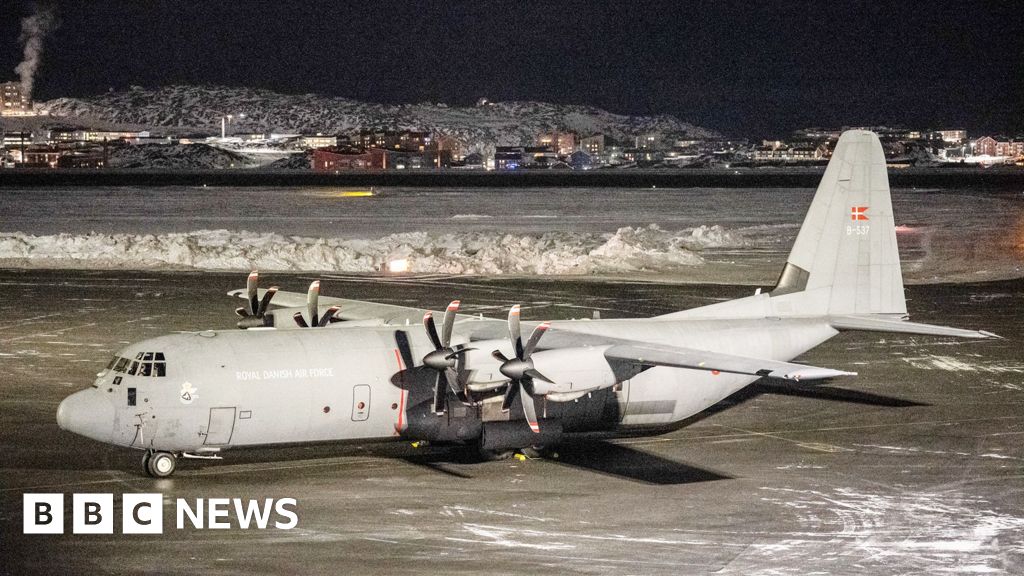
"I don't think troops in Europe impact the president's decision-making process, nor does it impact his goal of the acquisition of Greenland at all," White House spokesperson Karoline Leavitt said.

Denmark's defence minister, Troels Lund Poulsen, said from Copenhagen that he did not have a final figure for the envisaged expansion of NATO's presence in Greenland.
"But it is clear that we now will be able to plan for a larger and more permanent presence throughout 2026 and that is crucial to show that security in the Arctic is not only for the Kingdom of Denmark, it is for all of NATO," he said.

In Nuuk, Greenland, business owner Mads Petersen said it would be strange to see more troops.
"I don't hope it is the new normal," he said.


Guardians Monthly Goal

Members online

Online statistics

Members online
158
Guests online
4,988
Total visitors
5,146

Forum statistics

Threads
638,060
Messages
18,722,203
Members
244,261
Latest member
L.vgee
Back
Top