


I stand corrected. The child's mother was 10 KM away, not 10 minutes. My apologies.I think that what was said is that mum and grandparent had travelled about 10 km away to tend the sheep (or fix fences, or find lost sheep, or whatever reason MSM has decided).
I haven't seen anything that says that they were looking for sheep for 10 minutes?
imo
The boy’s mother and his other grandparent were 10km away, tending to the station’s sheep.

Scorching heat set to hinder outback search efforts
More than 100 team members are searching for four-year-old Gus amid scorching temperatures.7news.com.au



You are using an out of date browser. It may not display this or other websites correctly.
You should upgrade or use an alternative browser.
You should upgrade or use an alternative browser.
Australia AUSTRALIA - 4YO AUGUST (GUS) Missing from rural family home in Outback, Yunta, South Australia, 27th Sept 2025
- Thread starter jypsijemini
- Start date
-
- Tags
- south australia


I'm a bit late, I wasn't on in time yesterday to see this before LE finished searching the shafts, but I have permission from Total_C to post this awesome probability check:
"A simple probability check on the “wandered into a mineshaft” idea
I wanted to sanity-check the notion that a just-turned-4-year-old wandered off around 5 pm in late September and somehow ended up in one of six mine shafts located between 5.5 and 12 km from the homestead. This is purely geometry and physical limits.
1. How far a 4-year-old can realistically travel
To give this scenario every benefit of the doubt:
Walking speed for a small child in that terrain is roughly 2 km/h.
Maximum continuous movement before dark, cold and exhaustion is about 4 hours.
This gives an upper-limit straight-line radius of 8 km. That already assumes no stopping, no crying, no fear, no lying down, no looping, no terrain issues and perfect direction. Anything at 12 km is essentially out of physical reach.
2. Size of the actual target
Even being generous, if each shaft is roughly 5 m by 5 m, that is 25 m² of surface opening per shaft.
Six shafts give a combined “danger zone” of about 150 m².
3. Area the child could be in
A circle with an 8 km radius covers:
π × 8000² ≈ 201,000,000 m²
Now compare that with the combined 150 m² footprint of the shafts.
150 divided by 201,000,000 ≈ 0.00000075
That equals about 0.000075 per cent, or roughly one chance in 1.3 million.
This is already using extremely favourable assumptions for the shaft scenario.
4. Real behaviour makes the odds even lower
Four-year-olds almost never walk in a continuous straight line for hours. They wander, turn back, sit, hide, cry, freeze from fear or darkness and are slowed by terrain. All of this reduces the realistic radius, not increases it. Which means the shafts at 5.5 to 12 km lie well outside typical child-wander distances.
5. What this means once you add the known behaviour
The maths alone makes the “wandered into a distant shaft” scenario microscopic. But when you place that next to the post-incident family behaviour, which many have noted as atypical for a missing-child situation, it becomes even harder to support the wander-off theory.
The elements most people find unusual are:
• delayed reporting timeline
• hostility toward media contact
• communicating only through intermediaries
• unusual living arrangements, with the father living elsewhere from the mother and children
• complete absence from media appeals or public pleas for assistance
Individually, some of these could be explained away. Taken together, they form a pattern that does not align with what we normally see in genuine missing-child incidents where families desperately seek attention, exposure and help.
When you combine the statistical improbability with the behavioural context, the “wandered off and fell into a distant shaft” explanation becomes extraordinarily weak.
From a numbers standpoint alone, it simply does not hold weight."
While I agree on the premise that it is improbable to have occurred 12 km away, it is not improbable to have occurred within close vicinity to the house, if a shaft or mine exists closer to the house than is known. This is still probable (no matter the percentage of probability) until it is deemed improbable by ground scanning the entire area. Freak accidents are exactly that, freak accidents. The probability of a freak accident occurring may be 1% but even at a low percentage, it is still possible. Nothing can be negated or ruled out, to be fair and accurate, until there is zero percent probability.
Not wanting media attention may have nothing to do with Gus but rather fear of the focus going on his GM for the gender change as opposed to the grandson, because he is missing. Unfortunately, stigma is still alive and well, and sometimes the media "throws spaghetti at the wall to see what sticks", so to speak.
Delayed reporting may be because they didn't think he was missing, perhaps they thought he would show his wee face any minute. Then the minutes became longer until they realised that there was nothing else that they could do on their own and that they needed assistance if they were to find their son/grandson.
Father and mother may not be in a domestic relationship anymore. If this is the case, then no, it would not be unusual for them to live in separate abodes, and it would not be unusual for this child's mother to live at home where there is family support for her and her child.
Hostility towards media, oh, I can absolutely understand that! My SIL had collapsed on the front lawn of her home while the fire brigade was trying to get her young son's body out of a burning building, and the media was in her face, trying to catch her emotions for their audience. My MIL didn't take kindly to it either and physically pushed the media off of their property. The media can be.... let's say...more interested in a story than the emotional toll being experienced by a mother and/or family.
<modsnip: AI is not an approved source for facts in a case>
I have wondered if his mother had left the homestead in a vehicle to check on the sheep, and he was hiding in the vehicle, or if any other family members had come and gone during that time. This would give an opportunity for Gus to leave the property without leaving any evidence behind.
Just what if........ the grandmother remembers the timeline incorrectly for reasons unknown.
Just what if....... the daughter left just after her mother went inside.
Just what if .......... not everything is as it was remembered.
What then, what difference could that make?
Could it explain how Gus had "disappeared" without a trace?
Last edited by a moderator:


- Joined
- Jan 23, 2021
- Messages
- 17,989
- Reaction score
- 110,755
" 'Four-year-olds, they drop everything',
Yorke Mid North Superintendent Mark Syrus
said in early October.
'The fact we haven’t found a hat or a shoe or something is pretty unusual'.”


Interesting… Hmmm"From Beaumont children to Gus Lamont,
South Australia’s painful history of missing persons
drives new police powers.
View attachment 627245
More than 5000 missing persons cases
are reported in South Australia every year.
Police in South Australia have been handed stronger search and entry powers in high‑risk missing persons investigations,
a reform designed to give officers the ability to act faster when vulnerable people vanish.
The legislation,
passed through State Parliament,
allows senior officers to authorise entry into homes, vehicles, vessels or other places without the owner’s consent
if they reasonably suspect a missing person
— or information about them — is inside.
Authorisations can last up to 48 hours,
after which police must seek approval from a Supreme Court judge to continue."

From Beaumont children to Gus Lamont, South Australia’s painful history of missing persons drives new police powers
More than 5000 missing persons cases are reported in South Australia every year.



- Joined
- May 18, 2016
- Messages
- 739
- Reaction score
- 5,984
Dbm
Last edited:

the problem I have with all of this is: why didn't he cry out?I'm a bit late, I wasn't on in time yesterday to see this before LE finished searching the shafts, but I have permission from Total_C to post this awesome probability check:
"A simple probability check on the “wandered into a mineshaft” idea
I wanted to sanity-check the notion that a just-turned-4-year-old wandered off around 5 pm in late September and somehow ended up in one of six mine shafts located between 5.5 and 12 km from the homestead. This is purely geometry and physical limits.
1. How far a 4-year-old can realistically travel
To give this scenario every benefit of the doubt:
Walking speed for a small child in that terrain is roughly 2 km/h.
Maximum continuous movement before dark, cold and exhaustion is about 4 hours.
This gives an upper-limit straight-line radius of 8 km. That already assumes no stopping, no crying, no fear, no lying down, no looping, no terrain issues and perfect direction. Anything at 12 km is essentially out of physical reach.
2. Size of the actual target
Even being generous, if each shaft is roughly 5 m by 5 m, that is 25 m² of surface opening per shaft.
Six shafts give a combined “danger zone” of about 150 m².
3. Area the child could be in
A circle with an 8 km radius covers:
π × 8000² ≈ 201,000,000 m²
Now compare that with the combined 150 m² footprint of the shafts.
150 divided by 201,000,000 ≈ 0.00000075
That equals about 0.000075 per cent, or roughly one chance in 1.3 million.
This is already using extremely favourable assumptions for the shaft scenario.
4. Real behaviour makes the odds even lower
Four-year-olds almost never walk in a continuous straight line for hours. They wander, turn back, sit, hide, cry, freeze from fear or darkness and are slowed by terrain. All of this reduces the realistic radius, not increases it. Which means the shafts at 5.5 to 12 km lie well outside typical child-wander distances.
5. What this means once you add the known behaviour
The maths alone makes the “wandered into a distant shaft” scenario microscopic. But when you place that next to the post-incident family behaviour, which many have noted as atypical for a missing-child situation, it becomes even harder to support the wander-off theory.
The elements most people find unusual are:
• delayed reporting timeline
• hostility toward media contact
• communicating only through intermediaries
• unusual living arrangements, with the father living elsewhere from the mother and children
• complete absence from media appeals or public pleas for assistance
Individually, some of these could be explained away. Taken together, they form a pattern that does not align with what we normally see in genuine missing-child incidents where families desperately seek attention, exposure and help.
When you combine the statistical improbability with the behavioural context, the “wandered off and fell into a distant shaft” explanation becomes extraordinarily weak.
From a numbers standpoint alone, it simply does not hold weight."
why didn't the family dogs (sheep herders?) or LE's dogs find him? he's a little
kid, so he would probably pee or poop within 12-24 hrs and that would be trackable.
It is such a remote area- he is a cute child, but who would have even seen him to want to
take him?

- Joined
- Nov 27, 2021
- Messages
- 68
- Reaction score
- 509
Exactly, and also remember that just because it is undocumented and unmapped doesn't mean it is unknown, possible family, workers, etc have knowledge of it.This would mean that an undocumented and unmapped mine or shaft may exist on this child's GM farm, and that this child has found it,
Little kids are very slippery little devils.Little Gus seems to have outfoxed one of the most skilled and technologically sophisticated search and rescue operations in the region.


- Joined
- Jun 9, 2012
- Messages
- 2,882
- Reaction score
- 24,635
There is no context. It was during the night on ABC Late Nights. There was a contest where you had to answer 2 questions. This bloke started talking randomly that missing kid Gus only has himself and 'Fleur' looking for him. Because it was so random, the announcer shut down that discussion and got on with the quiz.Whoa, what? Sorry, can you give some more context?
- Joined
- Jun 9, 2012
- Messages
- 2,882
- Reaction score
- 24,635
I haven't read they were only gone for 10 minutes. I have heard that they had gone 10 kilometres from the house to tend to sheep.The latest news article I have seen says the mines have been searched and that they have come up with nothing of significance (my words). I also remember reading in another news article that another farm in the area was still finding undocumented and unmapped mines and shafts on their own property.
This would mean that an undocumented and unmapped mine or shaft may exist on this child's GM farm, and that this child has found it, unfortunately.
It's possible he tried to go in the direction that his mother and GM went when looking for the sheep, and he encountered one of these pitfalls (mines or shafts).
I am thinking back to when I lived on a farm, and my 4-year-old decided to wander away from the house. Curiosity saw him covered in used oil from an oil drum that the neighbour had in one of their farm sheds. And yes, my child was fenced in in a play area when he disappeared. Unfortunately, children do get bored, and they do "explore." Thankfully, I found him before he encountered a worse outcome.
10 minutes, they (GM and Mother) said, was the duration of time that they were out looking for the lost sheep. In 10 minutes (at a minimum), children can travel some distance, and/or they can get themselves into situations that they can't get themselves out of. And that's not saying that at exactly the 10-minute mark, the child stopped travelling, as that would be an assumption if I were to conclude that.
This child cannot survive long without fluid/water (3-4 days).
The only way that I can fathom that he would have survived this long away from his family is if he had been taken. And while I do remember one case where a young child was taken/abducted in Australia and found 18 days later was wee Cleo Smith, but I understand that her recovery was deemed extremely rare.
Do you have a link for them searching for sheep for only 10 minutes?
- Joined
- Jun 9, 2012
- Messages
- 2,882
- Reaction score
- 24,635
It was ABC Radio Night Life. Could have been around 1-3 am. Quiz show. People had to answer 2 questions to go in the draw for a prize. This bloke simple went off track talking about Gus. The announcer cut him off and got back on topic.What time was this roughly? Was it on a particular program? Other's maybe able to listen on playback radio.
- Joined
- Jun 9, 2012
- Messages
- 2,882
- Reaction score
- 24,635
It was ABC Radio Night Life. Could have been around 1-3 am. Quiz show. People had to answer 2 questions to go in the draw for a prize. This bloke simple went off track talking about Gus. The announcer cut him off and got back on topic.

Overnights - ABC listen
On Overnights, there's great music and interesting guests from Australia and all parts of the globe.
 www.abc.net.au
Sorry, I think it was overnights.
D
Deleted member 371916
Guest
the problem I have with all of this is: why didn't he cry out?
why didn't the family dogs (sheep herders?) or LE's dogs find him? he's a little
kid, so he would probably pee or poop within 12-24 hrs and that would be trackable.
It is such a remote area- he is a cute child, but who would have even seen him to want to
Why is Fleur Tiver, from the neighbouring property, so adamant Gus wasn’t taken?the problem I have with all of this is: why didn't he cry out?
why didn't the family dogs (sheep herders?) or LE's dogs find him? he's a little
kid, so he would probably pee or poop within 12-24 hrs and that would be trackable.
It is such a remote area- he is a cute child, but who would have even seen him to want to
take him?
Is it because she would’ve seen or heard a vehicle as Oak Park Road passes close to her homestead and there was not a vehicle on that road September 27 until the police were called?

- Joined
- Aug 9, 2012
- Messages
- 34,226
- Reaction score
- 340,264
Why is Fleur Tiver, from the neighbouring property, so adamant Gus wasn’t taken?
Is it because she would’ve seen or heard a vehicle as Oak Park Road passes close to her homestead and there was not a vehicle on that road September 27 until the police were called?
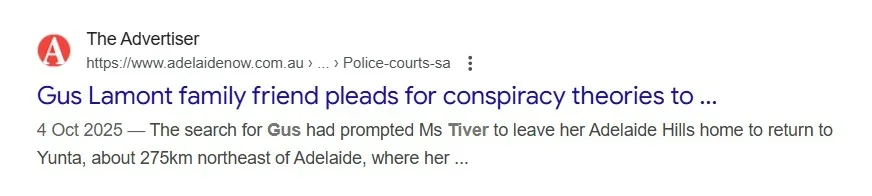
Fleur lives in the Adelaide Hills.
This is my previous post about this.

As a neighbour, Fleur may be concerned about her own safety. Imo
It seems like a dangerous part of the woods in which to reside.
One definitely doesn't want to get their neighbours offside.....
Fleur lives in the Adelaide Hills.

- Joined
- Feb 27, 2024
- Messages
- 121
- Reaction score
- 940
Don't like it when her and the police say "stop with the conspiracy theories" acting like Gus definitely wandered off and anyone who theorises otherwise is a looney, uneducated and a keyboard warrior.Why is Fleur Tiver, from the neighbouring property, so adamant Gus wasn’t taken?
Is it because she would’ve seen or heard a vehicle as Oak Park Road passes close to her homestead and there was not a vehicle on that road September 27 until the police were called?
D
Deleted member 371916
Guest
zesszesszess answered a question on here about the neighbouring property, Tiverton, belonging to Fleur Tiva . I shall go way back and try to find itFleur lives in the Adelaide Hills.
This is my previous post about this.
As a neighbour, Fleur may be concerned about her own safety. Imo
It seems like a dangerous part of the woods in which to reside.
One definitely doesn't want to get their neighbours offside.....
Fleur lives in the Adelaide Hills.
- Joined
- Aug 9, 2012
- Messages
- 34,226
- Reaction score
- 340,264
zesszesszess answered a question on here about the neighbouring property, Tiverton, belonging to Fleur Tiva . I shall go way back and try to find it
No need to go back and find it. As Fleur explained, the Tivers have been neighbours of Gus' family for generations.
But Fleur lives in the Adelaide Hills, not on her family's property.
imo
D
Deleted member 371916
Guest
I took this as Fleur Tivers family
zesszesszess
Active Member
Yes, that's correct. Tiverton was originally known as Pat's Well, before being acquired by the Tiver family.Thank you and welcome!!!
Is Tiverton associated with the Tiver family?
D
Deleted member 371916
Guest
She acted like Gus definitely wandered off and to ‘stop with the conspiracy theories’ as if she was nearby and there was no traffic on that roadNo need to go back and find it. As Fleur explained, the Tivers have been neighbours of Gus' family for generations.
But Fleur lives in the Adelaide Hills, not on her family's property.
imo
Guardians Monthly Goal

Goal Reached! We hit our target of 75 new Guardians!
New stretch goal: 100!
Our goal for the month is 75 new Guardians members to sign up. Have you been thinking about becoming a member?
Click here to find out how!


Online statistics
- Members online
- 142
- Guests online
- 2,400
- Total visitors
- 2,542
Totals may include hidden visitors.
Forum statistics
Community Rules
-
Be CivilTreat all members with respect. No personal attacks, harassment, or inflammatory language.
-
Victim FriendlyAlways show respect for victims and their families. No victim blaming or insensitive speculation.
-
Fact-based SourcingProvide credible sources for claims. Distinguish between verified facts and personal theories.
-
Social Media UseDo not post direct links to personal social media profiles of private individuals.
-
Copyright and PaywallsDo not copy full articles. Summarize and link to the original source instead.
-
Privacy and Personal InformationDo not post personal information such as addresses, phone numbers, or workplaces.
-
Registered Sex-OffendersDo not name or speculate about RSOs unless officially named in connection to a case.
-
Stay On TopicKeep discussions relevant to the case or topic at hand. Avoid off-topic tangents.
-
Accounts, Moderation, and DisputesOne account per person. Contact moderators privately for disputes or concerns.
-
Solicitation and FundraisingNo solicitation, fundraising, or promotion of personal ventures without approval.