OH - Annabelle Richardson, newborn, found in shallow grave, Carlisle, 7 May 2017 #1

Status
Not open for further replies.
  • #861
Skylar Richardson trial: 'I tried to cremate the baby,' she tells her father in police video

15 min ago

It’s been a question hanging over jurors in a Warren County courtroom ever since the Brooke Skylar Richardson trial began. And it's a question that's troubled her attorneys for years.

Richardson is charged with aggravated murder and involuntary manslaughter. She is accused of deliberately killing her baby and burying her in the backyard.

“I tried to cremate the baby,” Richardson said after a police interview in 2017.

This was the second time police spoke to her, and this interview would ultimately lead to her arrest.

Video of the interview, which is several hours long, hasn’t been played in court yet. But Assistant Prosecutor Julie Kraft read a transcript of part of the recording when Richardson’s father walked into the interview room.

“Honey, tell us what happened,” he said.

Richardson, who was 18 at the time, had denied burning her baby several times before that. She also denied deliberately killing her baby.

Her attorneys say she delivered a stillborn child and buried her in the backyard because she didn’t know what else to do.

Prosecutors say she killed her baby, burned her and buried her to hide the evidence. Richardson attended high school prom a few days before giving birth, and she didn’t want anyone to know she was pregnant.

In a police report detailed in court, a detective wrote Richardson lit her baby’s foot on fire with a lighter. The flames flared up to the baby’s chest before Richardson put them out.

~snip

More at link:
Skylar Richardson trial: 'I tried to cremate the baby,' she tells her father in police video

Oh, well that seals it for me! I don't know why but trying to set the baby on fire just totally changes how I view a lot of these scenarios put forward by her and about her. Trying to set the baby on fire smacks WAY more of trying to hide a crime and a total lack of remorse.
 
  • #862
Actual cause of death is not always necessary to determine a death was from homicidal violence. The circumstances can be as well, as with Caylee Anthony - method of disposal, evidence of premeditation, consciousness of guilt behavior, etc.

She buried her baby in her own backyard, and put flowers on the grave. She returned to the same medical practice to refill her bc pills, when she could have gone anywhere else. She freely told the DR she had buried her (stillborn) baby in her backyard. She cried loudly enough when telling the doctor this to be heard from outside the examination room.

What consciousness of guilt? What remorseless, indifferent "disposal" of the body?

Replying to points in your earlier post..

Her DR told her to expect to give birth in 8-10 weeks, not in 11 days. Did Skylar want the baby? No. And she never said otherwise. Not to any doctor, and not to the police. Did she look up "how to get rid of a baby"? Yes. If I understand correctly, she made a single search, imo, probably pretty shortly after she returned home from finding out she was for sure pregnant.

Does that search mean she wasn't in denial? No. If anything, it means she WAS in denial, imo, and hoping for a way to magically make things different.

I believe her- and see no reason not to- when she said that she thought she had more time to figure out what to do, how to tell. Meanwhile, she was still a teenager, about to graduate from high school, looking forward to her high school prom.

A whole lot of full grown adults would respond in the same way- putting off facing something they didn't want to /didn't know how to face, until they absolutely had to.

As for the next day texts about her belly. Sent to her dreadful mother. What they communicate to me is that Skylar believed her mother's love was conditional, that she'd forfeited that " love" by having a big belly, and that she was desperate to reclaim that "love."
 
  • #863
I heard that is to come in with the next police interview video. It will probably be played next week.

The commentators on CourtTV said that the 2nd police interview will be coming very soon. Probably shown on Monday or Tuesday.
They said the video is lengthy. 4 hours long.
 
  • #864
If those internet searches turn up google searches about abortion or getting rid of a baby, body, how to get away with killing someone etc.

Then it is all over for her. Jmo
 
  • #865
No health class that I've ever taken has instructed post birth care of the neonate. Nor does any TV show. Also, with what instrument at home in a bathroom or bedroom are you going to properly suction your neonate?

Really? I feel I've seen dozens of "endangered birth; baby is born imperiled. Will s/he live or die?" scenes in TV and movies, resulting in someone hollering things like "Clear the airway!" (and other reactions than that, of course. Often they don't want to traumatize the viewing audience). Personally, I think she would even have been better off just using a finger to try and scoop mucus, etc. out of the baby's little throat, rather than doing nothing. I agree they generally aren't going through a neonatal checklist and Apgar scores in these television/movie scenes.

But this is potentially a life-saving scenario, where the mother has nothing left to lose by trying anything vaguely sensible they can think of to get the baby to respond. "Squeezing" baby, doesn't enter into my realm of anybody's approved thoughts on lifesaving; and I can be certain the police are thinking of what type of actions would be appropriate for SR to take and which were not, considering that it's been established that they did ask her if she had formal CPR training. They, too, were thinking she could have done something to clear the airway; puff air into tiny lungs, etc. We can disagree on whether or not pop culture would have taught her these things, but I don't think it's inconceivable that she could have stumbled across it.
 
  • #866
I am SO curious as to what they found on the various electronics and what they found on the phones.
 
  • #867
Really? I feel I've seen dozens of "endangered birth; baby is born imperiled. Will s/he live or die?" scenes in TV and movies, resulting in someone hollering things like "Clear the airway!" (and other reactions than that, of course. Often they don't want to traumatize the viewing audience). Personally, I think she would even have been better off just using a finger to try and scoop mucus, etc. out of the baby's little throat, rather than doing nothing. I agree they generally aren't going through a neonatal checklist and Apgar scores in these television/movie scenes.

But this is potentially a life-saving scenario, where the mother has nothing left to lose by trying anything vaguely sensible they can think of to get the baby to respond. "Squeezing" baby, doesn't enter into my realm of anybody's approved thoughts on lifesaving; and I can be certain the police are thinking of what type of actions would be appropriate for SR to take and which were not, considering that it's been established that they did ask her if she had formal CPR training. They, too, were thinking she could have done something to clear the airway; puff air into tiny lungs, etc. We can disagree on whether or not pop culture would have taught her these things, but I don't think it's inconceivable that she could have stumbled across it.

That is why I thought it was odd that she was taking care of infants as young as 6 weeks old at her job but told the police that she has no CPR training and had not even taken the class yet.
 
  • #868
Thank you.
I hope we get to hear this. If true, that might change my opinion.

If true, putting a lighter to the baby's foot really bothers me. Where did she get the lighter? If the baby came unexpectantly in the middle of the night, did she traipse around the house bleeding and carrying the baby around looking for a lighter? Unless she was a smoker, I can't imagine that she had a lighter on hand - even for candles - most non-smokers use long matches, and those long multi-purpose lighters are hard to strike and hold. I just don't know. I need to know where and when she got the lighter.
 
  • #869
If true, putting a lighter to the baby's foot really bothers me. Where did she get the lighter? If the baby came unexpectantly in the middle of the night, did she traipse around the house bleeding and carrying the baby around looking for a lighter? Unless she was a smoker, I can't imagine that she had a lighter on hand - even for candles - most non-smokers use long matches, and those long multi-purpose lighters are hard to strike and hold. I just don't know. I need to know where and when she got the lighter.

One of the LE officers testified that he found it in her drawer.
 
  • #870
Thank you.
I hope we get to hear this. If true, that might change my opinion.

The chronology of events in that linked article is very confused/unclear. What's written makes it sound like Skylar told her father she' d tried to "cremate" the baby right after her FIRST police interview, and before police ever made that suggestion/accusation.

That's not my understanding from what her defense attorney told the judge. Her DT wanted to put their objections on the record to some specific portions of the interrogation being excluded from testimony, and he itemized/detailed those exclusions, one by one.

It sounded to me that the suggestion of burning was first made by LE, and during the second interrogation.

The suggestion Skylar said it first doesn't even make sense, especially in the context of what else she DID say about burying her baby, and in the context of the experts' testimony about upsetting the apple cart by not finding evidence of burned bones, etc.
 
  • #871
The forensic person said the baby died of homicidal violence but the manner of death could not be determined.

How is that even possible? We don't know how they died but we know how they died?
 
  • #872
Last edited:
  • #873
Cathy Russon@cathyrusson
#SkylarRichardson - The trial will resume Monday morning. Here's a list of the charges and possible punishments Richardson faces if convicted.


3,4 and 5 are a given surely , its 1 and 2 that being contested here . There is no defence for the three lower tariff charges listed IMO
 
  • #874
  • #875
Yes and the language is important. She didn't say, "I didn't hurt her! I didn't kill her!" She said, "I did not mean to hurt her! I never meant to kill my baby."

24 hours after the birth and death of her child she is excitedly showing her flatter belly. No sign of having gone through a traumatic birth during which she "panicked" and didn't know what to do so the child inadvertently died. “I’m literally so excited for dinner to wear something cute yayy my belly is back now I am takin this opportunity to make it amazing” “I’m literally speechless with how happy I am” “My belly is back omg I am never ever ever evertrrr letting it grt like this again your about to see me look freaking better than before omg.”

That's not sadness, confusion, or the after effects of panic. That's relief. Joy. Happiness that she got out of something. IMO.

She searched "how do I get rid of a baby” on the internet when she found out he was pregnant. So she knew about abortion. She knew about adoption. She wasn't in denial.

I think her parents have blood on their hands. This was a tightly controlled teenager for whom murder was more acceptable than premarital sex, pregnancy and anything that marred her mom's "perfect" life or her perfect body. But I do believe she intentionally planned to kill and killed her kid.

What penalty should there be for that? Do we as a society do nothing or would doing something maybe send a message to other parents intent on destroying their kids to attain the appearance of perfection, that they need to back off?

This is exactly why there needs to be some punishment here. Part of our legal system is deterrence and this case needs to be a deterrent to others.

Really? I feel I've seen dozens of "endangered birth; baby is born imperiled. Will s/he live or die?" scenes in TV and movies, resulting in someone hollering things like "Clear the airway!" (and other reactions than that, of course. Often they don't want to traumatize the viewing audience). Personally, I think she would even have been better off just using a finger to try and scoop mucus, etc. out of the baby's little throat, rather than doing nothing. I agree they generally aren't going through a neonatal checklist and Apgar scores in these television/movie scenes.

But this is potentially a life-saving scenario, where the mother has nothing left to lose by trying anything vaguely sensible they can think of to get the baby to respond. "Squeezing" baby, doesn't enter into my realm of anybody's approved thoughts on lifesaving; and I can be certain the police are thinking of what type of actions would be appropriate for SR to take and which were not, considering that it's been established that they did ask her if she had formal CPR training. They, too, were thinking she could have done something to clear the airway; puff air into tiny lungs, etc. We can disagree on whether or not pop culture would have taught her these things, but I don't think it's inconceivable that she could have stumbled across it.

There are lots of people who do not watch those types of shows. As I said before, I'm an RN and love true crime. I do not expect that others will have the same skills/information/etc that I do. We will never know what she really did or did not do to that baby. We just won't. The ONLY right answer in that scenario was to call 911 and then wake her parents. She could've done 10,000 other things, but that was the only action that would've saved the baby's life.

And, squeezing, actually could be an approved lifesaving action. It's actually how you do CPR on an infant when you have two rescuers. Again, not that I would've expected her to know that.

I am SO curious as to what they found on the various electronics and what they found on the phones.

Me, too. I think this will really speak to her state of mind about this.

That is why I thought it was odd that she was taking care of infants as young as 6 weeks old at her job but told the police that she has no CPR training and had not even taken.the class yet.

I thought it was odd, too, but even if she had taken it - it still doesn't cover how to properly care for a neonate. It may have helped, but I don't think she intended the baby to live anyway, so...
 
  • #876
Surely

3,4 and 5 are a given surely , its 1 and 2 that being contested here . There is no defence for the three lower tariff charges listed IMO

And I hope she is given the Maximum on each of the three charges.
 
  • #877
Skylar worked with infants as young as 6 weeks at her job

That seriously means literally nothing though when it comes to claiming she would or should know how to clear the airways of a newborn at birth. Babysitting does not involve anything remotely related to that. That said it is not absolutely necessary to use suctioning to clear an infants lungs anyway. But I babysat for over a decade before having my own children and I never had to deal with a placenta or a just born baby who need helping breathing. Why? Because I was babysitting NOT attending a birth. lol
 
  • #878
She did throw the towel in the trash (IIRC or heard convo between her and parents correctly) she put the trash bag in the trash elsewhere not in their own household trash). I feel as if we often hear of babies disposed in trash more often than burying them in their backyards.

I'm not picking sides here... I just find it curious that IF she harmed her living child she treated it worse than trash AND it's much easier (especially after enduring birth alone) to dispose of the body and the towel together. Rather than walking to the garage, getting a small spade and burying the body she just harmed/killed. Maybe my question is perceived as ridiculous but... I ask anyway!


It's not a ridiculous question. I don't know the answers. I've found a few things when it comes to disposal (lots of trash dumping for sure but also freezers and other methods) and also some data that informs my opinion she will not be sentenced to much:


Becky Sue Marrow concealed her pregnancy for 9 months then
dismembered and burned her newborn son. According to her
lawyers, she was in a ‘‘dissociated’’ mental state at the time
of the crime. However, as Marrow had tried to hide a preg-
nancy in the past, had attempted to divert witnesses from the
fire pit where she burned the infant’s corpse, and did not suffer
from any symptoms of amnesia, it is likely that the psychiatrist
was correct when he told the court, ‘‘She had clear insight. She
knew exactly what she was doing’’ (The Canadian Press, 2008).
However, she was only found guilty of ‘‘offering an indignity
to a dead human body and disposing of the dead body of a child
with the intent to conceal its birth’’ and sentenced to 2 months
house arrest
.

Resnick (1970) and several other studies have confirmed
that the majority of neonaticidal women are not mentally ill
at the time of the murder
and maternal suicide after neonaticide
is rare. Hatters-Friedman, Heneghan, and Rosenthal (2007), in
their review of 81 women who either denied or concealed their
pregnancies, found that none had psychotic denial and a psy-
chiatry consult was only requested on four of the women. In
2001, Meyer and Oberman reviewed 37 cases of neonaticide
and found that most of the perpetrators did not have a major
mental illness. In D’Orban’s British study, she found that the
majority of the neonaticidal women were not suffering from
psychosis or depression. Haapasalo and Peta¨ja¨ (1999), in their
Finnish study of 15 neonaticides, proposed that mental illness
was not a relevant variable, with less than 30%of the women
claiming any psychological issues. Similarly, the Finnish sam-
ple of Putkonen, Collander, Weizmann-Henelius, and Eronen
(2007) of 14 psychiatrically evaluated cases found only four
cases with psychotic symptoms.
The majority of infants killed in the 1st day are born out of a
hospital, usually at the woman’s home (Paulozzi & Sells, 2002),
although there are recorded cases of neonaticides in birthing
units (Mendlowicz, da Silva, Gekker, de Moreas, Rapaport, &
Jean-Louis, 2000, cited in Hatters-Friedman & Resnick,
2009). Newborns who are the second child of a woman under
age 19 are at an increased risk of homicide (Overpeck cited in
Spinelli, 2003). The hallmark example of neonaticide is that the
newborn is unwanted and so the woman, after concealing
the pregnancy for 9 months, gives birth alone, and then kills
the newborn via non-weapon methods such as suffocation,
strangulation, or drowning
(Meyer & Oberman, 2001).
Women who murder infants who are older than 1 day are
significantly different to women who murder newborns. They
tend to be older than 25, use weapon as well as non-weapon
methods of murder, are often married, and well educated
(Resnick, 1970; see Table 3).
These women tend to premeditate their murders (Logan,
1995, in Dalley, 1997) and may murder the infant as retaliation
against another person, during an episode of abuse, or to
remove an unwanted child (D’Orban, 1979).

Due to their small size and inability to defend themselves, the
murder of an infant does not require either strength or skill.
Therefore, smothering, strangling, suffocating, and drowning
are all common methods of infanticide, although many other
means are used including starving burning, stabbing or cutting
shooting, exposure, gross assault, gassing, scalding, poisoning,
and defenestration (see Table 4). Finkelhor and Ormrod (2001)
suggest that women are more likely to use their hands as a
weapon and less likely to use firearms, compared to men, but...
up to 25%of women who murdered their
children use weapons.

Denial/Concealment
‘‘Infant’s body discovered in trash’’ (LA times, February 9,
1996).
‘‘Infant’s body discovered near the 2-9 Dumpsters’’ (Daily
Trojan, 10/11/05).
‘‘The case of the frozen babies’’ (Schpoliansky & Childs,
2009).
‘‘Three babies found in deep freeze in Germany’s infanti-
cide epidemic’’ (Boyes, 2008). ‘‘Infant’s body discovered at
plant’’ (NY Times, May 4, 2006).
‘‘Infant’s body found inside plastic bag’’ (CBC News, April
2, 2009).
‘‘Infant’s body found in Onslow County garbage truck’’
(Capitol Broadcasting Company, October 27, 2008).
‘‘Infant’s body found in Erfurt freezer’’ (The Local, May 27,
2009).
‘‘Dead newborn found at abandoned apartment in northern
Japan’’ (Bay Ledger News, May 31, 2007).
As these news headlines show, the discovery of a newborn’s
corpse is an unfortunately frequent occurrence. In a study of
neonaticides published in 1990, 64%of the newborn’s corpses
were discovered by accident in garbage cans or other refuse
sites. None of the newborns could be matched to a missing per-
son report, which indicated that the woman had intentionally
concealed her pregnancy and abandoned the infant upon birth
(Crittenden & Craig, 1990)

One of the hallmark factors in neonaticide compared to
infanticide is the secrecy of the pregnancy and subsequent
birth. As noted above, women who commit neonaticide are
markedly different from women who commit infanticide. Neo-
naticidal women tend to be younger, emotionally immature,
and do not desire to become a parent at the time of the homi-
cide. Many of these women manage to conceal their pregnancies from their parents and others for the entire 9
months, although, according to Beyer et al. (2008), at least one
other person was aware of the pregnancy in 83%of the cases.

Beyer et al. (2008) further notes that in the majority of cases
the women went through labor and then murdered the infant
within close proximity to others, without disturbing anyone, let
alone calling for help. This behavior suggests intentional con-
cealment
. If a woman found herself experiencing labor and giv-
ing birth, somehow without ever having known she was
pregnant, an expected reaction would be to call for help. Even
if she mistakenly believed the baby was stillborn, calling for
help would still be the expected behavior, not placing the infant
in the trash as is done in these cases.


...Even when women were incarcerated, their sentence
lengths averaged less than half the sentence lengths of men
convicted of similar offenses. She cites similar results in Aus-
tralia, Canada, American, Denmark, and Sweden.
This aversion to holding women accountable for their
actions, often termed chivalric justice, has significant negative
implications for society
. It suggests that our society values the
lives of children far less than we value the lives of adults. In
addition, it reinforces the stereotype that women are irrational
beings under the control of their biology, unlike men.

https://www.researchgate.net/public...f_Research_Literature_on_Incidence_and_Causes

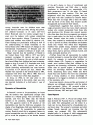
Attached is a screen shot of a page from another study which shows that a prominent motive in several neonaticides studied was the inability of the pregnant teen to reveal the pregnancy to her mother for fear of shame or punishment and rejection. So they actively killed the baby instead and concealed the body in cupboards, dustbins or rubbish dumps, etc. .

Neonaticides following "secret" pregnancies: seven case reports.

Mothers who kill their infant on the day of its birth (neonaticide) do not generally show signs of psychopathology. Mothers who commit neonaticide tend to be young, single, and immature, and kill to eliminate an unwanted child. Mothers who kill their older children (filicide) are frequently older, married, psychotic, depressed, or suicidal. Filicides tend to kill as a result of their psychosis, for altruistic reasons (to relieve child of suffering), accidentally (as in battered child syndrome), or to seek revenge on a spouse. Resnick notes that mothers who commit neonaticide are more likely to be incarcerated, whereas mothers who commit filicide are more likely to be hospitalized.
Infanticide - burial, body, funeral, life, history, beliefs, cause, rate, time

In contrast to filicide, neonaticide is committed almost exclusively by women. Neonaticidal mothers are younger, more often unmarried, and less likely to have psychiatric illnesses compared with women who kill their older children. While older children are often killed for altruistic motives (to relieve real or imagined suffering) or as a result of the perpetrators’ loss of temper,9 the newborns are killed simply because they are unwanted. The most common reason for neonaticide is extramarital paternity or impregnation that is considered unacceptable ethically or culturally, such as those exemplified in this series of reports. Women who commit neonaticide often conceal or deny the pregnancy prior to the birth of the child, with or without intermittent acknowledgement.2,4,10 The denial of pregnancy is most commonly observed in young, unmarried, and primiparous women, and may be affective or pervasive in nature.
Methods of neonaticide include suffocation, strangulation, head trauma, drowning, exposure, stabbing, burning, throwing to pigs, and burying alive.4 Unusual means such as inserting needles inside the cranium have also been reported.14 The delivery occurs almost exclusively outside a hospital setting, and most infants die from suffocation or drowning.2,4 Disposal of the infant, whether dead or alive, seems to be the most ‘fashionable’ means of getting rid of the babies. Newborns may be discarded into trash bins or dumpsters. Disposal into the sea also accounts for a substantial number of cases in Hong Kong (personal communication). Even if the baby is alive when being disposed of, they may die quickly either as a result of suffocation by being wrapped in a plastic bag or drowning, or because of severe hypothermia.
https://pdfs.semanticscholar.org/9e89/715bd45bb0b65cf2f528f6ab0c35ca4d963b.pdf
 

Attachments

  • pubhealthrep00202-0058.gif
    pubhealthrep00202-0058.gif
    132 KB · Views: 3
  • #879
Holy moly ! That's a response from an attorney :D


It's not a ridiculous question. I don't know the answers. I've found a few things when it comes to disposal (lots of trash dumping for sure but also freezers and other methods) and also some data that informs my opinion she will not be sentenced to much:


Becky Sue Marrow concealed her pregnancy for 9 months then
dismembered and burned her newborn son. According to her
lawyers, she was in a ‘‘dissociated’’ mental state at the time
of the crime. However, as Marrow had tried to hide a preg-
nancy in the past, had attempted to divert witnesses from the
fire pit where she burned the infant’s corpse, and did not suffer
from any symptoms of amnesia, it is likely that the psychiatrist
was correct when he told the court, ‘‘She had clear insight. She
knew exactly what she was doing’’ (The Canadian Press, 2008).
However, she was only found guilty of ‘‘offering an indignity
to a dead human body and disposing of the dead body of a child
with the intent to conceal its birth’’ and sentenced to 2 months
house arrest
.

Resnick (1970) and several other studies have confirmed
that the majority of neonaticidal women are not mentally ill
at the time of the murder
and maternal suicide after neonaticide
is rare. Hatters-Friedman, Heneghan, and Rosenthal (2007), in
their review of 81 women who either denied or concealed their
pregnancies, found that none had psychotic denial and a psy-
chiatry consult was only requested on four of the women. In
2001, Meyer and Oberman reviewed 37 cases of neonaticide
and found that most of the perpetrators did not have a major
mental illness. In D’Orban’s British study, she found that the
majority of the neonaticidal women were not suffering from
psychosis or depression. Haapasalo and Peta¨ja¨ (1999), in their
Finnish study of 15 neonaticides, proposed that mental illness
was not a relevant variable, with less than 30%of the women
claiming any psychological issues. Similarly, the Finnish sam-
ple of Putkonen, Collander, Weizmann-Henelius, and Eronen
(2007) of 14 psychiatrically evaluated cases found only four
cases with psychotic symptoms.
The majority of infants killed in the 1st day are born out of a
hospital, usually at the woman’s home (Paulozzi & Sells, 2002),
although there are recorded cases of neonaticides in birthing
units (Mendlowicz, da Silva, Gekker, de Moreas, Rapaport, &
Jean-Louis, 2000, cited in Hatters-Friedman & Resnick,
2009). Newborns who are the second child of a woman under
age 19 are at an increased risk of homicide (Overpeck cited in
Spinelli, 2003). The hallmark example of neonaticide is that the
newborn is unwanted and so the woman, after concealing
the pregnancy for 9 months, gives birth alone, and then kills
the newborn via non-weapon methods such as suffocation,
strangulation, or drowning
(Meyer & Oberman, 2001).
Women who murder infants who are older than 1 day are
significantly different to women who murder newborns. They
tend to be older than 25, use weapon as well as non-weapon
methods of murder, are often married, and well educated
(Resnick, 1970; see Table 3).
These women tend to premeditate their murders (Logan,
1995, in Dalley, 1997) and may murder the infant as retaliation
against another person, during an episode of abuse, or to
remove an unwanted child (D’Orban, 1979).

Due to their small size and inability to defend themselves, the
murder of an infant does not require either strength or skill.
Therefore, smothering, strangling, suffocating, and drowning
are all common methods of infanticide, although many other
means are used including starving burning, stabbing or cutting
shooting, exposure, gross assault, gassing, scalding, poisoning,
and defenestration (see Table 4). Finkelhor and Ormrod (2001)
suggest that women are more likely to use their hands as a
weapon and less likely to use firearms, compared to men, but...
up to 25%of women who murdered their
children use weapons.

Denial/Concealment
‘‘Infant’s body discovered in trash’’ (LA times, February 9,
1996).
‘‘Infant’s body discovered near the 2-9 Dumpsters’’ (Daily
Trojan, 10/11/05).
‘‘The case of the frozen babies’’ (Schpoliansky & Childs,
2009).
‘‘Three babies found in deep freeze in Germany’s infanti-
cide epidemic’’ (Boyes, 2008). ‘‘Infant’s body discovered at
plant’’ (NY Times, May 4, 2006).
‘‘Infant’s body found inside plastic bag’’ (CBC News, April
2, 2009).
‘‘Infant’s body found in Onslow County garbage truck’’
(Capitol Broadcasting Company, October 27, 2008).
‘‘Infant’s body found in Erfurt freezer’’ (The Local, May 27,
2009).
‘‘Dead newborn found at abandoned apartment in northern
Japan’’ (Bay Ledger News, May 31, 2007).
As these news headlines show, the discovery of a newborn’s
corpse is an unfortunately frequent occurrence. In a study of
neonaticides published in 1990, 64%of the newborn’s corpses
were discovered by accident in garbage cans or other refuse
sites. None of the newborns could be matched to a missing per-
son report, which indicated that the woman had intentionally
concealed her pregnancy and abandoned the infant upon birth
(Crittenden & Craig, 1990)

One of the hallmark factors in neonaticide compared to
infanticide is the secrecy of the pregnancy and subsequent
birth. As noted above, women who commit neonaticide are
markedly different from women who commit infanticide. Neo-
naticidal women tend to be younger, emotionally immature,
and do not desire to become a parent at the time of the homi-
cide. Many of these women manage to conceal their pregnancies from their parents and others for the entire 9
months, although, according to Beyer et al. (2008), at least one
other person was aware of the pregnancy in 83%of the cases.

Beyer et al. (2008) further notes that in the majority of cases
the women went through labor and then murdered the infant
within close proximity to others, without disturbing anyone, let
alone calling for help. This behavior suggests intentional con-
cealment
. If a woman found herself experiencing labor and giv-
ing birth, somehow without ever having known she was
pregnant, an expected reaction would be to call for help. Even
if she mistakenly believed the baby was stillborn, calling for
help would still be the expected behavior, not placing the infant
in the trash as is done in these cases.


...Even when women were incarcerated, their sentence
lengths averaged less than half the sentence lengths of men
convicted of similar offenses. She cites similar results in Aus-
tralia, Canada, American, Denmark, and Sweden.
This aversion to holding women accountable for their
actions, often termed chivalric justice, has significant negative
implications for society
. It suggests that our society values the
lives of children far less than we value the lives of adults. In
addition, it reinforces the stereotype that women are irrational
beings under the control of their biology, unlike men.

https://www.researchgate.net/public...f_Research_Literature_on_Incidence_and_Causes

Attached is a screen shot of a page from another study which shows that a prominent motive in several neonaticides studied was the inability of the pregnant teen to reveal the pregnancy to her mother for fear of shame or punishment and rejection. So they actively killed the baby instead and concealed the body in cupboards, dustbins or rubbish dumps, etc. .

Neonaticides following "secret" pregnancies: seven case reports.

Mothers who kill their infant on the day of its birth (neonaticide) do not generally show signs of psychopathology. Mothers who commit neonaticide tend to be young, single, and immature, and kill to eliminate an unwanted child. Mothers who kill their older children (filicide) are frequently older, married, psychotic, depressed, or suicidal. Filicides tend to kill as a result of their psychosis, for altruistic reasons (to relieve child of suffering), accidentally (as in battered child syndrome), or to seek revenge on a spouse. Resnick notes that mothers who commit neonaticide are more likely to be incarcerated, whereas mothers who commit filicide are more likely to be hospitalized.
Infanticide - burial, body, funeral, life, history, beliefs, cause, rate, time

In contrast to filicide, neonaticide is committed almost exclusively by women. Neonaticidal mothers are younger, more often unmarried, and less likely to have psychiatric illnesses compared with women who kill their older children. While older children are often killed for altruistic motives (to relieve real or imagined suffering) or as a result of the perpetrators’ loss of temper,9 the newborns are killed simply because they are unwanted. The most common reason for neonaticide is extramarital paternity or impregnation that is considered unacceptable ethically or culturally, such as those exemplified in this series of reports. Women who commit neonaticide often conceal or deny the pregnancy prior to the birth of the child, with or without intermittent acknowledgement.2,4,10 The denial of pregnancy is most commonly observed in young, unmarried, and primiparous women, and may be affective or pervasive in nature.
Methods of neonaticide include suffocation, strangulation, head trauma, drowning, exposure, stabbing, burning, throwing to pigs, and burying alive.4 Unusual means such as inserting needles inside the cranium have also been reported.14 The delivery occurs almost exclusively outside a hospital setting, and most infants die from suffocation or drowning.2,4 Disposal of the infant, whether dead or alive, seems to be the most ‘fashionable’ means of getting rid of the babies. Newborns may be discarded into trash bins or dumpsters. Disposal into the sea also accounts for a substantial number of cases in Hong Kong (personal communication). Even if the baby is alive when being disposed of, they may die quickly either as a result of suffocation by being wrapped in a plastic bag or drowning, or because of severe hypothermia.
https://pdfs.semanticscholar.org/9e89/715bd45bb0b65cf2f528f6ab0c35ca4d963b.pdf[/QUOTE

 
  • #880
I agree with some of the talking heads... Jurors must be confused as they have not seen the second interview with BSR - the one that prompted her arrest.

I hope they understand why the case was put to them in this particular order of events.

Jmo
 
Status
Not open for further replies.

Guardians Monthly Goal

Members online

Online statistics

Members online
76
Guests online
1,274
Total visitors
1,350

Forum statistics

Threads
635,406
Messages
18,675,614
Members
243,208
Latest member
HelpFindGus
Back
Top