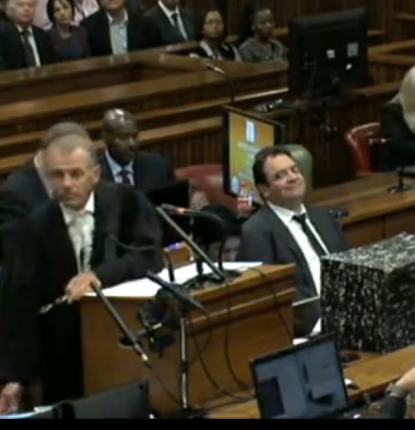
I remember watching that section of his testimony very well because Nel was trying hard to get OP to say he didn't fire a warning shot into the shower because he thought ("foresaw") a ricochet could end up hitting him. I can't find the section just now but below is the relevant dialogue in full (not just the 2 lines quoted by the State in its HOA's which take it out of context) from the official transcript and it is clear, at least to me, that OP's answer about the ricochet was hindsight and not what had happened at the time:
Yes G.bng youll interpret that no doubt as Ops use of the lessused past subjunctive tense( ?) ,ie. an imaginary scenario.
OP was certainly clumsy with English (even though was his first language) that was striking for me, and his tenses were all over the place throughout his days on the stand.
I dont expect SCA judges to be grammarists but I do think they will be experts in dealing with the deviations in witness testimony under cross, under pressure. ( I'm hoping Roux's blatant misinterpretations will be equally crystal clear to them.)
For me and countless others watching back then, his first two lines of the dialogue you quote, are past perfect tense. (I didnt do x, cause if I had done x , y would have happened. )
For me, Nels unfortunate use of the word foresaw triggered OP into another of his deviations, a quick swerve once he had realised the implications of foresaw. ( He was after all an evasive, very poor witness. ) This is exactly why the fuller context is better. (But TBH the preceding section is very useful as it deals with the detailed sequence in the past not couldve, wouldve shouldve
)
It is a brilliant piece of dialogue to quote- if you come across any more, please quote them.
For Nel, I think Afrikaans is his first language so occasionally I dont think he was as clever as he could be, simply with his choice of words in setting his traps for OP. I mean did you combined ever wasnt great when he meant "did you consider"
I know this is a poor example but here goes
..but need one to explain fatal risk to self
So
if I had swallowed that bottle labelled Poison next to me it would have killed me. therefore I didnt swallow at the time, as I was aware of it being poison ) ie. I WAS thinking at the time, foresaw risk.)
Contrast
If I had swallowed the poison it would have killed me but I didnt swallow it just because I wasnt thinking at the time of the risk to me. It could be reduced to semantics, but the logic is clear.
NOTE OP did not say - no, nel, at that time I actually was not aware that bullets can ricochet but I have since learned that about bullets,
...........as in no, at the time i could not read English and did not u'stand word poison.