Cullen Diamond?
The Crown Jewels contain some of the world’s most exceptional diamonds, shown here with the blue Stuart Sapphire.
This sapphire was reputedly smuggled out of the country by James II when he fled in 1688. It now adorns the back of the Imperial State Crown (1937).
The magnificent Cullinan I (top left) is the world’s largest top quality white cut diamond. The huge uncut stone was discovered in South Africa in 1905, and was cut to create nine major stones. Cullinan II (bottom right), the second largest stone, is now set into the front band of the Imperial State Crown.
Queen Elizabeth II on her coronation day. The Queen is wearing the Imperial State Crown
Photography by Cecil Beaton
© Victoria & Albert Museum, London
Or...
Koh-i-Nûr Diamond
The 105-carat Kohinoor diamond
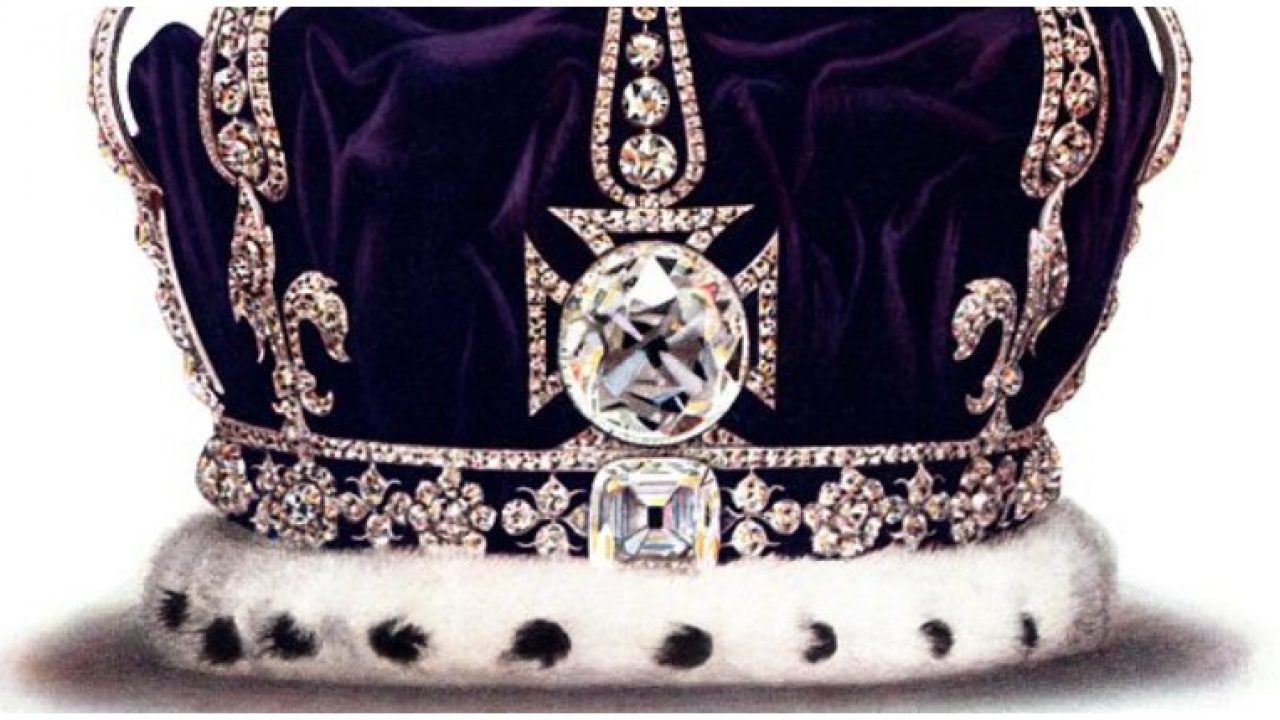
The history of the Koh-i-Nûr (or ‘Mountain of Light’) diamond is steeped in myth and anecdote. Discovered in 15th-century India, it was passed from ill-fated male hand to hand, until it earned a reputation of bringing bad luck to men. It was presented to Queen Victoria in 1849. It now adorns the front of Queen Elizabeth The Queen Mother’s Crown
The Kohinoor diamond, set in the Maltese Cross at the front of the Queen Mother's crown
Royal Collection Trust
© Her Majesty Queen Elizabeth II
Kings and queens of England have stored crowns, robes, and other items of their ceremonial regalia at the Tower of London for over 600 years. Since the 1600s, the coronation regalia itself, commonly known as the 'Crown Jewels' have been protected at the Tower.
Over 30 million people have seen them in their present setting at the Tower. They are possibly the most visited objects in Britain, perhaps the world. But most remarkable of all is that this a unique working collection.
The Imperial State Crown is usually worn by the monarch for the State Opening of Parliament. When the next coronation comes around, key items will be taken to Westminster in readiness for the ceremony.
An ancient ritual
The Crown Jewels are so significant because they symbolise the passing of authority from one monarch to another during the coronation ceremony.
The earliest detailed account of a coronation in England comes from 973 when the Anglo-Saxon King Edgar was crowned in a lavish ceremony in Bath. The coronation rituals have altered little in their essentials in over a thousand years

Yeah - They're the real deal.
Did you know?
The question most visitors ask about the Crown Jewels is, ‘are they real?’
Yes, they are!
Tower of London
 *
* What/where is "
Bucksminster" ??