

Austria - Thomas Plamberger leaves gf, Kerstin Gurtner to freeze to death on Austria's tallest mountain - charged with manslaughter - Jan.19/2025

  • #421
No, it's like someone hiking up a mountain and they are PERFECTLY fine until they get to a point where they aren't. Unless you are saying that he could physically stop her from going when she said she was perfectly fine if he wanted to but then in the US, that would be assault. I don't know if it would be assault in Austria.
Are you entertaining some scenario that has barely anything to do with this story or what?

This is what I was responding to and I quoted just part of it assuming that we are talking about this route on this mountain in January not other time, place and weather.
He might have told her snow boots and split board bad and she was going to do it anyway? That when she was getting tired or close to exhaustion, she figured she'd just "push through it" and he didn't notice until it was too late? I haven't seen anything that makes that not possible. If someone insists they will continue without the other person, what are the choices? Call for emergency help when there is not yet an emergency? Postulating an alternative scenario. I've known people like that. Do stupid things and no one can stop them. Does anything 100% rule this out?
Lets say it would happen exactly this way.
He told her snow boots and split board bad. = The most likely reason why to say such a thing would be cause he KNEW that splitboard and snow boots are bad idea there.
She said she's gonna do it anyway. = He might figure that okay, whatever, her decision. It would already be pretty bad. May happen but responsible, experienced hiker, not to mention climber should not be up for going with someone whos from the beginning insisting on commiting to bad decisions. That may be fateful with mushroom hunting, not to mention climbing III+ routes in Alps.
Then she was getting tired or close to exhaustion, she figured she'd just "push through it" and he didn't notice until it was too late. = And this is already impossible. Cause of the time. Sun on the sky and later lack of it would make it impossible for him to NOT NOTICE that she was tired and exhausted. Cause that route is to make in 3-4 hours in Summer. 4-6 in Winter. In that time they barely made it half that distance and it was already getting dark after "first" three. You wont find a mountain guide who will say that it would be possible to not notice that something is wrong there, period.

If someone insists they will continue without the other person, what are the choices?
A) Keep going against the other person's better judgement (bad).
B) Refuse to go anyway: Either youre turning back with me right now or you indeed continue alone cause Im not risking my own and your safety (also bad but there is a chance that it will make them change their mind).
C) Inform the person that you are notifying mountain police / rescue services about the situation (that also offers some chance to change their mind).
D) If theyre not changin their mind, then a call should be made. That doesnt mean fully blown rescue mission will blow up in 5 minutes. But makes the most experienced and best informed people aware of the situation. They may offer some tips, tell what to do, try to contact the other person or judge that it sounds like the other person may be going trough some sort of medical emergency and is unable to make a conscious decision at the moment and decide to send someone with assistance or decide on going on fully blown rescue mission as they know that for example big storm is coming.
No, it's like someone hiking up a mountain and they are PERFECTLY fine until they get to a point where they aren't. Unless you are saying that he could physically stop her from going when she said she was perfectly fine if he wanted to but then in the US, that would be assault. I don't know if it would be assault in Austria.
And D is what youre supposed to be doing after trying A, B and C. Or even jumping straight to D if things are moving fast.
Physical attempt at stopping someone is not what I would deem as the right course of action.

Would be a different story if he had no cell phone, no sportswatch, no phone reception and no way of notifying anyone, but we dont have a reason to entertain these scenarios in context of this case cause they dont apply here.
Maybe to a seasoned winter Austrian mtn climber how she was outfitted made no sense. And yet she got how far dressed like that? It couldn't have been too wrong if she made it all that way, but maybe just wrong enough and she thought she was good. And if she was doing fine, he thought she was good enough. Until she wasn't.
He's not charged cause of the shoes. Her shoes are just one element of it.
So, if a girlfriend were to say, "I'm going with or without you", would the boyfriend say "See ya." Or might he go if he could not convince her to turn around if HE thought it too dangerous, but she appeared just fine? Unless we have a full statement, we cannot possibly know. So that is an open possibility to me until I find something that says "Nope, not possible". That is what I am looking for.
Yes we can know and we do know cause that mountain is not one to climb after dark in Winter. People are not doing that and you can check it. Years of surveillance to look at. Or you can theorize that some do but with no headlamps, just for kicks and giggles. Cant rule that out.
I traveled with five emergency blankets. If I left someone wrapped in three and returned with two and for whatever reason the blankets were no longer with the person I left, It would look like I didn't use any unless you know I traveled with five. That is what I mean about missing information.
If you left someone wrapped in three blankets at mountain thats covered by several cams, having mountain police monitoring the situation with access to several meteorological points monitoring weather and winds chances that these blankets will mysteriously disappear are low. Could happen, sure. What would be your reasoning to not scream to everyone who would listen that you covered the person with blankets WHERE ARE THESE?! HOW ON EARTH COULD THAT HAPPEN?
That would be pretty good thing to mention if you were facing investigation, wouldnt it? He knew that investigation will happen the moment he learned that she died.
 
Last edited:
  • #422
You bring up an interesting point. I would think that if someone was in a Biv Sac, that would not blow off?
She was found with her backpack and split board still on her back. Everything I have heard says that he would have taken this off of her and wrapped her up---that having the backpack and board still on her made it harder for her, not easier. That she would have been losing more heat through that. But I do not know.
Bivvy sack would not blow off. Thermal blanket theoretically could.
She was losing body heat as she was climbing with these additional ~15 pounds of splitboard on her back. At the point when she couldnt walk anymore backpack would sort of offer some insulation from the cold, but only where it was. And taking that backpack off, and wrapping her back with blanket, then putting backpack back on would make it impossible for the blanket to be taken away by even the strongest winds.
Having backpack and splitboard on made climbing harder for her and any attempt at covering herself with anything or moving as she got exhausted.
 
  • #423
I am given to understand an exception to this rule is in the extreme conditions of the "death zone" on very high mountains.
RSBM
Grossglockner's elevation is 3,798m. So no, there is no "death zone" on this peak.

"In mountaineering, the death zone refers to altitudes above which the pressure of oxygen is insufficient to sustain human life for an extended time span.

This point is generally considered to be 8,000 m (26,200 ft), where atmospheric pressure is less than 356 millibars (10.5 inHg; 5.16 psi).[1]

The concept was conceived in 1953 by Edouard Wyss-Dunant, a Swiss doctor, who called it the lethal zone.[2]


All 14 peaks above 8000 m (the "eight-thousanders") in the death zone are located in the Himalaya and Karakoram regions of Asia."

 
  • #424
Absolute conjecture of course, but somehow he had the energy to get down safely after everything and that adds another layer of suspicion for me.
Yes, he also exhibited no signs of hypothermia when LE / rescue got to him on their way to save KG. Hmmmm.
 
  • #425
Thank you. I was curious because there are lots of places in the US that have spotty coverage. Or one day there is coverage and the next day not so much. I lose coverage a lot. Some of that is my particular phone, some is not.

In USA and in Canada, too. I would say, Eastern Washington, the eastern part of British Columbia and Alberta are spotty.

However, cellphones are part of the “infrastructure” that does not develop on its own but follows the population drift. You have to compare when a certain country/state got populated, the population/territory and perhaps, what industry is now driving the influx of people.

“Tourism” is a huge industry in the Alps but not only. There is farming, too, and many others. But tourism means, lots of people traveling through the area per day. In touristy areas, infrastructure has to develop.
 
  • #426
Maybe the heli had a thermal camera and there was still a heat signal?

I’m thinking about the quick exit by him after he decided to leave her. Could it be that during the 1,5h that he was sitting with K, he was having a meal (possibly had a primus and some food/drink to heat up). So he warmed himself up, ate and rested and climbed the rest of the way in good time? Absolute conjecture of course, but somehow he had the energy to get down safely after everything and that adds another layer of suspicion for me.
Heating meals out in the open like that would be extremely hard and not sure if even that rewarding cause could mean some digestive issues quick afterwards. Its not same as spending x hours in cold, coming back home and getting hot tea and soup, also no comfort of camp/tent. Would be risky. But protein bars, energy bars, packets of dried fruits and that sort of lightweight food full of carbs, proteins are easy to digest, predictable to digest and provide energy.
Thats why I was wondering if she was eating during the climb. She should be eating something many times to reasonably hope to make it. Not like fully blown meals but to the very least a bar every two hours. And he had to be eating as well. + hydration. Did they even had enough water or anything to drink during extra hours of climb? That would mean another 3-4 pounds extra in water to carry. Good for emergency situations but also thing that would slow them down on their way up.

Dont know for sure but Id tend to assume that climbing aint that different from other long physical activities where it works best and provides most energy and minimal risk of digestive issues if its multiple small meals/quick bites on the way instead of meal & 6 hours later another meal. Hard to totally rule that out thou, cause 1,5 hours would be enough to eat something bigger, take some rest, hovewer possible and start climbing as it already somewhat settles in stomach.

He should feed her and make sure she drank something before he left but Im pretty sure he forgot as he mentally switched with some climber doing last metres up on Nanga Parbat, holding it strong between 00:35 and 2:00 AM, before mentally coming back to his real location the moment he touched the stones at the end of the ramp and started going up Grossglockner.
 
  • #427
Heating meals out in the open like that would be extremely hard and not sure if even that rewarding cause could mean some digestive issues quick afterwards. Its not same as spending x hours in cold, coming back home and getting hot tea and soup, also no comfort of camp/tent. Would be risky. But protein bars, energy bars, packets of dried fruits and that sort of lightweight food full of carbs, proteins are easy to digest, predictable to digest and provide energy.
Thats why I was wondering if she was eating during the climb. She should be eating something many times to reasonably hope to make it. Not like fully blown meals but to the very least a bar every two hours. And he had to be eating as well. + hydration. Did they even had enough water or anything to drink during extra hours of climb? That would mean another 3-4 pounds extra in water to carry. Good for emergency situations but also thing that would slow them down on their way up.

Dont know for sure but Id tend to assume that climbing aint that different from other long physical activities where it works best and provides most energy and minimal risk of digestive issues if its multiple small meals/quick bites on the way instead of meal & 6 hours later another meal. Hard to totally rule that out thou, cause 1,5 hours would be enough to eat something bigger, take some rest, hovewer possible and start climbing as it already somewhat settles in stomach.

He should feed her and make sure she drank something before he left but Im pretty sure he forgot as he mentally switched with some climber doing last metres up on Nanga Parbat, holding it strong between 00:35 and 2:00 AM, before mentally coming back to his real location the moment he touched the stones at the end of the ramp and started going up Grossglockner.
As a long-distance bicycle traveler, I agree with everything you've said about eating. We "graze" throughout each day's ride, nibbling something every 30 min. or so, and having more substantial food every 2-3 hours. Eat full meal for breakfast and dinner.

I will say that if we got chilled, we would either find a place to get a hot beverage, or get out our little stove and make some tea or coffee. Getting that heat to the core is super helpful. IF he was able to boil water (Big if, with the winds and lack of shelter) that would have been very helpful. I remember seeing images from the mountain cams that had bigger lights or more spread out lights. Wonder if that could have been a camp stove?
 
  • #428
This article has more information from the people who brought down Kerstin's body. Looks like some of the quotes we have seen in other articles originated here. Article from days after the incident.

Contains time-elapsed video of the ascent and solo descent.

On Monday, one of the two alpine police officers from East Tyrol involved in the rescue ascent (he does not want to be named) spoke to the Kleine Zeitung about the "extremely challenging operation". "I was called by my boss in the middle of the night, I didn't even look at the clock, but left immediately," he explains. The ascent had to be done almost entirely conventionally, and the helicopter was only able to transport the rescuers about a quarter of the way – from above the Lucknerhaus to the glacier.
The weather conditions for the six rescuers were borderline: "It was pitch dark, cold and there was a strong wind. Sometimes it was gusty. The 6 degrees Celsius below zero feel much colder." Conditions that the alpinist couple also had to contend with.
A good five hours after the alarm was raised, the two alpine police officers and the four mountain rescuers were with the 33-year-old: "We really wanted to help, but unfortunately there was nothing more we could do for her." Whether the alpinist froze to death in the end or whether other reasons finally led to the drama, the police cannot and do not want to say definitively at this time. When asked, the alpine policeman involved in the rescue operation only explains this much: "Unfortunately, we have operations here again and again with alpine deaths, usually falls are the cause. But such tragic cases are actually rare."
The strong wind then made it even more difficult to rescue the victim, the deceased had to be transported down about 600 meters to 3200 meters - where the helicopter could take over: "My comrades had to abseil the body in the most difficult conditions. The danger of the ropes getting caught was always present with the serious wind problems," says Peter Tembler, local head of the Kals mountain rescue.

This perhaps explains why things took so long:
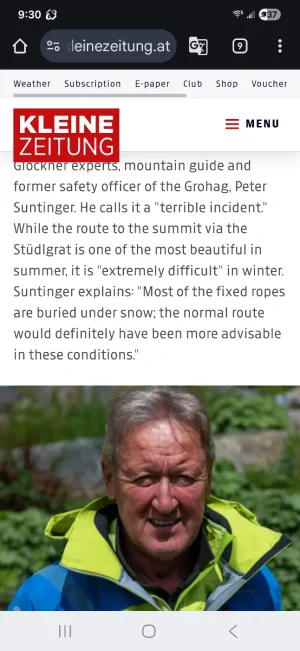
mountain guide and former safety officer of the Grohag, Peter Suntinger. He speaks of a "terrible case." The way to the summit over the Stüdlgrat is one of the most beautiful routes in summer, but "extremely difficult" in winter. Suntinger: "The majority of the belays are under snow, the normal ascent would definitely have been more recommended in this weather."
 
  • #429
Okay, this seems like a very good source. Alpinistin stirbt am Großglockner: Gutachten soll Klarheit bringen

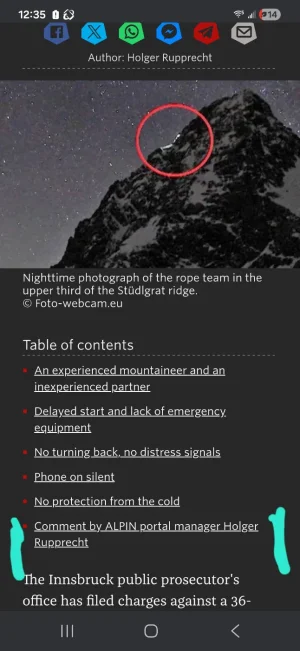
The table of contents:
From this article:
His mandate finds it incomprehensible that the rescue chain was only set in motion "so late". The police counter that the man only made his distress known in his call at 03:30 a.m. After that, the rescue team immediately began the five-hour ascent despite the most adverse weather conditions. In the meantime, it became known from the forensic medicine entrusted with the autopsy that the deceased had a viral infection.
"Perhaps that was the reason for this slump in performance," speculates the accused's lawyer and emphasizes the innocence of the companion: "He regrets infinitely how it happened and that it happened this way. And I, as his defense lawyer, can only say that he is not to be punished from a criminal point of view, and that the proceedings should be stopped." The 36-year-old did not know that the woman had been ill.
 
Last edited:
  • #430
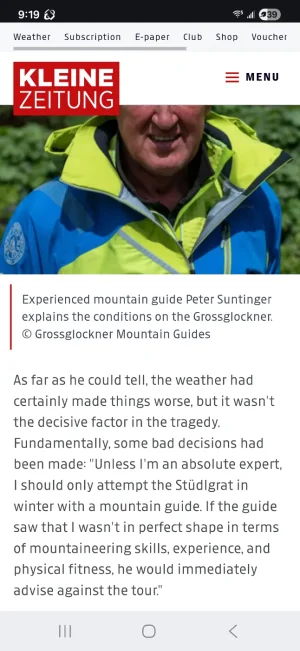
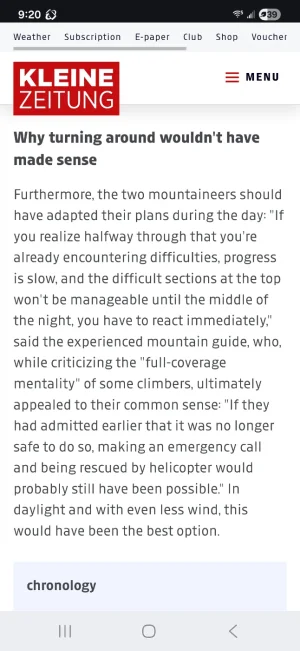
Excellent find, @georgiajean . Here is Peter Suntinger's full statement from your article in three snips. Again, compelling, IMO, about TP's errors.

Screenshot_20251225_213041_Chrome.webp

Screenshot_20251225_211958_Chrome.webp
Screenshot_20251225_212038_Chrome.webp

 
  • #431
From the tome @georgiajean just posted. This is for @Ghostwheel:

'Update from January 23, 2025: A mountain rescuer reports to the ORF (Austrian Broadcasting Corporation).​

Toni Riepler, head of operations for the Kals mountain rescue team, recounted the events of the night in an interview with ORF. He emphasized the importance of not jumping to conclusions, as the climbers were in an exceptional situation. The two individuals had a rescue blanket and bivouac sack with them on the mountain, but they were not used." [emphasis by me]
 
  • #432
In July, from this source Alpinistin stirbt am Großglockner: Gutachten soll Klarheit bringen
The investigations are stuck, it's statement against statement. Therefore, the competent court has commissioned an alpine-technical report

According to the ORF report, the alpine police officers on duty as well as mountain rescue and helicopter crew were questioned and the recordings of the surrounding webcams were evaluated. In addition, and this is likely to be decisive for the partly contradictory statements, an evaluation of all telephone recordings (call logs, etc.) of the night took place. The collected mountain of files is now to be handed over to an expert, who is to finally clarify the question of possible misconduct.
 
  • #433
Posting this video again, as it is the best summary of this case, from the people who know the mountain and who participated in the rescue. Well worth the 8 min, using CC.
 
  • #434
  • #435
  • #436
  • #437
  • #438
  • #439
So that 1,5 hours between calling and leaving he spend, according to him, on trying to force her to keep going.
 
  • #440
The reader comments are excellent.
That comment makes a ridiculous point IMO.

So the reason why he should be seen as inexperienced climber (against the judgement of people who are asked for their judgement in coverages of this case) and NOT ill-willed with all his actions is cause... he made so many "mistakes" he just had to be severely inexperienced to make so many mistakes?
Sure hell yeah, but that requires the assumption that there were all, indeed, honest mistakes. And thats not the point basically everyone who feels otherwise is making cause thats not the point of the discussions caused by this specific chain of events.

With a different discussion, where the main question would be: should people be held legally accountable for the mistakes they do while climbing with others that leads to fatalities?
I bet most people's opinion on that would be something like:
a) yes, to a degree, but if that mistake was something that couldnt be foreseen by the person as fatal then maybe not...
b) no, cause many people make mistakes and they dont want to cause harm to others, they just dont know better (at that point) so unless its...
But what reality has to do with this question?
Reality is that mistakes are made, people die, sometimes people die as a result of these mistakes, but there is no long list of people charged or sentenced for such climbing mistakes that led to fatalities. You have to dig through decades to find one or two examples.

And how its even appropriate to try to redirect the discussion from what happened on Gross on the 18th to 19th January 2025 to THAT question?
How sentencing Thomas could influence cases of other people who made like one, two or three mistakes from his long list of "mistakes"?
Like for example:
- agreeing to go with a companion that doesnt have the most appropriate gear/clothing,
- starting an hour or two too late,
- pushing forward despite of the sundown coming soon
OR
- not calling for rescue at, whats later deemed as the most appropriate moment to do so,
- not responding or picking up calls from rescue team while on the mountain,
- leaving an injured companion behind after waiting for the rescue for 1,5 hours and facing weather going consistently worse.

Mediocre lawyer can then say oh, your honor... and provide reasonable, probable and understandable scenario, or twenty possible scenarios of how client could totally not foresee the fatal possible consequences of that and 90% (or likely more) will feel like "yes, that sounds probable".

There is a reason why it doesnt apply here.
There is a reason why people are able to come up with explanations only as long as theyre relying on very very very basic summary of the events or as theyre blantly ignoring the totality of the alleged mistakes and completely dismiss what people like Peter Suntinger, Josef Kunzer, Peter Habeler, Josef Schnell say about it with their decades of experience with climbing, climbing Grossglocker AND climbers on Grossglockner.
People are making bad decisions daily. I tend to assume that nobody is more exposed for vide range of, and long list of daily provided examples of kinds of mistakes and bad decisions people do while climbing Grossglockner itself and in wider Grossglockner area. And for these ALL people asked for their insight about what could happen in this case and what could cause such an unheard of string of unfortunate decisions it all seem to be close to "umm, I dont really get it".

And Thomas has his innocent until proven guilty shield. It was not taken away from him. Theyre talking like they do, cause theyre keeping the benefit of the doubt for him strong.
I dont recall mountain guides and rescuers talking like that about anyone. Ever. What seems to be a fatal string of events, mixture of bad decisions and harsh weather causes people to want use the spotlight to make emphasis on general safety, which is IMO in the best interest of everybody.
But here, also IMO, but I strongly suspect that it may be in their opinions also, that it is in the best interest of everybody to take note, that there is a serious danger in believing that there is no limit on the amount of honest not-ill will mistakes that lead to somebodys death that could and should be safely seen as mistakes. He crossed that line. And his falsely belittled climbing experience doesnt change anything, cause (even if it was true, which it isnt) they werent just climbing "mistakes" that he did, he went against very basic human reasoning.
And thats proved by reasoning by all the other people who climbed pretty much anything ever. As its pretty freaking hard to find anything even remotely similar without jumping straight on K2 or to climbin reality from 1925.
 

Guardians Monthly Goal

Staff online

Members online

Online statistics

Members online
147
Guests online
1,598
Total visitors
1,745

Forum statistics

Threads
636,849
Messages
18,705,055
Members
243,940
Latest member
chriscantlose
Back
Top