

Australia - 3 dead after eating wild mushrooms, Leongatha, Victoria, Aug 2023 #9 *Arrest*

Status
Not open for further replies.
  • #301

More Q+A with the Mushroom Case Daily​

By Kristian Silva and Stephen Stockwell​

The ABC’s podcast Mushroom Case Daily podcast team are on the ground in Morwell, and this week we’re answering your questions.

If you have a question, you can send it to: [email protected].

Q: I'm struggling with the concept of reasonable doubt and how it applies in this case. What is the bar (no pun intended) for reasonable doubt? Do the jury get any training, advice, or direction on what equates to reasonable doubt? - Maria

The jury got some limited instructions at the start of the trial, and they'll get some really detailed instructions at the end once all the evidence and the closing arguments are done, but in summary, Justice Christopher Beale told the jury that if Erin Patterson is to be found guilty, the charges have to be proved beyond reasonable doubt.

Now that is described as the highest standard of proof that our law demands. Being 'probably guilty' or 'very likely' doesn't quite cut it.

It's kind of vague what it means, but the jury is told to use their common sense.

It doesn't have to be 100 per cent watertight when they look at all of the elements, but if they add them all up and it all points one way, then it's beyond reasonable doubt.

Q: In Australia, are juries allowed to discuss the trial amongst one another during lunch breaks? - Kirsten

They're strongly discouraged to because you just never know who's in the cafe around you.

There could be lawyers, there could be members of the public, so it's pretty risky.

In the jury room, it's advised that all the jury members be together for discussions and you don't splinter off into little groups and discuss the case.
 
  • #302
1 hours ago

Fresh death caps 'can last for a couple of weeks in the fridge': Expert​

Dr May was asked by Dr Rogers whether there were any other mushroom poisonings reported to the Victorian Poisons Information Centre in 2023.
He said there was a “presumed case” of death cap mushroom poisoning in May after a Chinese tourist ate a mushroom collected 50m from an oak tree.
The tourist was admitted to hospital with signs of organ failure, but recovered.
Dr May said there were 24 other cases where symptoms were reported, including hallucinations.
Earlier, he told the court death cap mushrooms turn “mushy” faster than commercial mushrooms, such as button mushrooms.
He said death cap mushrooms could last for a couple of weeks in the fridge, but it depended how fresh they were when they were collected and whether they were insect-infested.
“Generally, I would say within a couple of days to a week … it starts to decompose,” he said.
Dr May will return to the witness box at 2.15pm.

 
  • #303

More Q+A with the Mushroom Case Daily​

By Kristian Silva and Stephen Stockwell​

The ABC’s podcast Mushroom Case Daily podcast team are on the ground in Morwell, and this week we’re answering your questions.

If you have a question, you can send it to: [email protected].

Q: I'm struggling with the concept of reasonable doubt and how it applies in this case. What is the bar (no pun intended) for reasonable doubt? Do the jury get any training, advice, or direction on what equates to reasonable doubt? - Maria

The jury got some limited instructions at the start of the trial, and they'll get some really detailed instructions at the end once all the evidence and the closing arguments are done, but in summary, Justice Christopher Beale told the jury that if Erin Patterson is to be found guilty, the charges have to be proved beyond reasonable doubt.

Now that is described as the highest standard of proof that our law demands. Being 'probably guilty' or 'very likely' doesn't quite cut it.

It's kind of vague what it means, but the jury is told to use their common sense.

It doesn't have to be 100 per cent watertight when they look at all of the elements, but if they add them all up and it all points one way, then it's beyond reasonable doubt.

Q: In Australia, are juries allowed to discuss the trial amongst one another during lunch breaks? - Kirsten

They're strongly discouraged to because you just never know who's in the cafe around you.

There could be lawyers, there could be members of the public, so it's pretty risky.

In the jury room, it's advised that all the jury members be together for discussions and you don't splinter off into little groups and discuss the case.

In addition to the first question, the jury has an assigned "Jury Liaison", or similarly titled who provide them with direction, and the forms, to present any questions that the jury may have to the magistrate. It could be clarity on process, or, as simple as to request each Monday off... Any questions presented to the magistrate from the jury get absolute priority of his/her attention.
 
  • #304
Key Event
3m ago

We're back from break​


By Judd Boaz​

The jury has returned to Courtroom 4 and we're continuing with the testimony of Tom May, a fungi expert.

Before the break, Dr May was telling the court about death cap mushrooms, their toxicity and where they can be found in Victoria.

The prosecution's Nanette Rogers picks up the questioning, asking about other mushroom poisonings over the last 30 or 40 years.

 
  • #305
DBM duplicate.
 
  • #306
  • #307
7m ago

Court hears about other death cap poisonings in Australia​


By Judd Boaz​

Dr Rogers asks Dr May about death cap poisonings in recent decades.

There is no central registry where cases of death cap poisoning are kept tabs on.

Dr May says a Melbourne husband and wife who cooked wild mushrooms in 1996 or 1997 were poisoned, with the husband dying in hospital.

In the ACT between 1988 and 1998, there were about 10 cases of death cap mushroom poisonings.

Dr May said another report analysing the period between 1999 to 2012 found four patients who died from poisoning in Australia.


Key Event
3m ago

More photos of death caps shown​


By Judd Boaz​

Dr May says the toxic mushrooms are also deadly to pets, with at least one case of a cockerspaniel dying from ingesting a death cap.

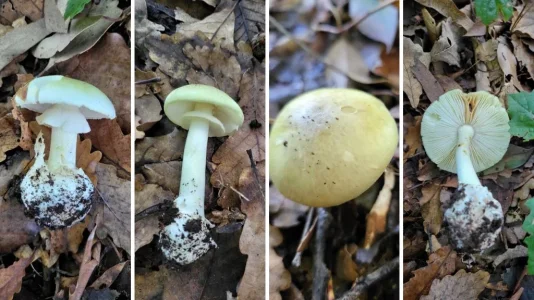
Dr Rogers shows four photographs to Dr May, and says the images were attached to an email sent by a police detective in November 2024.

The images are of mushrooms in the ground, and Dr May tells the court the photos are highly consistent with death cap mushrooms.

He says the yellowish-green colour, small white patches on the cap of the mushroom, well-developed cup and white gills are key features of the amanita phalloides.

Dr Rogers asks him to circle parts of the image on a screen.

Just now

Photos came from iNaturalist website, court hears​


By Judd Boaz​

The photos being shown to the court are linked to the citizen science website iNaturalist.

"Do you know whether these images appeared or not on iNaturalist?" Dr Rogers asks.

"I do know those images were posted on iNaturalist," Dr May says.

"They were posted as one record."
Dr Rogers asks his opinion about the images overall.

"I would say taking together the combination of the features, I would be — with a high degree confidence — identifying those images as amanita phalloides," he says.


  • #308
It’s getting late for me, are you okay to continue on your own @drsleuth ?
 
  • #309
It’s getting late for me, are you okay to continue on your own @drsleuth ?
Yes that's fine. Thanks for doing the ones you did ( I know we doubled up on a few but it's hard to follow the thread & see what's posted already when posting updates 😜 )
 
  • #310
These poor jurors will never want to hear of mushrooms again after this case!
 
  • #311
Yes that's fine. Thanks for doing the ones you did ( I know we doubled up on a few but it's hard to follow the thread & see what's posted already 😜 )
You guys are amazing. Thank you.
 
  • #312
2 minutes ago

Anatomy of a death cap​

Dr May has returned to the witness box.
The jury has been shown four photos of mushrooms for Dr May to describe.
He told the court the mushrooms pictured were “highly consistent” with death cap.
“I do know that those images were posted on iNaturalist,” he said.
“In my report, I note that the iNaturalist record mentions they were two metres from a large oak tree.”
He said he would identify the mushrooms depicted as amanita phalloides or death cap mushrooms with a “high degree of confidence”.

1747111163915.webp

The jury were shown these four images of mushrooms, posted on the iNaturalist site.

 
  • #313
2m ago05.38 BST

Past case of death cap fatality in Australia, court hears​

Prosecutor Nanette Rogers SC turns to recent death cap mushroom poisoning cases. Dr Thomas May says there is no central registry of death cap mushroom poisonings in Australia.

He points to a case, reported in 1997, where a husband and wife in Melbourne the previous years had cooked wild mushrooms. The husband later died in hospital.

Rogers takes May to a statement he made based on four images that were posted on the iNaturalist website.

May says the images are “highly consistent with amanita phalloides – death cap.”

He says the four images were posted together on the website but he cannot remember the exact date.

 
  • #314
If I bought dried mushrooms from an Asian grocers, I would definitely remember if it was in Oakleigh or Glen Waverley.
Depends how often you buy them and if you often frequent various shops.
 
  • #315
1m ago

Expert identifies mushrooms in series of photos​


By Judd Boaz​

Prosecutor Nanette Rogers SC points towards the first two images of the four presented, which show mushrooms sitting on a metal scale.

"What can you say about whether or not those fungi or mushrooms, whether they're consistent with being death cap mushrooms," she asks.

Dr May again refers to the colour of the mushroom's cap and gills and the physical characteristics of the mushroom cap.

He notes some parts of the cap had been eaten away, which was consistent with slugs or snails eating the mushroom.

Dr May says other mushrooms could look the same if presented in the same way, but he judges them to be death cap mushrooms with a high level of confidence.

Dr Rogers moves onto the third image of the set, which shows larger, round mushrooms on a scale with their stems cut off, weighing 490g.

She asks again what species the mushrooms could be.

Dr May identifies them as field or button mushrooms, pointing out the black gills and the width of the stems, with a high degree of confidence.


  • #316
03:14

Leading fungi expert on death cap mushrooms​

Mycologist Tom May, who is an internationally recognised fungi expert, told the jury death cap mushrooms can only be found beneath or close to oak trees or trees within the oak family.
Dr May, a mushroom expert who was the principal fungi research scientist at the Royal Botanical Gardens, said death caps had a 'symbiotic' relationship with oak trees.
He explained this means death caps can't live without an oak tree.
'In Australia it has only been reported with the oak family,' Dr May said.
The mushroom expert described death caps as mostly orangey in colour, but could be whiteish or brownish.
He said they change their appearance as they matured.
Dr May told the jury death cap mushrooms - known scientifically as amanita phalloides (pictured below) - were believed to have been accidentally introduced into Australia from Europe and were first detected in Victoria in the 1970s.
He said the mushrooms were 'relatively short lived' in the wild due to wet conditions and insects.
Dr May said death caps wouldn't last much longer in a refrigerator due to the fungi being infested with insects that 'keep working away' at the mushrooms.
The jury heard button mushrooms last longer in the fridge because they weren't infested with insects.
Dr May said there were many publicly available online databases that contained information regarding death cap mushrooms.
He said iNaturalist is Australia's largest publicly accessible citizen scientist app for uploading information about fungi.

amanita phalloides ; Shutterstock ID 217385554; purchase_order: -; job: -; client: -; other: - 12618101

Dr May told the jury you need an account to post information about wild mushroom, but don't need an account to view 'precise location information'.
'You can readily find the location of certain species,' he said.
Dr May also said iNaturalist contains information on where death cap mushrooms can be found.
He said death caps appear as red dots on a map and when you click on the dot it shows information including the image, date of observation and person who made the observation.
An image shown in court included the exact location of death caps in a suburban park.

The jury heard a death cap was detected in Loch on April 18, 2023.
The doctor said death cap mushrooms have been found in the ACT, NSW and parts of Victoria, including Gippsland towns Outtrim, Loch and Morwell.
In Victoria, death caps grow throughout metro Melbourne to the east into the Dandenong Ranges and in the west to Gisborne and Bendigo, the jury was told.
Overseas, the doctor said death caps, outside of their native Europe, have been detected in the United States and New Zealand, but not in Asia or China.
Dr May said cases involving death cap mushrooms occured when people ingested the deadly fungi by mistake.
Dr May, who published a book in 2021, told the jury toxins found in death caps can be in found other mushrooms.
In 2023, one poisoning involved a Chinese tourist who ate a mushroom, became sick, went to hospital, showed early signs of organ failure, but left hospital a week later.
In 24 other cases of reported wild mushroom poisonings, patients experienced gastro symptoms, but none involved organ damage.

 
  • #317
Wait, what? Porcini and Shiitake are very very different tasting - and from different parts of the world. Porcini from Europe and probably not sold in an Asian grocery store?

And who uses Asian mushrooms in an English Beef Wellington Recipe?

This "story" is all over the shop. IMO
The wording was Porcini OR Shiitake. Not and
 
  • #318
now14.46 AEST

‘High confidence’ mushrooms shown to him by police were death cap, expert tells court​

The jurors are now shown three images of mushrooms which were supplied to Dr Thomas May by a Victorian police detective.

The first image shows about a dozen mushroom caps spread out on a tray.

Prosecutor Nanette Rogers asks May if these are consistent with death cap mushrooms. May says “these photos are consistent with amanita phalloides.”

I have a high confidence it’s consistent with that.
But he says there are other mushrooms that could appear the same.

Another image shows five mushrooms on a scale.

May says these mushrooms are consistent with field mushrooms and button mushrooms, which he says can be purchased from a supermarket or green grocer.

May says it’s possible the mushrooms have been collected in the wild.

 
  • #319
2 minutes ago

Anatomy of a death cap​

Dr May has returned to the witness box.
The jury has been shown four photos of mushrooms for Dr May to describe.
He told the court the mushrooms pictured were “highly consistent” with death cap.
“I do know that those images were posted on iNaturalist,” he said.
“In my report, I note that the iNaturalist record mentions they were two metres from a large oak tree.”
He said he would identify the mushrooms depicted as amanita phalloides or death cap mushrooms with a “high degree of confidence”.

View attachment 585614

The jury were shown these four images of mushrooms, posted on the iNaturalist site.

JMO

As an Asian occasionally buying packs of "exotic" mushrooms at Asian grocery stores, for many years - I have never seen anything resembling these for sale.

Someone did not do her homework properly..
 
  • #320
Key Event
1m ago

Mushroom expert posted death cap location to iNaturalist​


By Judd Boaz​

Dr Rogers turns the conversation back to iNaturalist.

"Do you have a profile on that site?" she asks.

"I do have a profile on that site, and the name is funkeytom," he says.

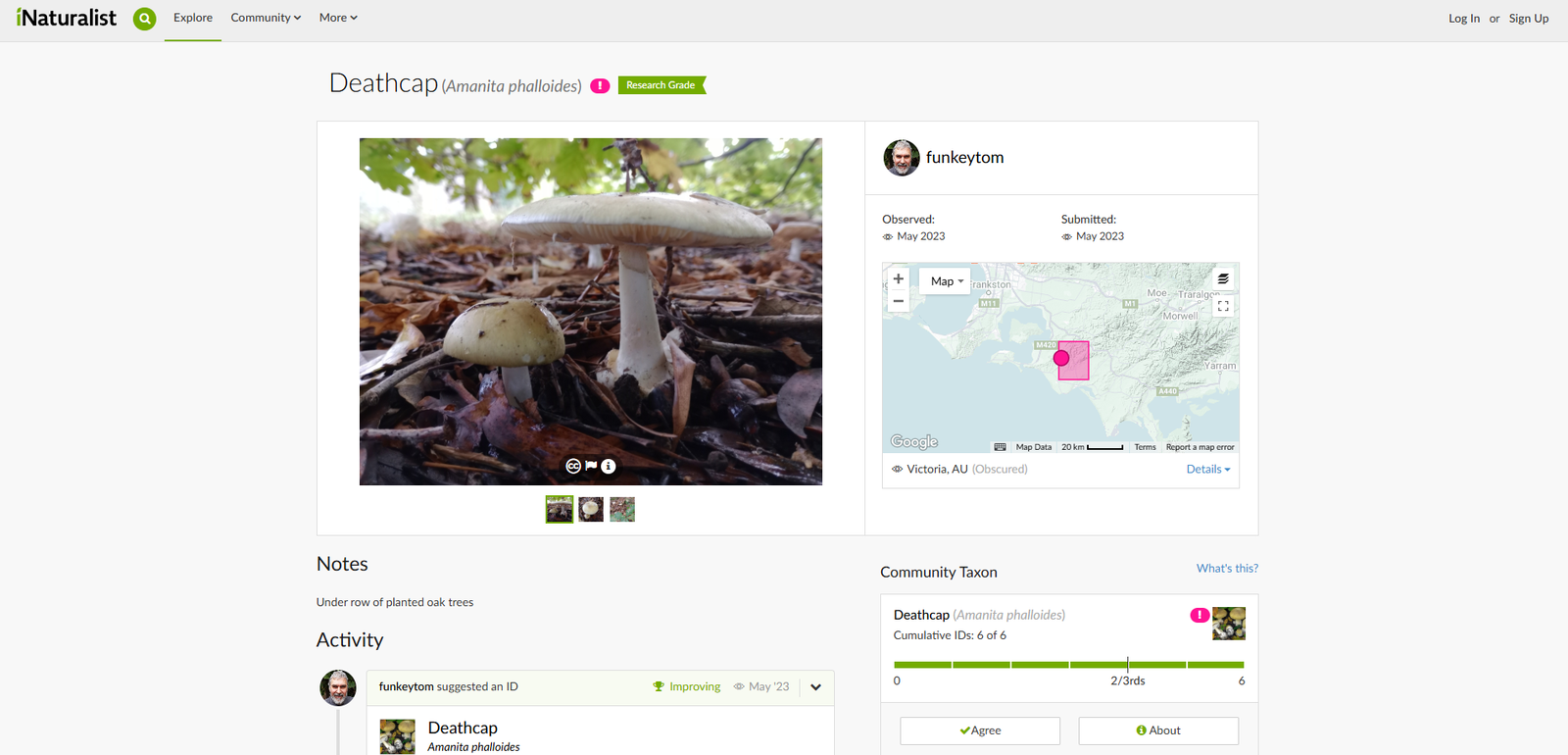
Dr May then says that he himself posted an observation of death cap mushrooms at Outtrim on May 21, 2023.

The post is then shown to the court, and Dr May confirms the post is his.

He says he was giving a presentation to a local community group in Outtrim about fungi, and after going for a walk, observed the mushrooms.

lcimg-9f80e491-319a-46e9-89e3-983e337b1319.png
The May 21 post made by Dr Tom May on iNaturalist (iNaturalist)

 
Status
Not open for further replies.

Guardians Monthly Goal

Staff online

Members online

Online statistics

Members online
209
Guests online
2,364
Total visitors
2,573

Forum statistics

Threads
637,349
Messages
18,713,306
Members
244,114
Latest member
princeeditor
Back
Top