Now that law enforcement has classified this case as
a major unsolved crime, the possibility of
abduction can no longer be overlooked.
JMO/IMO. I’ll cite only public sources below. This post focuses solely on the physical environment, known timeline, and feasible movement through the terrain.
So, how could a
double child abduction occur in such a quiet, remote, and sparsely populated area?
I’ve spent hours compiling and cross-referencing all available information to outline two possible working theories:
a planned abduction versus an
opportunistic one.
Below is a breakdown—condensed to the best of my ability—of the
terrain, property layout, and the
potential abduction routes that may have been used.
SECTION 1: CASE OVERVIEW
Last confirmed public sighting: Afternoon of May 1, 2025 — Jack (4) and Lilly (6) Sullivan seen on surveillance with family.
Disappearance: On the morning of
May 2, parents reported hearing both children inside the home. By
~10:00 a.m., they were gone.
The parents began searching the property and surrounding area immediately. When they were unable to locate the children, the children’s mother contacted RCMP to report them missing.
Residence: Trailer-style home in Lansdowne Station, NS, near a wooded
pipeline corridor ~8 km from
Hwy 104.
Exit: Believed children left through silent sliding rear door, into backyard.
Evidence found 1.2 km NE of home: one child-sized boot print + piece of fabric (family believes from Lilly’s blanket).
RCMP has not confirmed the fabric's origin, nor have they conclusively stated that the bootprint matches with either Lilly or Jack.
Despite
extensive search and rescue,
no additional signs were found.
SECTION 2: PROPERTY LAYOUT & ACCESS
View attachment 597051
Small trailer-style home located on Gairloch Road inLansdowne Station, Pictou County, NS.
Gairloch Road is a
quiet, rural route with
light local traffic and
sparse housing. It connects to
Mount Thom Road and leads to
Highway 104, approximately
8 km away.
The nearest town is
New Glasgow (~30 km northeast). Nearby communities include
Churchville,
River John, and
West Branch.
View attachment 597059
Map of Sullivan residence in rural Pictou County, Nova Scotia, showing proximity to Mount Thom Road, West Branch, and Highway 104. Dense forest surrounds the home, offering multiple access points via wooded terrain.
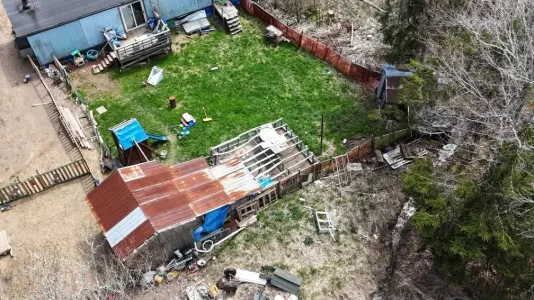
Yard contents include
children’s toys, a
plastic play structure, and signs of
frequent outdoor activity.
The
rear yard is not fully enclosed—a
partial wire fence surrounds some of the property, but
several sections are broken or missing, making entry easy.
A
sliding glass door at the back exits to a
downward slope leading directly into the
forest.
The
front of the home faces Gairloch Road, with
forest directly across the street.
View attachment 597042
Aerial view of the Sullivan home facing Gairloch Road. Note the direct forest access at rear of property, the minimal fencing, and forested area across the road — all factors potentially relevant in an abduction scenario.
SECTION 3: WANDERING THEORY (Unlikely)
- No continuous tracks or scent trail.
- Boot print and fabric found 1.2 km from home — challenging distance for two young children.
- Jack and Lily would have needed to travel ~1.2 km into the forest — a journey considered highly unlikely for children aged 4 and 6, especially without leaving more evidence behind.
- Extensive search efforts (ground crews, scent dogs, aerial/drones, infrared surveillance, 160+ personnel) have yielded no trace of either child.
- Terrain includes dense woods, wetlands, and uneven slopes.
- Despite exhaustive efforts, including multiple search phases, nothing definitive has been uncovered to suggest the children simply wandered off.
While
wandering remains a theoretical possibility, the
lack of evidence and distance involved make it
increasingly improbable.
SECTION 4: EVIDENCE CONTEXT — BOOT PRINT & FABRIC
A
child’s boot print was located on
May 3rd, approximately
1.2 km from the residence, along a wooded service trail connected to a
pipeline corridor.
It has
not been confirmed whether the print belonged to
Lilly or Jack, but for the purposes of this analysis, it is
presumed to be Lilly’s.
May have resulted from a moment of
resistance, pivot, or stumble.
Spring terrain (pine, moss, leaf cover) may have
obscured additional or lighter tracks.
A
piece of fabric was located
nearby — believed by family to be from
Lilly’s blanket.
No
additional trail,
debris, or
damage to foliage was reported in the area.
View attachment 597047
Clothing and Accessories — Footwear worn by Jack (top) and Lily (middle), along with Lily’s ladybug backpack (bottom). None of these items have been recovered.
BACKPACK NOT FOUND — Raises Serious Questions
According to
Major Crimes investigators, Lilly was wearing a backpack at the time she disappeared.
Despite
extensive search efforts, it has
never been located.
If the children had simply wandered off into the woods and succumbed to the elements,
the backpack should have turned up.
Its continued absence strongly suggests
human intervention — potentially someone who
removed the children and concealed or kept their belongings.
SECTION 5: POTENTIAL ENTRY & EXIT SCENARIOS
View attachment 597058
Map of Nova Scotia highlighting Highway 104 through Pictou County — a potential escape route for an abductor traveling east or west across the province.
A. Opportunistic Abduction — Front or Side Yard
- Offender spots children playing unsupervised near the front or side of the home, possibly within view of the tree line.
- Uses lure (e.g., puppy, reward, request for help) to engage them.
- Leads or escorts one or both children toward a waiting vehicle.
➤ Strengths: Quick access and fast departure via Gairloch Road to Mount Thom Rd then on to Highway 104 — allowing the abductor to leave the area rapidly and undetected.
➤ Weaknesses: High visibility from road; no confirmed front- or side-yard sighting; doesn’t align with boot print/fabric location unless staged — the rear trail is not along this route.
➤
Additional Context:
Opportunistic child abductions are extremely rare — accounting for less than 1% of non-family abductions (NCMEC, U.S. data). These events require a precise convergence of time, opportunity, and motive. Still, not impossible, especially in rural areas with minimal visibility or oversight.
Potential offenders might include:
- Traveling tradespeople or delivery drivers
- Neighbors, visiting friends or family, or service personnel associated with nearby properties
- Hunters or fishermen familiar with local access points or trails
B.
Organized Abduction — Rear Trail Access
- Offender familiar with area enters through woods behind property.
- Approaches quietly, intercepts children from rear yard.
- Leads them into forest and toward waiting vehicle on pipeline trail.
➤
Strengths: Matches boot print/fabric location and offers concealment from neighbors or passing traffic. Allows for approach and exit without using the main road or driveway.
➤
Weaknesses: Requires careful planning, confidence, and physical endurance. Risk of unexpected adult presence in home or neighborhood remains a deterrent.
➤ Additional Context: In solved stranger abductions involving more than one child, investigators often uncover signs of planning — things like prior surveillance, familiarity with the area, or use of a lure. These elements appear in the majority of documented U.S. cases (NCMEC/NISMART data).
Offender may be someone on the periphery of the family’s life — a casual acquaintance, neighbor, or someone aware of their living situation.
May have observed children playing in the backyard on previous days. Play equipment, toys, or other visual cues would have clearly indicated the presence of young children.
May have known that May 2 was a PD day, meaning the children would be home and possibly outside.
Familiarity with back trails or local terrain would allow for an escape route that avoids the main roads entirely.
SECTION 6: POSSIBLE ABDUCTION PATHWAY & TIMELINE
View attachment 597060
Hypothetical escape route illustrating an abductor’s approach from the pipeline trail, trekking ~15–18 minutes through wooded terrain to reach the rear of the Sullivan property — consistent with the location of physical evidence found ~1.2 km northeast of the home.
- Offender parks 4x4 on pipeline trail, ~1.2 km NE of home.
- Walks through woods to rear of property (~15–18 min).
- Engages children in yard. Children may have been lured willingly — e.g., promise of adventure, seeing an animal — or subtly threatened. Both may have complied voluntarily or under fear.
- Leads children through wooded trail back to vehicle (~25–30 min): Jack (4) likely carried in arms or on hip. Lilly (6) may have walked, or been carried on back.
- Loads children into vehicle and drives toward Hwy 104.
Total estimated duration:
~45–55 minutes.
Questions to consider:
• Which route seems most plausible based on terrain and timing?
• Could someone unfamiliar with the area have pulled this off?
• What does the location of the potential evidence suggest, if anything?
• How likely is it that someone would know about the trail behind the house?
• Does the terrain suggest a planned abduction scenario, or a spontaneous choice?
Disclaimer: I’ve spent
hours reviewing maps, timelines, and
confirmed details to explore a possibility that hasn’t been widely discussed: a
potential abduction, based on
terrain,
access points, and where (potential)
evidence was found.
This post isn’t about
dismissing other theories — just taking a step back from speculation and focusing on what the scene itself might be telling us.
Everything here is just
my opinion, and I hope people stay
open to different possibilities as more information becomes available. With so little confirmed so far, it’s easy to get locked into one idea. I want to stay
open minded, as tunnel vision never helps in any case.
Sources:
Nova Scotia Major Crime Reward – Jack & Lilly Sullivan
Official case listing; includes missing persons details, clothing, and reward.
CBC News – New Details of Investigation
Reports encrypted radio traffic about a blanket possibly linked to the case.
Global News – Surveillance & Search Efforts
Covers early search efforts and video footage obtained by RCMP.
OIG Audit Report 09-08
U.S. DOJ / FBI – Child Abduction Patterns (OIG)
Stats and behavioral trends in child abduction investigations.






 cps.ca